Is Romeo and Juliet a Comedy or a Tragedy? It Plays Like a Comedy for Two Acts, Then the Genre Turns
Watch the first two acts with the ending taken out of your head and it is genuinely hard to tell what kind of play you are watching. The comic machinery runs unbroken through a secret wedding, which in a comedy would be the last scene. Here it is the halfway mark.


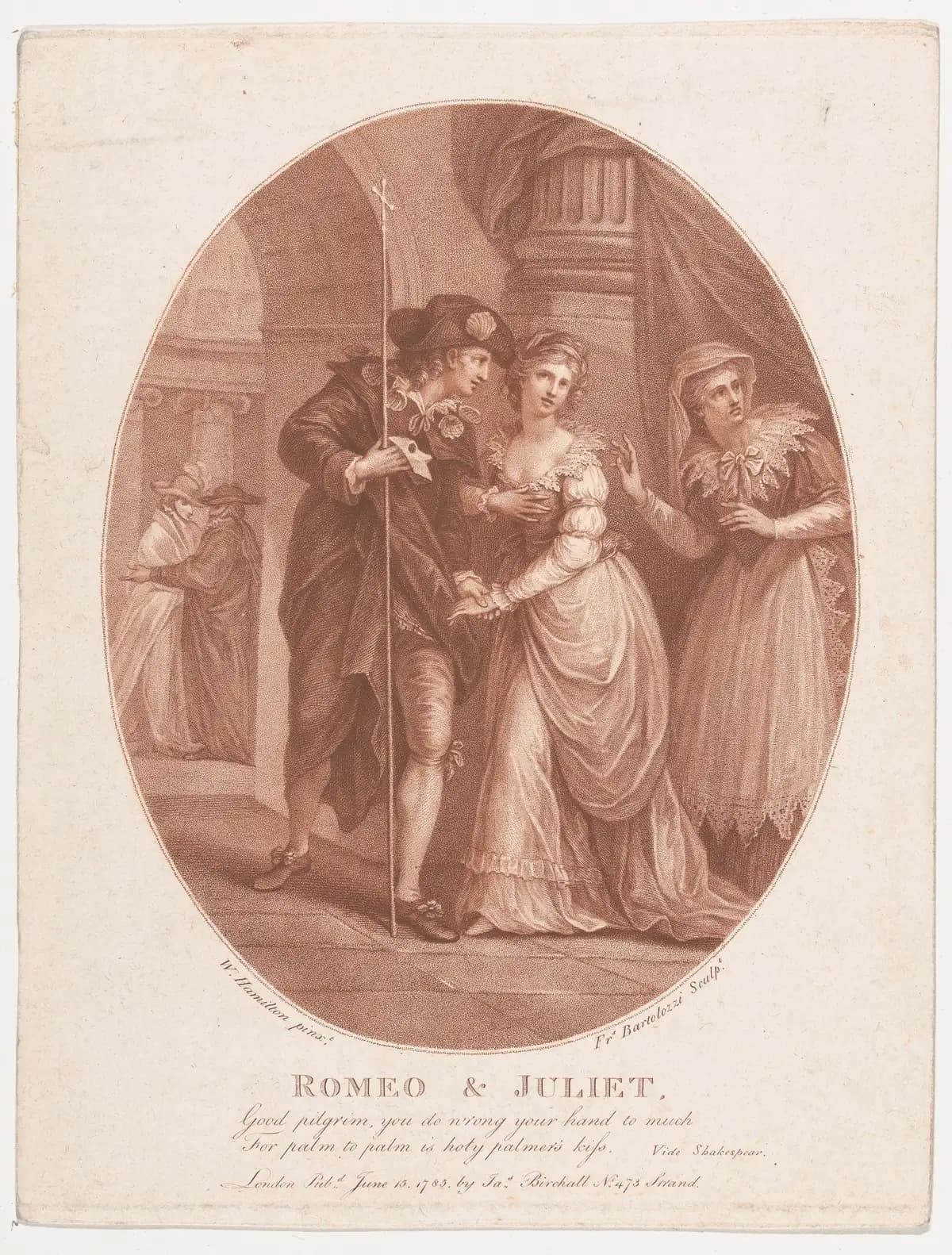
Watch the first two acts of this play with the ending removed from your head and it is hard to tell what you are watching. Two servants open it with a thumb-biting joke in prose. A man who cannot read hands a party invitation to the wrong guest. A nurse tells the same dirty joke twice in one scene. A boy sneaks into an enemy’s house in a mask, meets a girl, and they flirt in a shared sonnet that ends with her teasing him about his technique.
Every one of those is a standard piece of Shakespearean comedy machinery, and they run more or less unbroken for two acts, right through a secret wedding. In a comedy the secret wedding is the resolution. Here it is the halfway mark, and about an hour later two men are dead in a square. Both halves are playable as separate doorways in the playable Romeo and Juliet, which is a fast way to feel the join.
- Acts 1 and 2. Bawdy servants, a masked party, a meet-cute in sonnet form, a nurse as go-between, a secret marriage.
- Act 3, Scene 1. Hot afternoon, a street, two deaths, and a banishment.
- Acts 4 and 5. A fake death, a real one, a sealed letter that never arrives, a tomb.
- The Prologue. Told you the whole thing in fourteen lines before any of it started.
📜 The Prologue spoils it, then the play behaves as if it hadn’t
Whatever else is ambiguous here, the play’s own opinion of itself is not. Before Act 1 a Chorus walks out and gives away the ending in a sonnet: two households, an ancient grudge, and a couple described as “star-cross’d” whose “death-mark’d love” is the subject of the evening. The audience is told there will be bodies, and is told before anyone has been introduced.
That is a strange thing to do and then follow with a thumb-biting gag. The reason it works is that the Prologue never addresses the characters at all. It arms the audience, who then watch two acts of jokes knowing exactly what the jokes are standing on. What the phrase “star-cross’d” actually meant in 1595 is a separate post on this hub, and it is not what the greeting cards think.
🎭 Everything in Acts 1 and 2 is comedy machinery
The parts are so standard they can be listed. A pair of low-status characters open in prose with dirty wordplay: Sampson and Gregory arguing about who will bite a thumb at whom, and then negotiating the legal exposure of biting it. Comedies open there; tragedies almost never open on two employees arguing about the legal definition of an insult.
Act 1, Scene 2 gives Verona an illiterate servant sent out with a written guest list, who solves the problem by asking a passing stranger to read it, and the stranger is Romeo. The exchange that follows is a straight comic routine, three questions long.
“Whither should they come?” — “Up.” “Whither to supper?” — “To our house.” “Whose house?” — “My master’s.”
Act 1, Scene 3 introduces the Nurse, who reminisces for forty lines about Juliet as a toddler and lands a bawdy joke about her falling backward, then repeats the punchline twice more before Juliet begs her to stop, three deliveries in nineteen lines. Act 1, Scene 4 sends the young men to the party in masks, which is disguise, the engine of half of Shakespeare’s comic plots.
Then the meeting itself, which is the most technically comic thing in the play. Romeo and Juliet’s first conversation is built as a shared sonnet, fourteen lines split between them, on a running joke about pilgrims kissing the hands of saints. He takes four lines, she takes four, and they trade the rest until the closing couplet, and he kisses her on the line after it. Her verdict on it is a punchline.
“You kiss by the book.”
Act 2 keeps going. The Nurse works as go-between and gets ambushed in the street by Mercutio, who spends the scene making jokes about the time of day that would not survive a modern schools edition. She complains about her back. The lovers marry in secret, offstage, with an adult conspirator arranging it. In A Midsummer Night’s Dream or Much Ado that wedding is the last scene.
🔥 The turn happens in one scene, and Benvolio calls it first
Act 3, Scene 1 opens with a weather report that is also a warning. Benvolio wants to go indoors.
“The day is hot, the Capulets abroad, / And if we meet, we shall not scape a brawl, / For now these hot days, is the mad blood stirring.”
Mercutio answers with a joke, because that is still what this play does. Before Act 3, Scene 1 is over, two characters are dead and the third is banished, and the comic machinery never restarts. The Nurse stops being funny and becomes a woman giving bad advice under pressure. Disguise stops meaning a mask at a party and starts meaning a drug that counterfeits death. The go-between plot stops being a farce about message-carrying and becomes a plot about a message that does not arrive. Every comic device in the first half gets reused in the second with the humour taken out.
The death that does it belongs to its own essay on this hub, which is where the weight of that scene properly sits. The point here is narrower and structural: the play does not slide from one register to the other, it cuts.
💔 A love story, or a case study in bad decisions?
This is where readers reliably split, and both camps are reading the same text correctly. One side takes the play at the Prologue’s word: a real love, wrecked by a feud and by luck, and the speed of it is the point rather than the flaw, because that is what the feeling is like at fourteen and at seventeen. The other side counts the decisions and finds a four-day sequence in which nobody involved pauses for a single afternoon, and reads the whole thing as a study of what happens when adolescent certainty meets adult incompetence.
The text supports both, and it is worth noticing that it supports them with different equipment. The romance reading lives in the verse, which is the best in the play and is given entirely to the lovers. The bad-decisions reading lives in the plot, which is a chain of avoidable errors so tight that removing any one link saves everybody. A play that argues with itself this cleanly is not confused. It is built that way.
If you want the plot side of that argument in detail, the case that Romeo himself is the problem is set out on this hub, alongside the case against Friar Laurence. There is also a real 1972 psychology study named after this play, about what obstacles do to attraction, and that is covered here.
⚖️ So which is it
A tragedy, with two acts of comedy loaded into the front of it on purpose. Shakespeare’s colleagues settled the filing question in 1623, when the First Folio sorted the plays into comedies, histories and tragedies and put this one in the third group. The construction is the argument: an audience that has spent two acts laughing has been made to like these people in the specific way comedy makes you like people, lightly and without bracing. Then the play spends three acts collecting on that. A tragedy that opened in a tomb would cost far less.
It also explains why the play survives every possible staging. Directors who lean into the first half get a fast, funny, filthy show that turns on the audience. Directors who lean into the second get a chamber piece about panic. Both are in the text, which is free and complete at Project Gutenberg, and the whole thing, by the Prologue’s own boast, runs two hours. If you want to see which register a given film picks, the adaptations post sorts them out.
Sources
- The Tragedy of Romeo and Juliet — Project Gutenberg
- First Folio — Wikipedia
- The Shakespeare First Folio — Folger Shakespeare Library
- Romeo and Juliet: A Modern Perspective — Folger Shakespeare Library
Frequently asked questions
- Is Romeo and Juliet a comedy or a tragedy?
- A tragedy. The 1623 First Folio, which sorted Shakespeare's plays into comedies, histories and tragedies, files it in the third group. The question keeps coming back because of where the turn falls. The play has twenty-four scenes, and the one that kills Mercutio and Tybalt is the twelfth. The comic machinery runs to the exact midpoint.
- Where does Romeo and Juliet stop being funny?
- Act 3, Scene 1, and the play announces it in the first four lines. Benvolio asks to go indoors because the day is hot and the Capulets are abroad. The scene's last joke belongs to the man it kills: bleeding out, Mercutio tells them to ask for him tomorrow and they shall find him a grave man.
- Why does Romeo and Juliet tell you the ending in the Prologue?
- Because the suspense was never meant to be about what happens. The Chorus gives away the deaths in fourteen lines before Act 1, which leaves the audience watching two acts of jokes knowing what the jokes stand on. Then it happens again. A second Chorus sonnet opens Act 2. Two prologues, both sonnets, fourteen lines each.
- Is Romeo and Juliet a realistic portrayal of teenage love?
- Readers split, and both sides read the same text correctly. The romance case lives in the verse, which is the best writing in the play. The bad-decisions case lives in the calendar. In Act 3, Scene 4, hours after Tybalt's death, Paris tells Capulet it is Monday and Capulet fixes the wedding for Thursday.
- What makes a Shakespeare play a comedy rather than a tragedy?
- Structure more than mood. A Shakespearean comedy runs on disguise, bawdy wordplay from low-status characters, parents blocking a match, a meddling go-between, and a marriage that resolves everything. Romeo and Juliet has all of them, in order. The wedding happens in Act 2, Scene 6, the eleventh of the play's twenty-four scenes, with thirteen still to come.
Enjoyed this one?