“Wherefore Art Thou Romeo” Does Not Mean “Where”: Five Romeo and Juliet Lines Everyone Misreads
Four centuries of misquotation have done something specific to this play. Its most famous lines are the ones most likely to be read backwards, and they all drift the same way: a warning becomes a compliment, a complaint becomes a valentine, a grammatical word becomes a location.


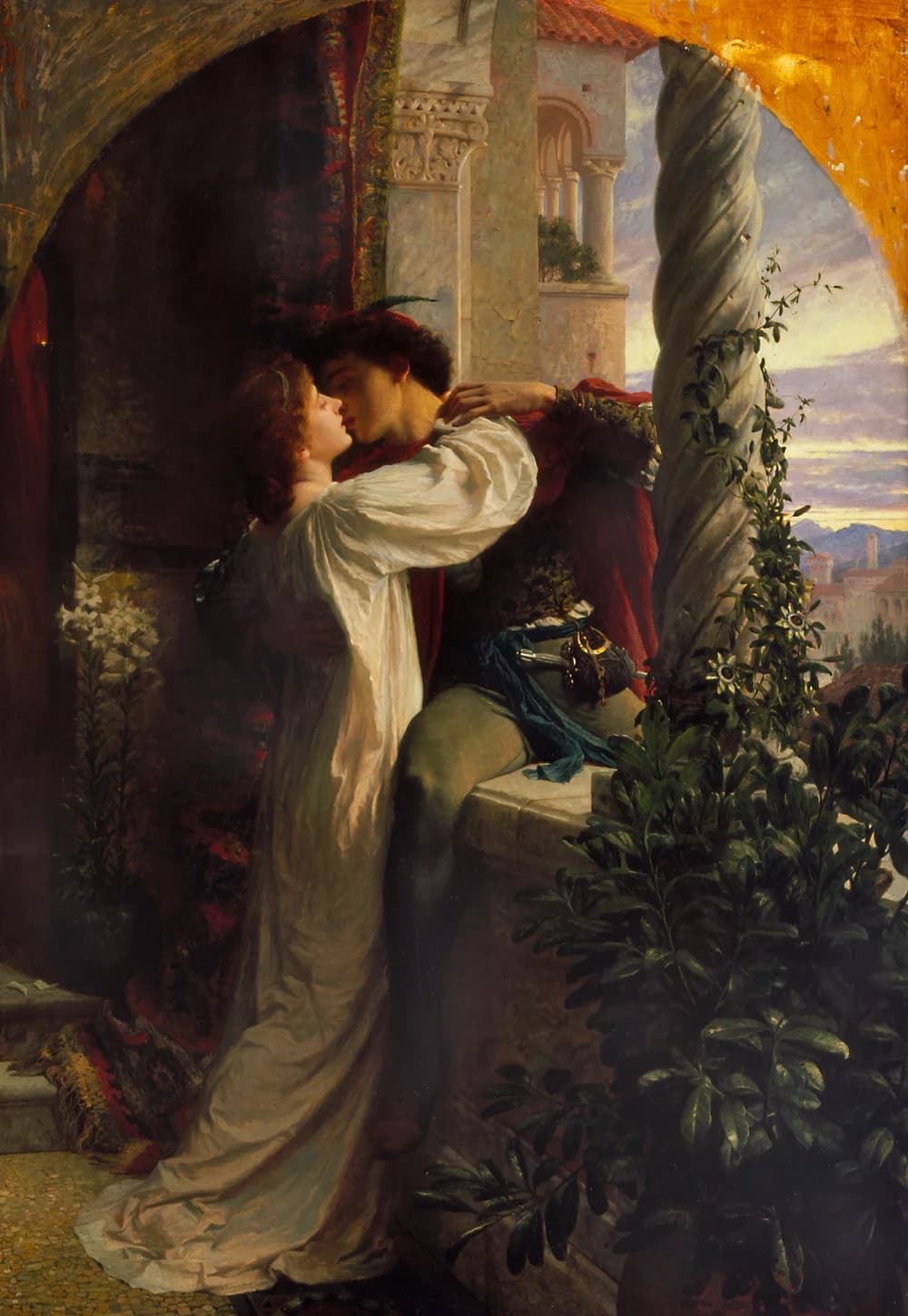
Juliet is alone on a balcony at night, talking to herself, and she has no idea Romeo is standing in the dark below her. That is the first thing to know about the most quoted line in the play. She has no reason to call out for him and does not. She is asking about his surname, and the word she uses to ask it, wherefore, meant why in 1595 and means why now, in the handful of places it survives.
Four centuries of misquotation have done something specific to this play. Its most famous lines are the ones most likely to be read backwards, and they all drift the same direction: a warning becomes a compliment, a complaint becomes a valentine, a grammatical word becomes a location. Here are five, each checked against the text.
- “Wherefore art thou Romeo?” Why are you called Romeo. Not where are you.
- “Star-cross’d lovers” Wrecked by the stars. A forecast of disaster, printed before the play starts.
- “A rose by any other name” An argument Juliet makes and the plot then demolishes.
- “My only love sprung from my only hate” Dismay, said out loud, three lines after she learns his surname.
- “Parting is such sweet sorrow” A teenager stalling at dawn, not a line for a eulogy.
A different quotation problem has its own essay on this hub: the lines attributed to Shakespeare that he never wrote, which is covered there. This post is the opposite case. Every line below is genuinely in the play, and all five are speakable in the playable Romeo and Juliet, where the balcony is one of the doorways. What moved was the meaning.
🌙 “Wherefore art thou Romeo” was never about where he was standing
The misreading is easy to picture, because a lot of school productions stage it that way: Juliet leans over the rail, peers into the garden, and calls his name into the dark. It scans. It is also contradicted by the very next line she speaks.
“O Romeo, Romeo, wherefore art thou Romeo? / Deny thy father and refuse thy name.”
You cannot answer “where are you” with “stop being a Montague”. The two lines only work together if the first one asks a why-question, and it does. Wherefore is built the same way as therefore, which nobody has ever mistaken for a place. It survives in one common phrase, the whys and wherefores, where it still means reasons.
There is a second small casualty in the same speech. Romeo opens the scene with “But soft, what light through yonder window breaks?”, and soft there is not describing the light. It is an interjection, closer to hush or hold on, the word a man says to himself when he has just seen something and wants to stop moving. Two words into the most romantic scene in English, and one of them is already a stage direction.
⭐ “Star-cross’d” was a forecast of disaster, not a compliment
The phrase appears once in the entire play, and it appears before the play. The Chorus walks out, announces two feuding households in Verona, and gives away the ending in fourteen lines. The couple are introduced in the sixth of them.
“From forth the fatal loins of these two foes / A pair of star-cross’d lovers take their life.”
In the astrology this play assumes, the stars are not neutral scenery. They govern outcomes, and to be crossed by them is to be actively thwarted. The couple are being described as under a bad sign, in a sentence that also tells you they die. Romeo himself uses the same picture in Act 5, Scene 1, when he hears Juliet is dead and answers, “Is it even so? Then I defy you, stars!” He is not thanking them.
The modern sense of star-crossed, meaning romantically fated, destined against the odds, is a compliment made out of a diagnosis. It survives because both halves of the Prologue’s claim came true. The love was real and the disaster was real, and the word kept the first while quietly dropping which one it was pointing at.
🌹 “A rose by any other name” is an argument the play then demolishes
The line is usually quoted as a piece of settled wisdom: names are arbitrary, the thing itself is what counts, call it what you like. That is exactly what Juliet is arguing. The text also gives her opponent the whole rest of the story.
“What’s in a name? That which we call a rose / By any other name would smell as sweet.”
Read the speech to the end and it stops sounding like philosophy. She finishes with an instruction, “Romeo, doff thy name, / And for thy name, which is no part of thee, / Take all myself,” and Romeo accepts on the spot: “Call me but love, and I’ll be new baptis’d; / Henceforth I never will be Romeo.” Two teenagers agree that a surname is nothing. Everyone else in Verona spends five acts proving it is the only thing that has ever mattered there, and both of them are dead inside four days because of it.
Quoting the rose line as wisdom, in other words, means agreeing with the character whose theory the play is built to test. It is a good line and a losing case, and Shakespeare knew which it was, because he gave Juliet the sceptic’s answer too, a hundred and fifteen lines later, when Romeo swears by the moon and she calls the whole exchange “too rash, too unadvis’d, too sudden”.
The popular version also loses a phrase. The text has “That which we call a rose”, which is a philosopher’s construction. The version on the mug starts at “A rose by any other name”, which is a greeting card.
🗡️ “My only love sprung from my only hate” is not a valentine
This one gets printed on wedding stationery, which is a remarkable place for it to end up. Juliet says it at the end of the ball in Act 1, Scene 5, in the ten seconds after the Nurse tells her the boy she has been kissing is a Montague.
“My only love sprung from my only hate! / Too early seen unknown, and known too late! / Prodigious birth of love it is to me, / That I must love a loathed enemy.”
Every word after the famous one is a complaint. Prodigious sits between my only hate and a loathed enemy, which rules out the modern sense of impressive. It carries the older one: a birth so unnatural that it gets recorded as a portent. Loathed enemy is not affectionate. The speech is a young woman realising she has walked into the exact trap her household has been arming for generations, and saying so in four lines before the Nurse can hear her properly.
Read as a valentine it means love conquers all. Read on the page it means she saw the whole shape of the disaster on the first night and went ahead anyway, which is both sadder and much more interesting.
🌅 “Parting is such sweet sorrow” is a stalling tactic
The line has become a funeral and graduation standby, a formal way to say that goodbyes hurt because the thing being left was good. Juliet means something much smaller and much more recognisable. She has said good night to Romeo three times already and keeps calling him back.
“Good night, good night. Parting is such sweet sorrow / That I shall say good night till it be morrow.”
The joke is in the second line, which the quotation always cuts. She is announcing that she intends to keep saying goodbye until sunrise, because saying goodbye is the last excuse she has to keep him standing there. A few lines earlier she has already told him she wants him gone no further than a bird on a thread, so she can pull him back. Anyone who has ended a phone call four times in one night has performed this speech.
🧭 Why all five drifted the same way
Three of these five come from one scene. That is not an accident of selection; the balcony scene is the most quoted seven minutes in English, and quotation is what does the damage. A line that gets detached from its scene keeps its music and loses its argument, and what rushes in to fill the gap is whatever the audience already believes about the play.
What the audience believes about this play is that it is the great romance. So the warning in the Prologue turns into a promise, the complaint at the ball turns into a vow, the stalling at dawn turns into an elegy, and a question about a surname turns into a search. Every drift moves in the same direction, towards the version the culture wants the play to be. The text underneath is stranger, faster and considerably less consoling.
One famous line is deliberately left alone here. Mercutio’s dying “A plague o’ both your houses” in Act 3, Scene 1 has its own essay on this hub, and it deserves the room. If you want the argument about what kind of play these lines are sitting inside, that is a separate post, and the full cast list, down to the apothecary and the three watchmen, is set out here. The play itself is free and complete at Project Gutenberg, and the Prologue calls the whole thing “the two hours’ traffic of our stage”, which is the only line in this post that still means what it says.
Sources
- The Tragedy of Romeo and Juliet — Project Gutenberg
- Romeo and Juliet, read the play — Folger Shakespeare Library
Frequently asked questions
- What does “wherefore art thou Romeo” actually mean?
- Why are you called Romeo. Juliet is alone and does not know he is below her, so it cannot be a question about where he is. The two lines after it settle the matter: deny thy father and refuse thy name; or if thou wilt not, be but sworn my love, and I'll no longer be a Capulet. She is offering to trade surnames.
- Does “wherefore” mean “where”?
- No, it means why. It is built the same way as therefore, which nobody mistakes for a place, and it survives in modern English in the phrase the whys and wherefores. The play uses the word five times, and the famous one is the only one anybody quotes. The misreading persists because the word has otherwise vanished.
- What does “star-crossed lovers” mean?
- Thwarted by the stars, in the astrological sense the play assumes: opposed by fate, under a bad sign, doomed. It appears exactly once, in the Prologue, in the same sentence that announces the couple will die. The play is full of stars otherwise. Juliet's is the loveliest and the darkest: take him and cut him out in little stars.
- What does “a rose by any other name” actually mean?
- Juliet is arguing that a surname is arbitrary and detachable, because she wants Romeo to give his up, which he immediately offers to do. Read as settled wisdom it is a greeting card. Read in place it is the one theory the rest of the play exists to disprove. The play's only other rose is a stack of old cakes of roses on the apothecary's shelf in Act 5.
- Why do people think “star-crossed” is romantic?
- Because both halves of the Prologue's claim came true. The love is real and the doom is real, so the phrase kept the yearning and lost track of which half it was naming. The play's other fate word never got the same treatment. Nobody puts Romeo's own verdict on a card: O, I am fortune's fool.
- Is the balcony scene actually on a balcony?
- Not in Shakespeare. The word balcony appears nowhere in the play. Act 2, Scene 2 is headed simply Capulet's Garden, Juliet comes to a window above it, and Romeo's own line is what light through yonder window breaks. Window appears six times in the text and balcony none. The balcony belongs to later staging tradition.
Enjoyed this one?