Who's Who in Romeo and Juliet: Every Character, From the Prince to the Apothecary
The play is named after two people and has thirty-three distinct speaking parts. The gap is where the good material is: a nurse with a dead daughter of her own, a suitor the play humanises right before killing him, a peacemaker who silently disappears, and a woman who never walks onstage at all.


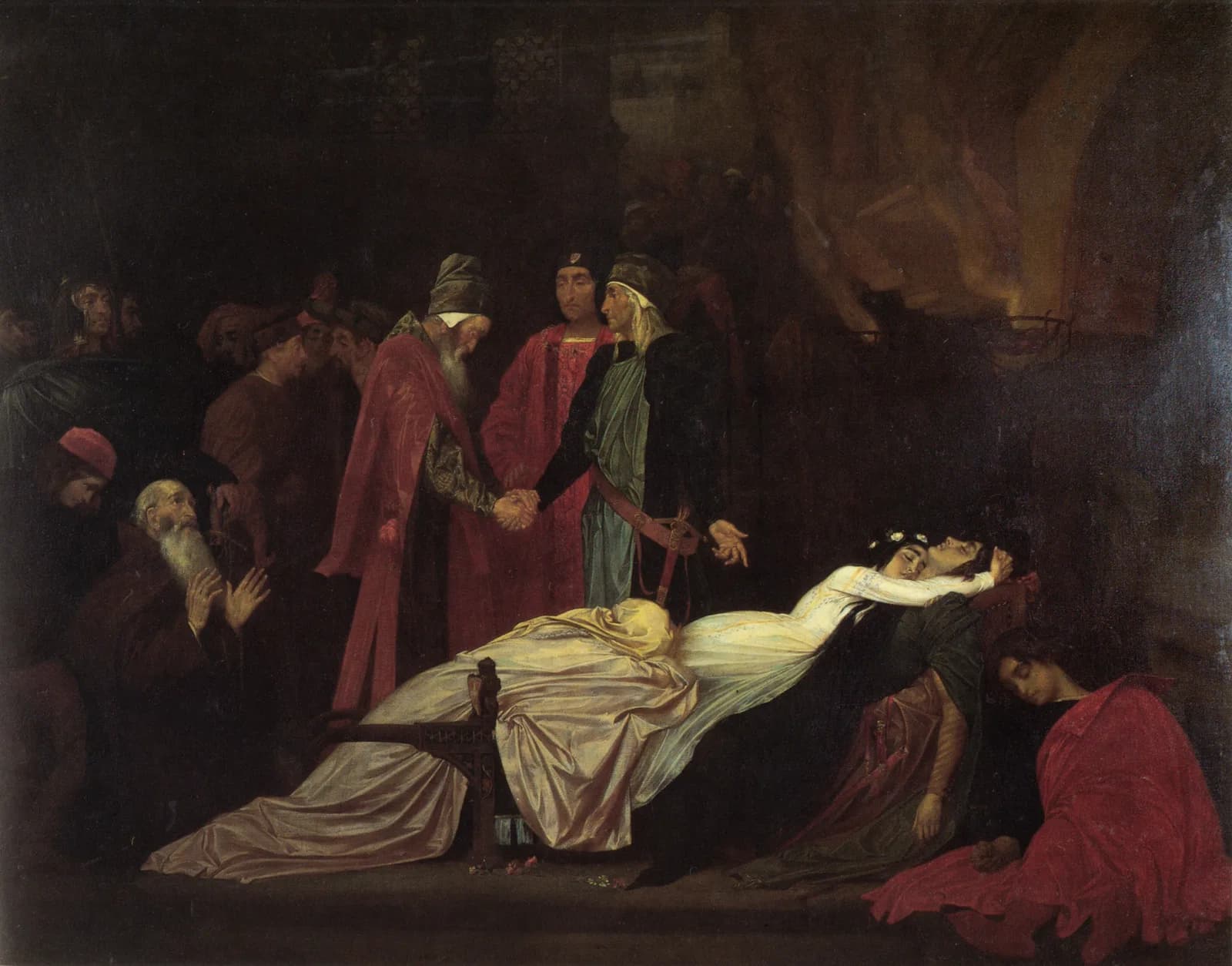
The play is named after two people and has thirty-three distinct speaking parts. Most readers can name six of them. That gap is where the good material is: a nurse who talks more often than anybody except the lovers, a suitor the play humanises about ninety seconds before killing him, a peacemaker who quietly disappears halfway through, and a woman who is discussed at length, appears on a party guest list, and never walks onstage at all.
Every number below was counted from the public-domain text rather than remembered. Two words on method: a speech is one turn at speaking, and a line is one printed line in that edition, which is slightly generous to the characters who speak in prose. Other cast lists print a smaller number, usually in the low twenties, because they fold the servants, musicians and watchmen into groups instead of counting each speaking head. Twenty-four of these people are playable in the playable Romeo and Juliet, including the apothecary and the watch.
- Romeo, 162 speeches. Juliet, 118. Nobody else in the play reaches 91.
- Tybalt, 17 speeches.The play’s most feared character speaks 35 printed lines in total.
- Prince Escalus, three scenes. He appears only after somebody has died, all three times.
- Lady Montague, two speeches. She dies offstage, and her husband announces it in a single line.
🏛️ The two houses, and the family standing between them
The Dramatis Personae is worth reading before the play, because it settles relationships that productions routinely blur. Benvolio is Montague’s nephew, so Romeo’s cousin. Tybalt is printed as nephew to LadyCapulet, not to Capulet, which makes him Juliet’s cousin on her mother’s side and slightly more of an outsider in that house than most stagings suggest.
The detail that reframes the whole play is on the Prince’s side of the list. Mercutio is “kinsman to the Prince”. Paris is “a young Nobleman, kinsman to the Prince”. Both men die. The ruler enforcing the peace loses two relatives to a quarrel between two families he is not related to, which is why his final judgment lands the way it does.
🍼 The Nurse: more separate speeches than anyone but the lovers
Ninety separate speeches, third in the play behind Romeo and Juliet. By printed lines she ranks only fifth, at 267, behind Friar Lawrence and Capulet as well, which is the shape of the part: she interrupts often and orates rarely. She is a working woman employed to raise someone else’s daughter, and the play gives her a biography almost nobody notices. In Act 1, Scene 3 she mentions a daughter of her own, Susan, who was the same age as Juliet and is dead.
“Susan and she—God rest all Christian souls!—/ Were of an age.”
That line is thrown away in the middle of a long comic ramble, and it explains the rest of her behaviour. She is the go-between, the joke engine of the first two acts and the only adult Juliet trusts. Then in Act 3, Scene 5, with Juliet secretly married and facing a forced wedding to Paris, the Nurse advises her to go ahead and marry him anyway, and calls Romeo “a dishclout” by comparison. Juliet never confides in her again. It is the most efficient betrayal in the play and it is delivered as practical advice.
One curiosity for anyone who reads the play twice. In Act 4, Scene 4, Capulet says “Look to the bak’d meats, good Angelica”. It is the only appearance of that name in the text, and editions have never agreed on whether he is speaking to the Nurse or to his wife. The most talkative servant in Shakespeare may or may not have a first name.
⚔️ Tybalt, Paris and Benvolio: three young men, three exits
Tybaltis the character everyone remembers as the antagonist, and he speaks seventeen times in the entire play, for thirty-five printed lines. Mercutio calls him “Good King of Cats”, mocking a fencing reputation the play never lets him demonstrate against an equal. He is not written as a villain with a plan. He is written as a young man who has decided the feud is a matter of honour and who never once considers standing down, and thirty-five lines is all that takes.
Parisis the play’s quiet trick. He is the arranged suitor, which normally makes a character disposable, and Shakespeare declines to make him unpleasant. He is courteous to Juliet, formal with her parents, and the last thing anyone learns about him comes from his own page, who tells the Prince his master came to the tomb with flowers to strew his lady’s grave. He dies about four minutes later in a fight neither man wanted.
Benvoliohas sixty-three speeches, more than Mercutio, and his first line in the play is an order to stop fighting: “Part, fools! put up your swords, you know not what you do.” His name means roughly good will, and he spends the play trying to earn it, opening Act 3, Scene 1 by asking Mercutio to go indoors and asking again, later in the same scene, that they withdraw somewhere private. He speaks for the last time in Act 3, Scene 1, reporting Tybalt’s death to the Prince, and then he is simply gone. Shakespeare gives him no exit line, no death and no explanation. The peacemaker leaves the play at the exact moment peace stops being available.
Mercutio is deliberately not covered here, because he has an entire essay of his own on this hub. For the record: sixty-two speeches, 231 printed lines, and dead halfway through.
👑 Prince Escalus appears three times, and someone has always just died
This is the cleanest piece of structural design in the cast list. The Prince speaks in exactly three scenes across five acts. Act 1, Scene 1, after a street riot. Act 3, Scene 1, after Mercutio and Tybalt. Act 5, Scene 3, in the tomb. He is not a character so much as a recurring consequence, and each of his three entrances is the state arriving too late.
The two adults doing the most actual damage are less visible in the line counts than you would expect. Capulet has 270 printed lines, fourth in the play, and the case that the tragedy belongs to him and the other parents is argued in full here. Friar Lawrence has 350, which makes him the third-largest part in the play, ahead of both fathers and the Nurse. That is a remarkable amount of stage time for a supporting character, and what he does with it is its own argument.
🕯️ The servants, the watch, the apothecary and the woman who never appears
Sampson and Gregory open the play with thirty-five speeches between them and never speak again after Act 1, Scene 1. Two Capulet servants start a public riot with a joke about biting a thumb, and the play they set in motion no longer needs them.
Balthasaris Romeo’s servant, twelve speeches, and he carries the worst news in the play from Verona to Mantua. Abram, a Montague servant, has five. Peter, the Nurse’s man, has thirteen, most of them in a strange, funny scene with three musicians immediately after Juliet is found apparently dead.
Friar John speaks four times and is the reason the play ends the way it does; the letter he cannot deliver is covered here. The Apothecary speaks four times in Act 5, Scene 1, a starving man who sells poison against the law because forty ducats is more money than he has seen. Capulet’s Cousin, listed as an old man, speaks twice, both times at the party, both times about how long ago it was that he and Capulet last wore masks.
Lady Montaguespeaks twice, worries about her son, and dies offstage. Her husband reports it in the last scene in nine words: “Grief of my son’s exile hath stopp’d her breath.” And Rosaline, who is the reason Romeo goes to the party at all, exists in this play as one name on a written guest list. She is discussed by four characters and appears in none of the scenes. What she is doing there is its own essay.
One counting trap worth knowing. This edition gives a First, a Second and a Third Watch, but only the first two get a speaker heading on a line of their own. The Third Watch delivers his single line, “Here is a Friar that trembles, sighs, and weeps”, on the same line as his name. That is how he falls out of almost every count of this cast, including the first pass of this one. The full text is free at Project Gutenberg if you want to run the counts yourself.
Sources
- The Tragedy of Romeo and Juliet — Project Gutenberg
- Romeo and Juliet, read the play — Folger Shakespeare Library
- Romeo and Juliet — Wikipedia
Frequently asked questions
- How many characters are in Romeo and Juliet?
- Thirty-three distinct speaking parts in the public-domain text, plus non-speaking maskers, guards and attendants. The printed cast list names eighteen people outright and identifies six more by role alone. The load is lopsided: Romeo has 163 speeches and Juliet 118, while the Prince has 16, Balthasar 12 and Friar John 4.
- Who is the Nurse in Romeo and Juliet?
- Juliet's childhood carer and go-between, and the third most frequent speaker in the play at ninety separate speeches, exactly twice as many as Lady Capulet's forty-five. She mentions in Act 1 a daughter of her own, Susan, the same age as Juliet, who is dead. In Act 3 she tells Juliet to forget her marriage and take Paris.
- Why does Benvolio disappear from Romeo and Juliet?
- Shakespeare gives no reason, which is what makes it striking. Benvolio has sixty-three speeches, more than Mercutio's sixty-two, and tries to prevent violence in every scene he appears in. His first job in the play is reconnaissance: telling Lady Montague he saw Romeo before dawn under the grove of sycamore west of the city. His last words report Tybalt's death.
- Who is Tybalt and why does he hate the Montagues?
- He is printed as nephew to Lady Capulet, which makes him Juliet's cousin on her mother's side rather than a Capulet by blood. The play never gives him a personal grievance. It gives him a procedure. In Act 2, Scene 4 Benvolio reports that Tybalt has sent a letter to Romeo's father's house, so the duel is a written challenge before it is a street fight.
- Is Juliet's house in Verona real?
- The building at Via Cappello 23 is a real place and a genuine tourist attraction, but Juliet is a fictional character and the house is not documented as anyone's historical home. The play itself gives no address at all. It says Verona fifteen times and Mantua sixteen, and never names a street.
- Who dies in Romeo and Juliet?
- Six people. Mercutio and Tybalt die within one scene of each other in Act 3, Scene 1. Paris, Romeo and Juliet all die in the tomb in Act 5, Scene 3, in that order. The sixth is Lady Montague, dead offstage of grief at Romeo's exile. The play's last line names Juliet first: this of Juliet and her Romeo.
Enjoyed this one?