Is Friar Laurence to Blame for Romeo and Juliet? He Married Them, Drugged Her, and Trusted the Post
Every major turn in the second half of Romeo and Juliet is something Friar Laurence decided, including the one point of failure that destroys it. He confesses all of it to the Prince and offers to be executed, and the Prince answers that he has always been known for a holy man.


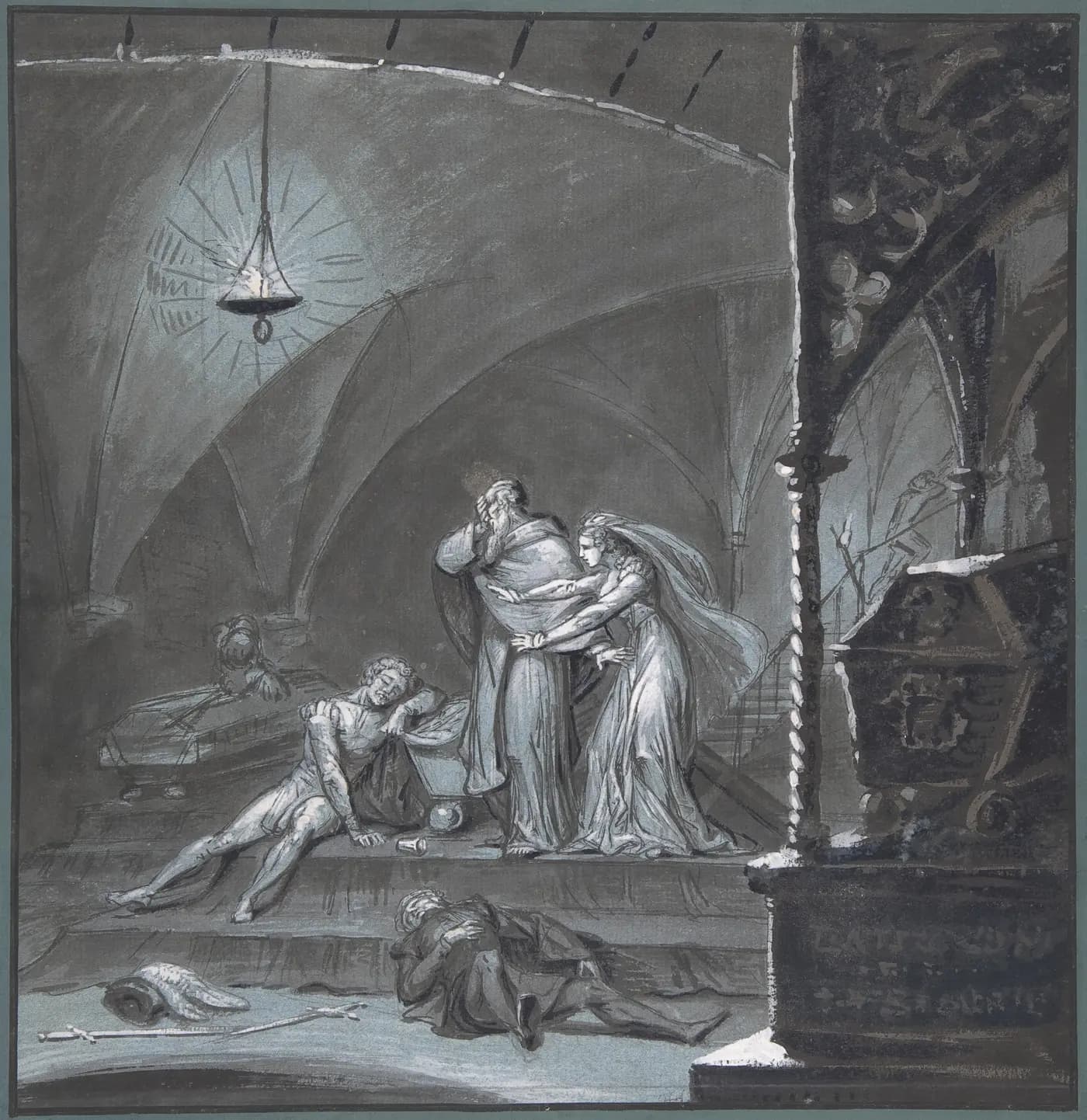
Every major turn in the second half of this play is something Friar Lawrence decided. He marries two teenagers from feuding houses in secret. He supplies a drug that stops a fourteen-year-old’s pulse for forty-two hours. He builds a rescue that depends on one letter reaching one town, appoints one man to carry it, and does not check. Then, standing in the tomb with the plan in ruins and Juliet awake beside two bodies, he leaves. The order of events in that tomb is laid out in our Romeo and Juliet ending explainer.
And at the end, when he lays all of it out in front of the Prince and formally offers his own execution, the Prince answers: “We still have known thee for a holy man.” That combination is what makes the question interesting. The play stages the accusation in more detail than any other charge in it, and then declines to deliver the verdict.
- He performs the marriage. Secretly, the day after they meet, having just warned Romeo to go slowly.
- He supplies the drug. A vial that mimics death for forty-two hours, given to a girl who is fourteen.
- He builds a one-messenger plan. The rescue works only if his letter reaches Mantua first.
- He leaves the tomb. On his own account, a noise scared him and Juliet would not come.
A note on his name before anything else. The public-domain text quoted throughout, which is the same one the playable version uses, spells him Friar Lawrence. Plenty of editions print Friar Laurence. They are the same character, and the split goes back to the early printings rather than to any modern preference. He is also playable, herbs and all, in the playable Romeo and Juliet, where the sleeping draught is a doorway of its own.
🧪 The man who is introduced holding poison and medicine
Shakespeare gives him an entrance that is almost too neat. In Act 2, Scene 3 the Friar walks on at dawn with a basket, filling his “osier cage” with weeds and flowers, and delivers a short lecture on how the same plant does two opposite jobs.
“Within the infant rind of this weak flower / Poison hath residence, and medicine power.”
Nine scenes later he hands Juliet a vial of exactly that. The play tells you in advance what kind of help this man provides, and he tells you himself. He is not a villain and nothing in the text suggests he acts from malice. He is something more useful to argue about: a competent adult who keeps choosing the clever option over the safe one.
The same scene contains his own best advice, given to Romeo and then ignored by both of them: “Wisely and slow; they stumble that run fast.” What Romeo does with that instruction is its own essay on this hub. What the Friar does with it is perform the wedding the next afternoon.
📜 The plan, and the sentence that gives away its flaw
Act 4, Scene 1 is where he stops improvising and starts engineering. Juliet arrives at the cell with a knife and a deadline. He talks her out of the knife by proposing something considerably more elaborate: go home, agree to marry Paris, sleep alone, drink this.
“And in this borrow’d likeness of shrunk death / Thou shalt continue two and forty hours, / And then awake as from a pleasant sleep.”
Then comes the load-bearing line. Having described the drug, the fake funeral and the vault, he explains what makes the whole thing survivable: “In the meantime, against thou shalt awake, / Shall Romeo by my letters know our drift, / And hither shall he come.” That is the entire safety mechanism. One letter, to one man, in one town, and the girl in the vault has no way to signal anyone if it fails.
There is no second messenger. There is no arrangement to confirm delivery, no instruction to Balthasar, who is Romeo’s own servant and in Verona for the funeral, and no contingency for the possibility that Romeo hears about a Capulet funeral from literally anyone else in a city where the funeral is public. The scheme is a chain of single links, and its designer is the only person who can see the whole chain.
🦠 A plague is what actually stops the letter
The detail most summaries flatten into “the message went astray” is far more specific in the text, and it is the play’s bleakest joke. Friar John never gets out of Verona because the town’s health searchers seal him in.
“The searchers of the town, / Suspecting that we both were in a house / Where the infectious pestilence did reign, / Seal’d up the doors, and would not let us forth.”
He cannot even hand the letter on, because nobody will touch anything coming out of a quarantined house: “Nor get a messenger to bring it thee, / So fearful were they of infection.” A literal plague, in a play whose most famous curse asks for one, is what breaks the rescue. Mercutio’s dying line has its own essay on this hub, and it is worth reading next to Act 5, Scene 2.
Notice what the Friar does with the news. He does not send a second rider to Mantua. He asks for a crowbar and says, “Now must I to the monument alone.” The word alone is his own. With three hours before Juliet wakes and a plan already in pieces, he still tells nobody.
⚖️ His confession is a guilty plea with a hedge inside it
When the watch drags him back to the tomb, the Friar gives the longest speech of explanation in the play. It opens with a sentence that manages to accuse and excuse him in the same breath.
“I am the greatest, able to do least, / Yet most suspected, as the time and place / Doth make against me, of this direful murder. / And here I stand, both to impeach and purge / Myself condemned and myself excus’d.”
What follows is not evasive. He names the marriage, “I married them”, and the drug, “a sleeping potion”, and the failed delivery, “he which bore my letter, Friar John”. He volunteers the fact that the Nurse was in on it. And he closes by offering to be executed: if anything “miscarried by my fault, let my old life / Be sacrific’d... Unto the rigour of severest law”. A man does not usually itemise the case against himself that thoroughly unless he expects to be believed.
🏃 And then there is the part he admits in the middle of it
Inside that same confession sits the detail that does him the most damage, and he supplies it himself. Juliet wakes in the vault. Romeo and Paris are dead on the floor. There is a noise outside, and the Friar tries to move her to a convent.
“Stay not to question, for the watch is coming. / Come, go, good Juliet. I dare no longer stay.” — “Go, get thee hence, for I will not away.”
The stage direction that follows is two words plus a name: Exit Friar Lawrence. He leaves a fourteen-year-old alone in a burial vault with the body of the husband he married her to, having just told her the plan is over, and his own account of it later is “a noise did scare me from the tomb; / And she, too desperate, would not go with me”. Whatever the case for the potion, the marriage and the letter, this is the one moment where nothing intellectual is at stake and he still gets it wrong.
🕊️ So does the play convict him?
No, and the refusal is deliberate. The Prince hears the whole confession and the offer of execution, and answers in one line: “We still have known thee for a holy man.” Then he turns to the families. His closing judgment blames the feud and, remarkably, himself, for tolerating it: “And I, for winking at your discords too, / Have lost a brace of kinsmen. All are punish’d.” Juliet, earlier, had said the same thing about the Friar in Act 4, Scene 3, testing whether the vial might be poison and deciding no, because “he hath still been tried a holy man”.
So the play holds two things at once. The Friar caused every mechanism of the disaster, and the play’s own institutions decline to punish him for it. That is not a plot hole. It is a fairly exact picture of how a catastrophe with many authors actually gets settled, and it is why “who is to blame” has kept classrooms arguing for four centuries. The reading that puts the weight on the parents instead is set out here, and the reading that puts it on Romeo is here. All three are arguable off the same text, which is free at Project Gutenberg.
Sources
- The Tragedy of Romeo and Juliet — Project Gutenberg
- Romeo and Juliet, read the play — Folger Shakespeare Library
- Romeo and Juliet: A Modern Perspective — Folger Shakespeare Library
Frequently asked questions
- Is Friar Laurence to blame for Romeo and Juliet's deaths?
- He designs every mechanism of the disaster: the secret marriage, the drug, and a rescue that depends on one letter reaching one town. What complicates it is that the play never delivers a verdict on him. He confesses in full, offers his life, and the Prince calls him a holy man. He also has more speeches than Juliet's father, fifty-five against fifty.
- Why doesn't Friar Laurence's letter reach Romeo?
- Because of an actual plague. In Act 5, Scene 2, Friar John explains that Verona's health searchers suspected the house he was visiting of infection and sealed the doors, so he never left the city. He is the smallest part that matters: four speeches in the whole play, and the letter he carries is never quoted or read aloud anywhere in it.
- What does Friar Laurence confess at the end of Romeo and Juliet?
- Everything, in order. He tells the Prince he married them, that he supplied a sleeping potion, and that his letter went undelivered by Friar John. He also admits leaving the tomb when he heard a noise. He opens with a promise he does not keep: I will be brief, for my short date of breath is not so long as is a tedious tale.
- Is Friar Laurence punished at the end of the play?
- No punishment is pronounced on him onstage. After the confession the Prince says only that he has always been known for a holy man, then blames the feud and himself for tolerating it. The last practical decision in the play is not a sentence at all. Montague announces that he will raise Juliet's statue in pure gold.
- Why does Friar Laurence agree to marry Romeo and Juliet?
- He states the reason on the spot, and it is not romance. Having just mocked Romeo for switching from Rosaline overnight, he agrees in Act 2, Scene 3 with a political motive: 'In one respect I'll thy assistant be, for this alliance may so happy prove to turn your households' rancour to pure love.' His method for ending a feud is two teenagers and a secret.
Enjoyed this one?