Every Romeo and Juliet Adaptation, Ranked for Faithfulness: 1968, 1996, 2013 and the 2024 Broadway Revival
The popular answer is that 1968 is the faithful one, and it turns out to be half right. Ranked on one axis, how much of Shakespeare's actual play reaches you: the version that keeps every word, the version that keeps the ages and cuts a whole scene, and the version that rewrote the lines.


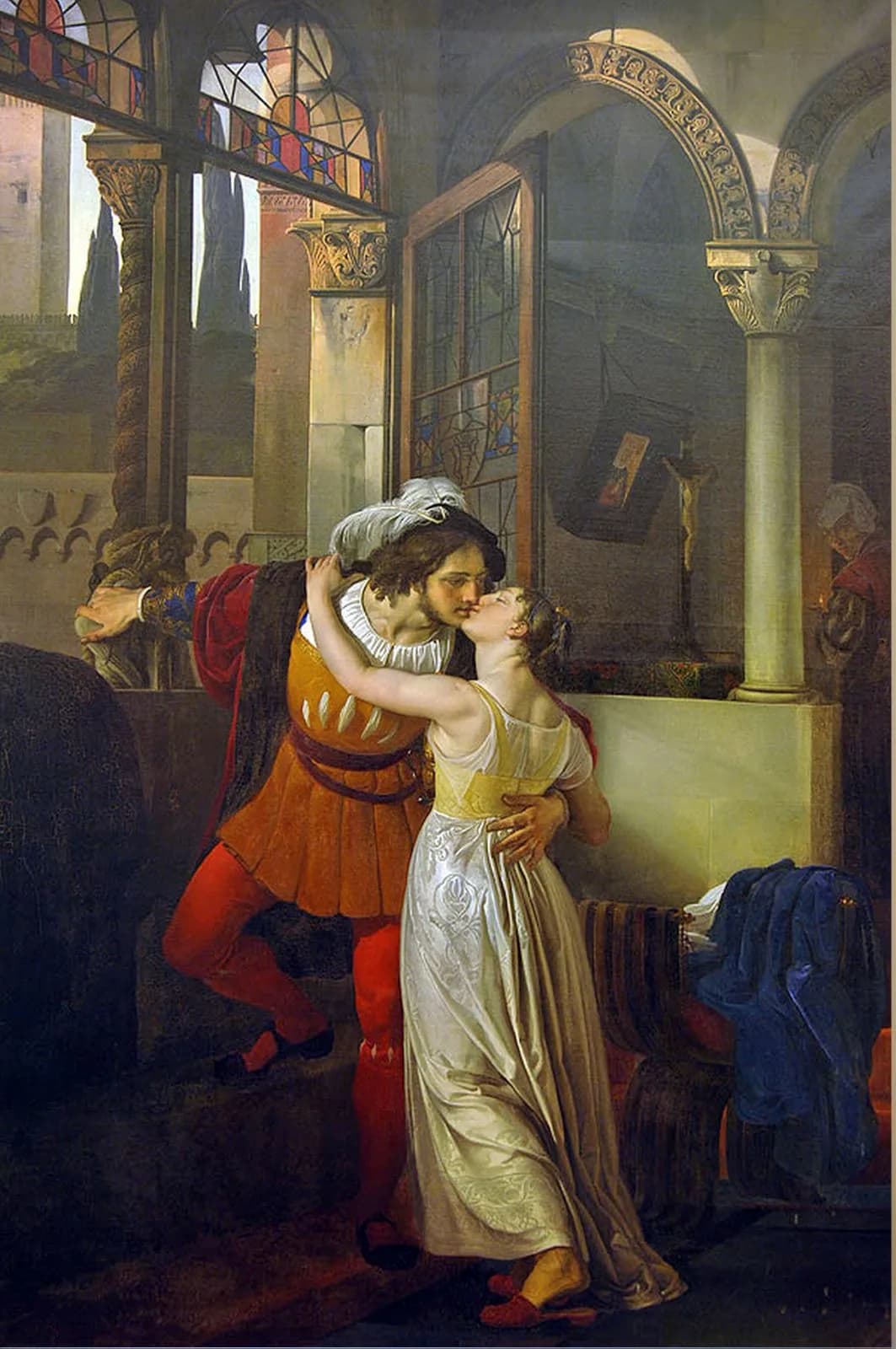
Nobody has solved Romeo and Juliet on screen twice the same way, because faithfulness here is not one thing. A film can be faithful to the words, or to the ages of the people saying them, and the three versions everyone argues about each pick one and let the other go. The popular answer, that 1968 is the faithful one, turns out to be half right in an interesting way.
So here is a ranking with its axis stated, which is the only kind worth reading: how much of Shakespeare’s actual play reaches the audience. Every claim below was checked against a named outlet this week. The ones that could not be checked have been left out rather than smoothed over, and there are three of those. If you would rather stage the thing than compare stagings, the playable Romeo and Juliet opens the Capulet ball as one of its seventeen doorways.
- 1. Luhrmann, 1996.Keeps Shakespeare’s dialogue and changes everything you can see.
- 2. Zeffirelli, 1968. The only version cast near the right ages, and it cuts the text hard to get there.
- 3. Carlei, 2013. Julian Fellowes rewrote much of the dialogue. That decides the ranking on its own.
- Not ranked.The 2024 Broadway revival has closed, and & Juliet was never this story.
🎬 The short answer, and the axis each one wins
The play is unusually specific about one thing films are unusually bad at honouring: Juliet is a child. The text gives her age outright, and an essay on this hub is built around what that does to the story. Romeo’s age, worth knowing before anyone argues about casting, is never stated anywhere in the text at all.
The other thing the play has is its language. Those two axes do not move together, and the history of Romeo and Juliet on film is basically the history of directors trading one for the other. Get the ages right and you are working with performers who cannot carry four hundred lines of verse, so you cut. Keep the verse intact and you are casting adults.
🔫 1996: every word kept, and the guns named after swords
Baz Luhrmann’s Romeo + Julietis remembered as the version that changed everything, and on the axis that matters here it changes the least. Wikipedia’s article on the film and Rotten Tomatoes both record the central decision: Shakespeare’s dialogue is retained, and the setting moves to a fictional Verona Beach with Leonardo DiCaprio and Claire Danes speaking the original lines inside it. A viewer who has never read the play hears close to all of it.
That creates one very specific problem. The text is full of swords and the film has none. The solution is now the best-loved piece of trivia about the production, and Mental Floss states it plainly.
“Luhrmann alluded to the original weapons by stamping all of the guns with names of swords. Some characters carry a ‘Dagger’ 9mm, while others have a ‘Rapier’.”
There is a Sword model in the range too, and Wikipedia’s article, citing the Los Angeles Times, records the same convention. It is a joke and it is also a translation. Tybalt can be told to draw his sword, reach for a pistol, and the line still works. Whether that reads as ingenious or absurd is the argument this film has been generating for thirty years, and both sides are looking at the same frame.
🕯️ 1968: the only one that cast teenagers, and what it cost
Franco Zeffirelli’s version is still the reference point, and the reason is a casting decision no major film has repeated since. Per Wikipedia’s account of the production, Olivia Hussey was fifteen when she was cast as Juliet and sixteen during filming, and Leonard Whiting was sixteen as Romeo. Everything the film is good at follows from that: the awkwardness, the speed, and the sense that nobody in the frame has the authority to stop anything.
It was not treated as a curiosity at the time. The Academy’s own records for the 41st Academy Awards list four nominations, including Best Picture and Best Director, with wins for Cinematography and Costume Design. A Shakespeare film starring two teenagers competed for Best Picture.
The trade is in the script. Both Wikipedia and Turner Classic Movies describe substantial cuts to the play’s text, and TCM notes that some Shakespearean purists were unhappy about them. The clearest example is a whole scene: Romeo’s killing of Paris at the tomb in Act 5 was filmed and then removed from the release. That is not a trim. It is the deletion of the last violent decision Romeo makes, which is load-bearing evidence in the argument about his character. So 1968 gets the people right and hands you less of the play.
Olivia Hussey died on 27 December 2024, aged 73, per NPR. Most of the tributes came from people who first saw the film in a classroom, which is a fair summary of how that performance has travelled.
📝 2013: the one that rewrote the lines
Carlo Carlei’s version looks the most conventionally like a Shakespeare film of the three and is the least faithful of them by this ranking’s measure. The screenplay is by Julian Fellowes, and it modernises a great deal of the dialogue while keeping the major soliloquies more or less intact.
Reviewers noticed immediately. The Telegraph ran its piece on the film under a headline asking what Fellowes had done to Romeo. The objection was not the changed setting, since 1996 changed far more of that and is remembered fondly. It was that a viewer cannot tell which lines are Shakespeare’s and which are new, because they sit in the same register in the same scenes.
On the other axis it lands halfway. Per Wikipedia’s pages for the two leads, Hailee Steinfeld was sixteen at the film’s October 2013 release and Douglas Booth was twenty-one, so it is the only version besides 1968 with a Juliet anywhere near the character’s age. Worth being fair about, too: an adaptation that eases the language is a real service to some audiences. It simply cannot rank first on a measure of how much of the play survives, when its defining choice is to replace some of it.
🎭 The 2024 Broadway revival, and the musical it is not
Sam Gold’s Broadway production put Kit Connor and Rachel Zegler in the leads at the Circle in the Square Theatre, with original music by Jack Antonoff. Broadway.com lists the first performance on 26 September 2024 and the official opening night four weeks later on 24 October, and both Broadway.com and the New York Theatre Guide have it closing on 16 February 2025. It is not currently playing, and a fair number of pages online still imply otherwise.
It also gets confused, constantly, with a different show. & Julietis a jukebox musical built on Max Martin’s pop catalogue with a book by David West Read. It opened on Broadway in 2022, at a different theatre, with a different creative team, and it begins by imagining that Juliet does not die. Any summary that blends the two is guessing.
And one adaptation is so successful that people forget it is one. West Side Story, the 1957 Broadway musical filmed in 1961 and again by Steven Spielberg in 2021, moves the feud to rival gangs in 1950s New York and renames the lovers Tony and Maria. It uses no Shakespeare dialogue: the book, lyrics and score are original work. That makes it the most radical adaptation on this page and the least useful one for anybody trying to hear the play.
📺 So which one should you actually watch
If you want to hear the play, watch 1996 and accept the shirts. If you want it to feel like something happening to children, watch 1968 and know you are getting an edited text with one whole scene missing. If you want an easier way in and do not mind that some lines are new, 2013 is an honest option as long as you know that going in. If you want the story with none of the language, West Side Story has been doing that since 1957.
The thing none of them can be is neutral. Every version has to decide what a sword is, how old these people look, and whether the first two acts are funny, which is a question of its own. The text they are all adapting is free and complete at Project Gutenberg, and reading the Capulet ball scene before or after any of these films is the cheapest way to see exactly what each director chose to spend.
Sources
- Romeo and Juliet (1968 film) — Wikipedia
- The 41st Academy Awards, 1969 — Academy of Motion Picture Arts and Sciences
- Olivia Hussey, who starred in 1968's Romeo and Juliet, has died — NPR
- Romeo and Juliet (1968) articles — Turner Classic Movies
- Romeo + Juliet — Wikipedia
- 12 Star-Crossed Facts About Romeo + Juliet — Mental Floss
- William Shakespeare's Romeo + Juliet — Rotten Tomatoes
- Romeo & Juliet (2013) — Rotten Tomatoes
- Romeo, Romeo, what's Julian Fellowes done to you? — The Telegraph
- Romeo + Juliet on Broadway — New York Theatre Guide
- Romeo + Juliet — Broadway.com
- & Juliet — Wikipedia
- West Side Story — Wikipedia
Frequently asked questions
- Which Romeo and Juliet movie is the most faithful to the play?
- It depends which faithfulness you mean, and no film wins both. Luhrmann's 1996 version keeps Shakespeare's dialogue while moving everything visible. Zeffirelli's 1968 version is the only one cast near the characters' ages, and it gets there by cutting, including Romeo's killing of Paris. That cut lands in Act 5, Scene 3, the longest scene in the play.
- Is West Side Story based on Romeo and Juliet?
- Yes, loosely. The 1957 Broadway musical, filmed in 1961 and again by Spielberg in 2021, moves the feud to rival gangs in 1950s New York and renames the lovers Tony and Maria. It uses none of Shakespeare's dialogue. It also drops the play's own word for the quarrel: grudge, which the Prologue uses once and the text never repeats.
- Is the 2024 Broadway Romeo + Juliet still running?
- No. Sam Gold's production at the Circle in the Square Theatre, with Kit Connor and Rachel Zegler and original music by Jack Antonoff, first performed on 26 September 2024, opened on 24 October and closed on 16 February 2025. Any staging has a scale problem first: the cast list names two dozen parts before it reaches the citizens, maskers, guards and watchmen.
- Why does the 1996 Romeo and Juliet use guns instead of swords?
- Because Baz Luhrmann moved the story to a modern Verona Beach while keeping Shakespeare's dialogue, so the text's blades had to survive somehow. Wikipedia's account, citing the Los Angeles Times, records the solution: the prop handguns carry model names taken from the play's weapons. The text gave him plenty to work with. Sword appears thirteen times.
- Is & Juliet the same story as Romeo and Juliet?
- No, and the two get confused constantly. & Juliet is a jukebox musical on Max Martin's catalogue, with a book by David West Read, which opens by imagining that Juliet does not die. Shakespeare gives her three words on the subject. Snatching Romeo's dagger in Act 5, Scene 3, she says: O happy dagger.
Enjoyed this one?