The Best A Tale of Two Cities Movie Adaptation, Compared
One performance from the 1930s keeps winning an argument against everything filmed since, and the Academy record shows it was never nominated for acting.


Ask which version to watch and the answer has been the same for decades, which is unusual for a novel this often filmed. The interesting part is why one performance from the 1930s keeps winning an argument against everything made since, and what the competing version did differently on purpose. If you would rather be inside the story than watching it, the playable A Tale of Two Cities opens on the same scenes every director has to stage.
🎞️ The 1935 picture, and the performance people cite
Metro-Goldwyn-Mayer released it in December 1935 with Ronald Colman as Sydney Carton, and the reviews were immediate. Andre Sennwald filed for The New York Times on 26 December 1935 that Colman “gives his ablest performance in years as Sydney Carton” and predicted the picture would cause a rearranging of ten-best lists.
What did not follow was an acting nomination. The Academy’s own database shows the film taking exactly two nominations at the 9th Academy Awards — Outstanding Production for MGM and Film Editing — while the Actor category that year went to Paul Muni over Gary Cooper, Walter Huston, William Powell and Spencer Tracy. Colman is not on the list anywhere. Readers who bring up his Carton today almost always bring up the omission in the same breath, which is its own kind of evidence about how the performance landed.
🎩 The 1958 film, in deliberate black and white
The Rank Organisation’s version arrived in 1958 with Dirk Bogarde as Carton and Dorothy Tutin as Lucie Manette, directed by Ralph Thomas, and its most revealing production decision was about colour. Thomas refused it. The novel, he said, “was written in black and white, and it’s got to be made in black and white”, which in 1958 was a choice a British studio had to justify rather than a default.
Its screenwriter, T. E. B. Clarke, made a second structural decision that is easy to miss and changes everything downstream: he compressed the story’s span to three years. Dickens runs his plot across roughly two decades, so the compression tightens the thriller and flattens the long slow accumulation of grievance that the middle Books are actually about. The reviews caught the effect without naming the cause, ranging from Variety’s “good adventure yarn” to the Monthly Film Bulletin’s “eminently respectable but scarcely distinguished”.
| MGM, 1935 — Ronald Colman as Carton | Rank, 1958 — Dirk Bogarde as Carton |
|---|---|
| Black and white, the norm for a studio picture of its year | Black and white because Ralph Thomas refused colour outright |
| Carries the novel's own long span of years | Timeframe compressed to three years by T. E. B. Clarke |
| Two Academy nominations, neither of them for acting | No Academy nominations |
| “His ablest performance in years” — The New York Times | “Eminently respectable but scarcely distinguished” — Monthly Film Bulletin |
The Garret Prisoner is a doorway in the playable A Tale of Two Cities: you are in the room above the wine-shop with the man who has forgotten his own name, and you can coax him, wait him out, or say the name and see what happens. Role-play A Tale of Two Cities →
🎭 The stage Carton that came first
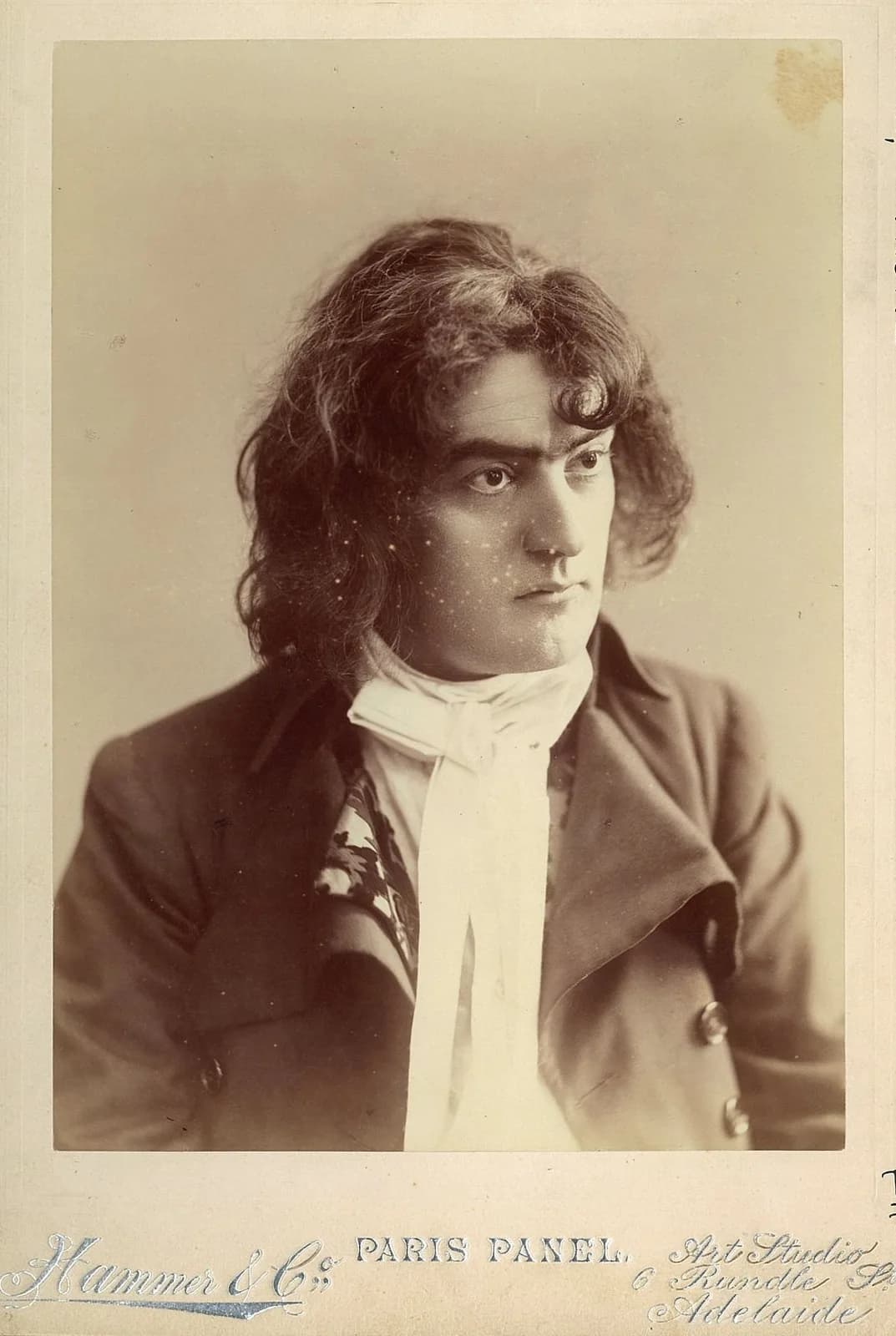
Cinema inherited this story from the theatre, and the theatre had been running it hard for half a century before the cameras arrived. The photograph at the top of this page is one piece of the evidence: Tyrone Power Snr., father of the film star of the same name, in costume as Sidney Carton, photographed in Adelaide around the turn of the twentieth century and held by the State Library of New South Wales.
That lineage explains a lot about how the story photographs. Stage productions had already decided which scenes the audience came for, and the films took the list over more or less intact: the mail coach, the garret, the trial, the wine-shop, the street. It also explains the acting register. Colman is playing a part that had been a touring star’s calling card for two generations, and the weariness he brings to it reads as a deliberate correction to that inheritance.
🧩 The three problems every version has to solve
Whatever the budget, the same three obstacles come up, and how a director handles them tells you more than a star name does.
The first is the doubling. Two men have to look enough alike to fool a courtroom, and the novel stages that with a barrister being asked to remove his wig so the jury can compare faces (l.588–594). Casting one actor in both parts makes the resemblance total and the acting impossible; casting two makes the acting easy and the resemblance a matter of faith.
The second is the garret. Doctor Manette spends his introduction making shoes and answering to a cell number, “One Hundred and Five, North Tower” (l.331), and the scene is almost entirely internal. Every screen version keeps it anyway, because without it the second half has no foundation to stand on.
The third is the crowd. Saint Antoine has to be a place with a temperature rather than a set full of extras, and this is where budget shows most plainly. Readers arguing about which adaptation is best are usually, underneath, arguing about which one made the street feel inhabited. The novel itself is free at Project Gutenberg if you want to check what the camera left out.
Sources
- A Tale of Two Cities (1935 film) — Wikipedia
- The 9th Academy Awards, 1937 — Academy of Motion Picture Arts and Sciences
- A Tale of Two Cities (1958 film) — Wikipedia
- Tyrone Power Snr. as Sidney Carton in A Tale of Two Cities, ca. 1899–1901 — State Library of New South Wales, via Wikimedia Commons
- A Tale of Two Cities (Project Gutenberg eBook #98) — Project Gutenberg
Frequently asked questions
- Any adaptations of A Tale of Two Cities?
- A great many, going back to the silent era, with a long television record alongside the features on both sides of the Atlantic. No single catalogue covers film, television, radio and stage together, which is why the counts quoted online disagree with each other and why this piece gives none. The two versions people actually compare are the 1935 and 1958 features.
- What is the best movie version of A Tale of Two Cities?
- By long consensus, MGM’s, directed by Jack Conway. It is the one whose performance people still name, and the Academy gave it Outstanding Production and a Film Editing nomination for Conrad A. Nervig. If you want the crisper thriller rather than the bigger performance, the Rank version cuts the story down to a three-year span and moves considerably faster.
- What are some film adaptations of “A tale of Two Cities”?
- The two in general circulation are MGM’s 1935 feature with Ronald Colman and the Rank Organisation’s 1958 one with Dirk Bogarde and Dorothy Tutin. Both are black and white, and in the second case that was a fight the director had to win rather than a default. Earlier silent features and later television versions exist but are harder to find outside an archive.
- What is the famous line from A Tale of Two Cities?
- “It was the best of times, it was the worst of times.” Almost every screen version opens on it or puts it in a voice-over, because it does in one sentence what a title card cannot. This series has a separate essay on what the line actually argues, and on the second famous sentence that gets misattributed to other books entirely.
- What is the most accurate book to movie adaptation?
- For this novel, neither of the two leading versions is trying to be. Dickens built the novel in three Books — Recalled to Life, the Golden Thread and the Track of a Storm — and the middle one alone runs twenty-four chapters, which is more story than a two-hour film can carry, so every adaptation drops strands rather than compressing them evenly. The 1935 version keeps more of the book’s shape; the 1958 one keeps more of its pace.
Enjoyed this one?