The 1963 Cleopatra Is Not Shakespeare: What the Film, the Stage and the Play Each Get Right
Almost everyone picturing Antony and Cleopatra is picturing a film with none of Shakespeare's words in it. Here is what the 1963 epic actually adapts, which two screen versions stage the play itself, which staging theatre people still name, and the one scene every director is graded on.


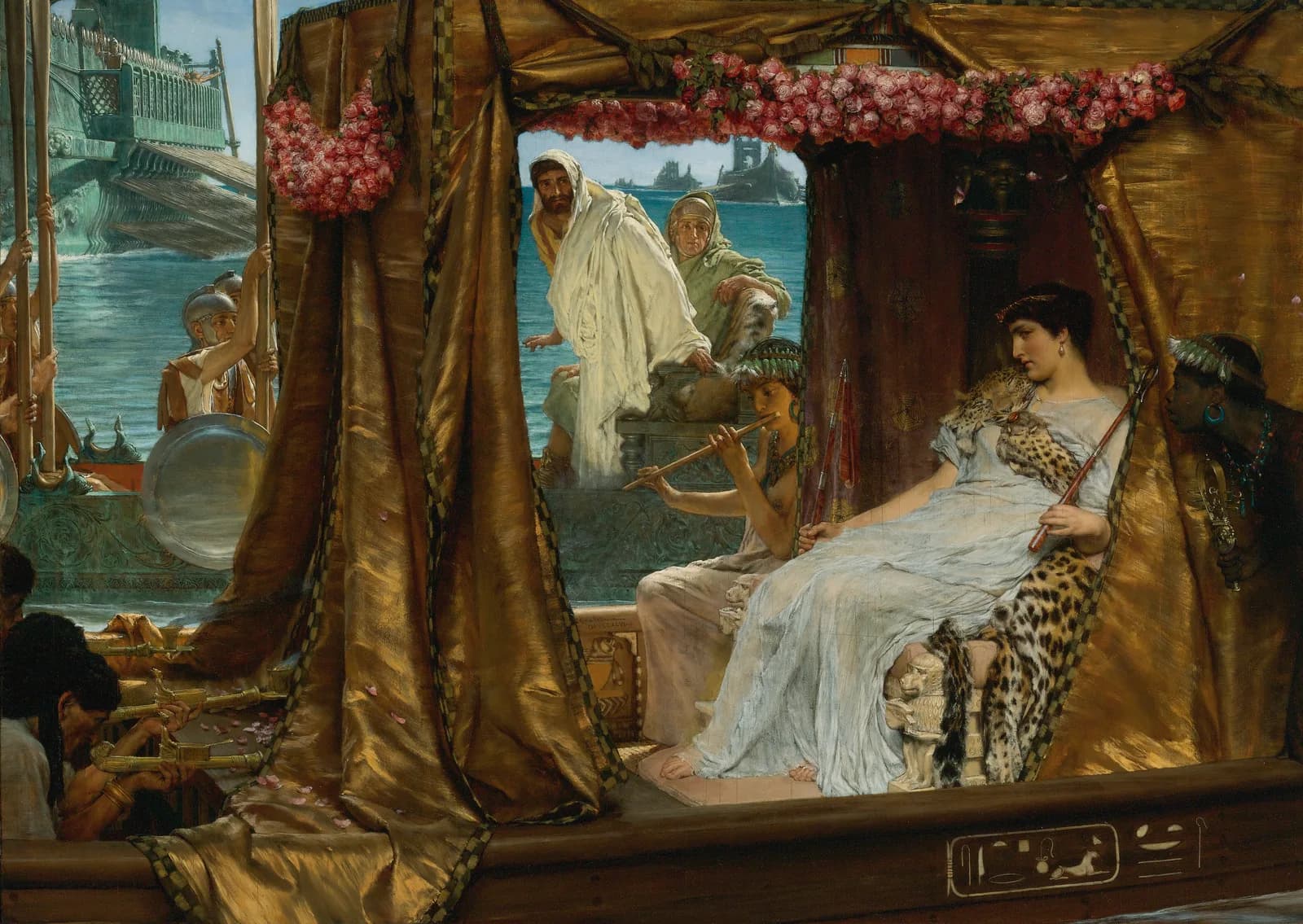
Ask most people to picture Antony and Cleopatra and they picture Elizabeth Taylor in gold, walking into Rome on a sphinx. That film has almost nothing to do with the play Shakespeare wrote. It shares the history and the two names, and not one line of the dialogue.
Below is what each version actually is, which two carry Shakespeare’s text, and which one to start with. If you would rather be inside the story than watching it, the same events run as a playable Antony and Cleopatra, which opens on the barge at Cydnus.
🎬 The famous one is not the play
Cleopatra(1963) was directed by Joseph L. Mankiewicz, who wrote the screenplay with Ranald MacDougall and Sidney Buchman. Wikipedia’s article on the film records what they worked from: Carlo Maria Franzero’s 1957 book The Life and Times of Cleopatra, plus the ancient historians Plutarch, Suetonius and Appian. Britannica’s entry lists the same three writers. Shakespeare appears in neither credit list.
This matters more than a footnote, because the 1963 film is where most people’s idea of the story comes from, and it is telling a different story. It begins with Julius Caesar and runs to Cleopatra’s death, covering roughly eighteen years. Shakespeare starts after Caesar is already dead, with Antony in Egypt and Rome pulling at him, and gives you the last decade at speed. The film is a biography of a queen. The play is the record of a decision and everything it costs.
The film is also famous for reasons outside itself. Britannica notes that Taylor and Richard Burton were married to other people during production, that the resulting publicity was enormous, and that the picture did not recover its cost in theatrical release. That is a real piece of film history. It is not a piece of Shakespeare history.
📽️ The two screen versions that use the text
Charlton Heston made his own Antony and Cleopatrain 1972. He directed it and played Antony, with Hildegarde Neil as Cleopatra, for the Rank Organisation. It is a film of the play: the actors speak Shakespeare’s lines, cut and rearranged as any staging cuts them. It is also a vanity project in the honest sense: an actor who wanted this play to exist on film, and made one.
The BBC made the other one for its complete Shakespeare series. Jonathan Miller directed and produced it, taped it between 5 and 10 March 1980, and the BBC first broadcast it on 8 May 1981, with Colin Blakely as Antony and Jane Lapotaire as Cleopatra. Miller dressed his Rome and Egypt as sixteenth-century Europe on purpose, arguing that the play can only be understood through the eyes of the people who first watched it. Whether that reading helps or gets in the way is the one thing anybody still argues about with this production.
If you want the words with the least between you and them, those two are the field. Neither is a spectacle. Both are the play.
🎭 The staging people still name
The Royal Shakespeare Company’s own past-productions page lists the title roles across its history, and the 1972 entry is Richard Johnson and Janet Suzman, directed by Trevor Nunn. Two years later ATV filmed that staging for television, directed for the camera by Jon Scoffield, with Patrick Stewart playing Enobarbus and a then-unknown Ben Kingsley in a small part. It survives, and it is the version theatre people tend to bring up first.
Enobarbus is the reason. He is the friend who watches Antony choose wrong, says so, and cannot live with what he does about it, and this hub has a whole essay on him. Note only that Stewart came back to the play decades later as Antony himself, opposite Harriet Walter, in the RSC’s 2006 production.
The most recent version with a wide audience is the National Theatre’s, directed by Simon Godwin with Ralph Fiennes and Sophie Okonedo. The National’s own listing gives the run: the Olivier Theatre, 18 September 2018 to 19 January 2019, and it streams on National Theatre at Home. Modern productions keep re-casting this queen, which is a pattern the play itself predicted and another essay here takes up.
- Cleopatra (1963). Mankiewicz, Taylor, Burton. An original screenplay from Franzero and the Roman historians. No Shakespeare.
- Antony and Cleopatra (1972).Heston directing and starring, Hildegarde Neil as Cleopatra, Rank. Shakespeare’s text.
- Antony and Cleopatra (1974).ATV’s film of Trevor Nunn’s RSC staging. Johnson, Suzman, Patrick Stewart as Enobarbus.
- BBC Television Shakespeare (1981). Jonathan Miller, Colin Blakely, Jane Lapotaire, in Renaissance dress.
- National Theatre (2018). Simon Godwin, Ralph Fiennes, Sophie Okonedo. Streaming on National Theatre at Home.
🎞️ Why the play fights the camera
There is a reason the screen versions are respected rather than loved, and it is structural. Antony and Cleopatra runs 42 scenes, two of them six spoken lines long, scattered across Alexandria, Rome, Messina, Misenum, a galley, Syria, Athens, Actium and a series of army camps. On a bare Jacobean stage that is a strength, because two men can walk on and the location changes with the first sentence. On film every one of those changes wants a set, a costume plan and an establishing shot, and the result is either a very expensive picture or a lot of curtains.
The bigger problem is that the two events an audience arrives wanting to see are both withheld. The sea battle at Actium happens offstage; what the audience gets is two soldiers on a plain, listening and describing. Cleopatra’s arrival at Cydnus, the single most visual thing in the story, is also offstage and reaches us second-hand as a speech. A film can show both, and the moment it does, it has replaced Shakespeare’s method with the opposite one, which is exactly the trade the 1963 epic made without having to worry about the text at all.
⛵ The scene every version is graded on
There is one passage that decides how a production is remembered, and the joke of it is that Shakespeare never stages the thing itself. Cleopatra arrives at Tarsus on a barge to meet Antony, and we hear about it afterwards, in Rome, from Enobarbus, who was there.
“The barge she sat in, like a burnished throne, / Burned on the water.”
A director has three options and all of them are exposed. Show the barge and it will look cheaper than the sentence. Cut to the speaker and the whole weight sits on one actor holding a room. Do nothing and the audience notices the gap where the famous image was supposed to be. Reviewers reach for this scene because it is the one place where a budget and a piece of language are asked to compete directly. What the text itself is doing there gets its own essay on this hub.
✅ Which one to watch first
For the text with the fewest obstacles, take the 1981 BBC broadcast; it is complete, it is slow in the way the play is slow, and Jane Lapotaire’s Cleopatra holds up. For the sense of a live theatre event, the 1974 broadcast of Nunn’s staging still carries it, and Stewart’s Enobarbus is the performance people describe from memory decades later. For a modern production with a full house behind it, the National Theatre’s 2018 recording is the one currently streaming.
Watch the 1963 Cleopatra for what it is: an expensive, strange, genuinely watchable studio epic about the same people. Just do not sit down expecting to hear the play, because you will not hear a word of it. Both texts are free to read, side by side, at Project Gutenberg and in the Folger edition.
Sources
- Antony and Cleopatra (Project Gutenberg text) — Project Gutenberg
- Cleopatra | Movie, Elizabeth Taylor, Richard Burton, Cast, Crew, & Facts — Encyclopædia Britannica
- Cleopatra (1963 film) — Wikipedia
- Antony & Cleopatra — past productions — Royal Shakespeare Company
- Antony & Cleopatra (2018) — National Theatre
- BBC Television Shakespeare — Wikipedia
Frequently asked questions
- Is the 1963 film Cleopatra based on Shakespeare's play?
- No. Joseph L. Mankiewicz wrote the screenplay with Ranald MacDougall and Sidney Buchman, working from Carlo Maria Franzero's 1957 book and from Plutarch, Suetonius and Appian. The two openings settle it. The film starts with Julius Caesar alive; the play starts with a Roman officer, Philo, calling Antony the triple pillar of the world transformed into a strumpet's fool.
- Which Antony and Cleopatra film is closest to Shakespeare's text?
- Two of them stage his actual dialogue. Charlton Heston directed and starred in a 1972 film for the Rank Organisation, with Hildegarde Neil as Cleopatra. The BBC's version, directed by Jonathan Miller, was taped in March 1980 and broadcast on 8 May 1981. Either has to get through 3,535 spoken lines whose longest single speech is twenty-four.
- Is Antony and Cleopatra a sequel to Julius Caesar?
- In effect, yes, though Shakespeare wrote them seven or eight years apart. Antony is a supporting character in Julius Caesar and delivers the funeral speech there. Antony and Cleopatra picks him up years later as one of three men ruling Rome, and the Caesar in it is Octavius, the murdered man's adopted heir.
- Who has played Enobarbus?
- Patrick Stewart is the performance named most often: he played Enobarbus in Trevor Nunn's Royal Shakespeare Company staging, filmed for television in 1974, and returned in 2006 as Antony opposite Harriet Walter. The part is smaller than its reputation. Enobarbus speaks in twelve of the play's forty-two scenes and dies in Act 4 Scene 9, overheard by a sentry.
- Where can I watch the National Theatre's Antony and Cleopatra?
- It streams on National Theatre at Home. Simon Godwin directed Ralph Fiennes and Sophie Okonedo in the Olivier Theatre, and the National's own listing gives the run as 18 September 2018 to 19 January 2019. Any production is judged on its last hour: Act 5 has only two scenes, and Cleopatra is absent from the first of them.
- Why is Cleopatra's barge entrance the scene adaptations are judged on?
- Because Shakespeare never stages it. The arrival at Cydnus reaches the audience second-hand, as Enobarbus describing it afterwards in Rome, so a director must either show a boat that will look cheaper than the sentence or trust one actor to hold the room. He is not even allowed to finish. Agrippa interrupts him twice inside the speech.
Enjoyed this one?