“I Am Dying, Egypt, Dying” and Five More Antony and Cleopatra Lines, Explained With Their Scenes
People quote this play more than they read it, and the quoting has drifted. The most famous line in it belongs to a man who has already failed to kill himself and is being hauled up a wall on ropes, and it is not the last thing he says.


People quote this play more than they read it, and the quoting has drifted. What follows is six lines with the scene each one belongs to, and what is actually happening on stage while it is said. At least two of the six are not doing the job the quotation pages give them.
Every one is quoted from the free Project Gutenberg text, with the act and scene attached. The same scenes are walkable in the playable Antony and Cleopatra, which keeps a doorway at the monument.
📖 Six lines, with their scenes
- Act 1 Scene 1, Antony.“There’s beggary in the love that can be reckoned.” The play’s opening exchange, answering her demand to be told how much.
- Act 1 Scene 5, Cleopatra.“My salad days, / When I was green in judgment, cold in blood.” Dismissing her younger self, and her earlier Romans.
- Act 2 Scene 2, Enobarbus.“The barge she sat in, like a burnished throne, / Burned on the water.” A soldier in Rome, describing a party he attended.
- Act 4 Scene 14, Antony.“Unarm, Eros. The long day’s task is done, / And we must sleep.” Taking off his armour, minutes before he tries to die in it.
- Act 4 Scene 15, Antony.“I am dying, Egypt, dying.” Wounded, hauled into the monument, twice in one scene.
- Act 5 Scene 1, Caesar.“The breaking of so great a thing should make / A greater crack.” The winner, told his rival is dead.
⛵ The entrance that happens offstage
The most cinematic moment in Shakespeare is a man talking in a room in Rome. Cleopatra sailed up the Cydnus to meet Antony in a gilded barge, and the play does not show it. What it gives you instead is Enobarbus, a blunt professional soldier with no reputation for poetry, being asked about it at a dinner in Rome and turning into a different writer for the rest of the scene.
“The barge she sat in, like a burnished throne, / Burned on the water.”
Two verbs carry it. The throne is burnished, meaning polished until it throws light back, and the boat burns on the water without being on fire. Shakespeare put the most extravagant description in the play into the mouth of the character least likely to produce one, which is why the speech convinces. The same speech later contains the line about age and infinite variety, and an essay on this hub belongs to that half. Directors have to solve the barge with a budget, which is another essay again.
🩸 “I am dying, Egypt, dying”
The scene is worse than the line suggests. Antony has fallen on his own sword and failed to die of it. His guards refused to finish him and left. He is carried to Cleopatra’s monument, and she will not open the door, because Caesar’s men are outside and she does not intend to be taken. So the women haul him up the wall on ropes, and he speaks this while being lifted.
“I am dying, Egypt, dying. Only / I here importune death awhile until / Of many thousand kisses the poor last / I lay upon thy lips.”
“Egypt” is his name for her. He uses it to her face in Act 3 as well, and the substitution is the whole relationship in one word: the woman and the country are not separable, and choosing her was choosing it. He repeats the phrase later in the same scene, wanting wine and a little more time to talk. His actual last words come after that, and they are much plainer.
“Now my spirit is going; / I can no more.”
Most quotation pages give you the famous line and stop. The scene keeps going for another twenty lines, and the difference between the two sentences is the difference between a man performing his death and a man having one. What led him here is covered in the essay on his long decline.
✂️ The other three, quickly
The first line of the play is a complaint about Antony from a soldier nobody remembers, and the second thing that happens is the exchange everyone quotes. Cleopatra tells him to say how much he loves her, which is a demand for a number. Antony refuses to give one: “There’s beggary in the love that can be reckoned.” A love with a figure attached is a poor love. Seventeen scenes later, in Act 3 Scene 6, the whole war will be fought over quantities of exactly this kind, in provinces.
In Act 1 Scene 5 Cleopatra is missing Antony and asks for mandragora so she can sleep through the gap until he comes back. Her attendant Charmian teases her by praising Julius Caesar, which is a thing Cleopatra herself used to say. Her answer is the line that entered the language: “My salad days, / When I was green in judgment, cold in blood.” Green here means unripe rather than fresh. She is not being nostalgic about her youth; she is filing it as a period of bad taste, and the play never lets her be sentimental about anything, including herself.
The quietest of the six comes in Act 4 Scene 14, and it is the last calm thing Antony says. He has lost the fleet, believes Cleopatra has betrayed him, and is having his armour taken off by a servant, and the sentence he produces belongs to any exhausted person at the end of any day: “Unarm, Eros. The long day’s task is done, / And we must sleep.” Seventy-two lines later he is trying to die on that same servant’s sword. Shakespeare puts the ordinary sentence directly before the catastrophe, which is why it lands.
The sixth belongs to the winner, and it arrives in Act 5 Scene 1 when a soldier brings Antony’s sword to Octavius. He does not say he will miss him. He says the universe has under-reacted: “The breaking of so great a thing should make / A greater crack.” The lions should have been driven into the streets. It is the only moment Octavius sounds like he has an inner life, and the essay on him takes it up.
🐍 The source admits it does not know
Shakespeare worked from Plutarch’s Life of Antony, and one of the pleasures of reading the source is finding out how much of it Plutarch himself would not vouch for. His account of Cleopatra’s death, in section 86, gives three incompatible versions in a single paragraph: the asp hidden under the figs, the asp kept in a vase and provoked with a golden spindle, and poison carried in a hollow bodkin wound into her hair. He reports that no mark was found on her body, that the snake was never seen inside the monument, and that something like its trail was noticed on the sand outside.
“But what really took place is known to no one.”
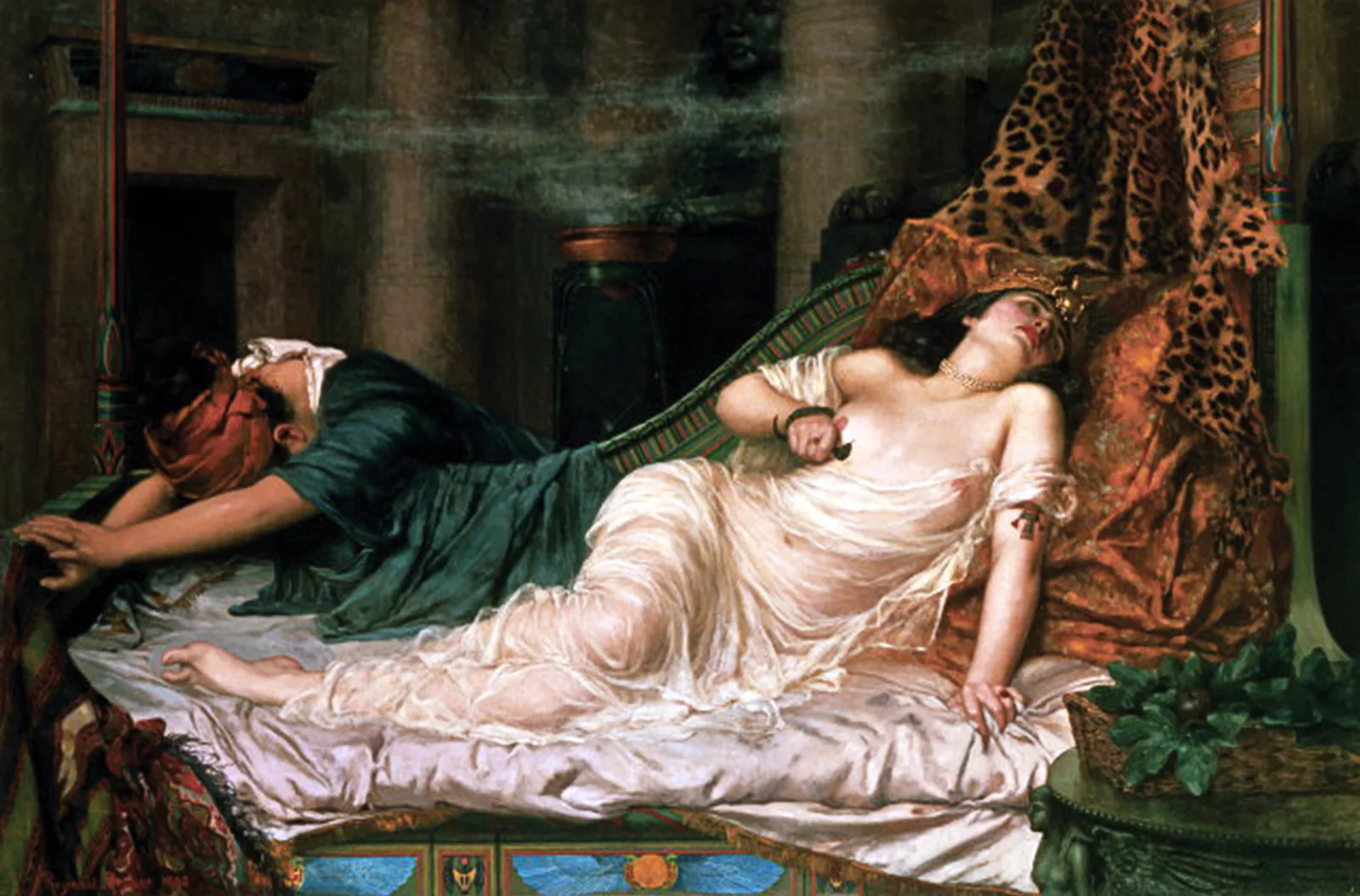
The ancient historian closest to the event, writing the book Shakespeare turned into the play, files the most famous death in Roman history as unresolved. What everyone remembers instead is a picture: Plutarch notes in the same passage that Caesar carried an effigy of Cleopatra with an asp clinging to her through his triumph in Rome. The image people picture is the winner’s float. Her own version of the ending has an essay to itself on this hub.
🔗 Three more lines, covered elsewhere
Three of this play’s best-known lines already have essays of their own here, which is why they are not in the six above. “Let Rome in Tiber melt” is Antony in the opening scene, refusing to hear news from home. “Age cannot wither her” is the second half of the barge speech. “I have immortal longings in me” is Cleopatra, dressing for her own last scene. The full text is at Project Gutenberg, with a modern-spelling edition at the Folger Shakespeare Library, and Plutarch’s life of Antony at Project Gutenberg #674.
Sources
- Antony and Cleopatra (Project Gutenberg text) — Project Gutenberg
- Plutarch's Lives, Dryden translation revised by A. H. Clough — Project Gutenberg
- Antony and Cleopatra — Folger Shakespeare Library
Frequently asked questions
- What does “I am dying, Egypt, dying” mean?
- It gets shared as a romantic deathbed line and the scene is not romantic. Antony says it in Act 4 Scene 15 while being hauled on ropes up the outside of Cleopatra's monument. Egypt is his name for her, not the country, and he only starts using it late. All three times he calls her Egypt come after he has lost at Actium.
- What are Antony's actual last words?
- Not the famous line. Twenty lines later, after telling Cleopatra to seek her honour and her safety with Caesar, he finishes on something much plainer: Now my spirit is going; I can no more. The stage direction follows immediately, and Cleopatra answers it with a nineteen-line speech, one of the longest in the play.
- Is “the barge she sat in” from the same speech as “infinite variety”?
- Yes. Both belong to Enobarbus in Act 2 Scene 2, describing Cleopatra's arrival at Cydnus to a Roman dinner table. What gets lost in quotation is the setting. Act 2 Scene 2 is the second-longest scene in the play at 288 lines, and it is the scene in which the marriage to Octavia is arranged.
- What does “my salad days” mean?
- Cleopatra uses it in Act 1 Scene 5 to dismiss her younger self: my salad days, when I was green in judgment, cold in blood. Green means unripe, not fresh. The same scene has her at her least green. She orders a greeting sent to Antony every day, or, she says, I'll unpeople Egypt.
- Did Cleopatra really die from a snake bite?
- Plutarch gives three incompatible versions in one paragraph and then declines to choose. What he is sure about is the research. Cleopatra collected poisons, had them tried on prisoners condemned to die, found the quick ones painful and the painless ones slow, then moved to venomous animals and settled on the asp for its drowsiness.
- Who says “There's beggary in the love that can be reckoned”?
- Antony, in the opening scene, answering Cleopatra's demand that he tell her how much he loves her. A love you can put a figure on is a poor one. Her first line in the play is that demand for a number. Her last, four acts later, is an unfinished question: What should I stay.
Enjoyed this one?