Mark Antony's Long Decline: How Shakespeare Turns Rome's Greatest Soldier Into a Man Who Loses Everything
Antony makes his choice in the first scene and never takes it back. Shakespeare spends the rest of the play delivering the bill: a warning he accepts and ignores, a battle he leaves while winning, allies who go over one at a time, and a death he has to ask the guards to finish.


Antony makes his choice in the first scene of the play and never takes it back. The essay on this hub about the man who threw away a world for a person covers that decision and argues it was made awake. This essay is about the other three and a half acts, and about how precisely Shakespeare schedules the consequences.
The decline has a shape, and the play announces it early. You can walk it yourself in the playable Antony and Cleopatra, which keeps a doorway for the worst night of it.
🔮 The play tells you in Act 2
In Act 2 Scene 3, minutes after agreeing to marry Caesar’s sister, Antony is left alone with the Egyptian soothsayer, who wants to go home and wants Antony to go home too. Asked directly whose fortunes will rise higher, the soothsayer names Caesar and then explains.
“Thy dæmon—that thy spirit which keeps thee—is / Noble, courageous, high, unmatchable, / Where Caesar’s is not. But near him, thy angel / Becomes afeard, as being o’erpowered.”
No curse is laid on him here, and no doom is foretold. The diagnosis is narrower and worse. Antony is the better man everywhere except in one specific room, and the room is wherever Octavius is standing. The soothsayer even gives the evidence: at dice, at cockfighting, at quails, Caesar wins against the odds every time.
What makes the scene remarkable is Antony’s answer. He does not scoff. Alone on stage he works through the same evidence, concedes it, and says “Be it art or hap, / He hath spoken true.” Then he sends for Ventidius, arranges the Parthian campaign, and announces that he is going back to Egypt anyway. He has just been handed a correct diagnosis and the treatment, and he declines the treatment in the same breath.
🌊 Actium, reported by the men who watched
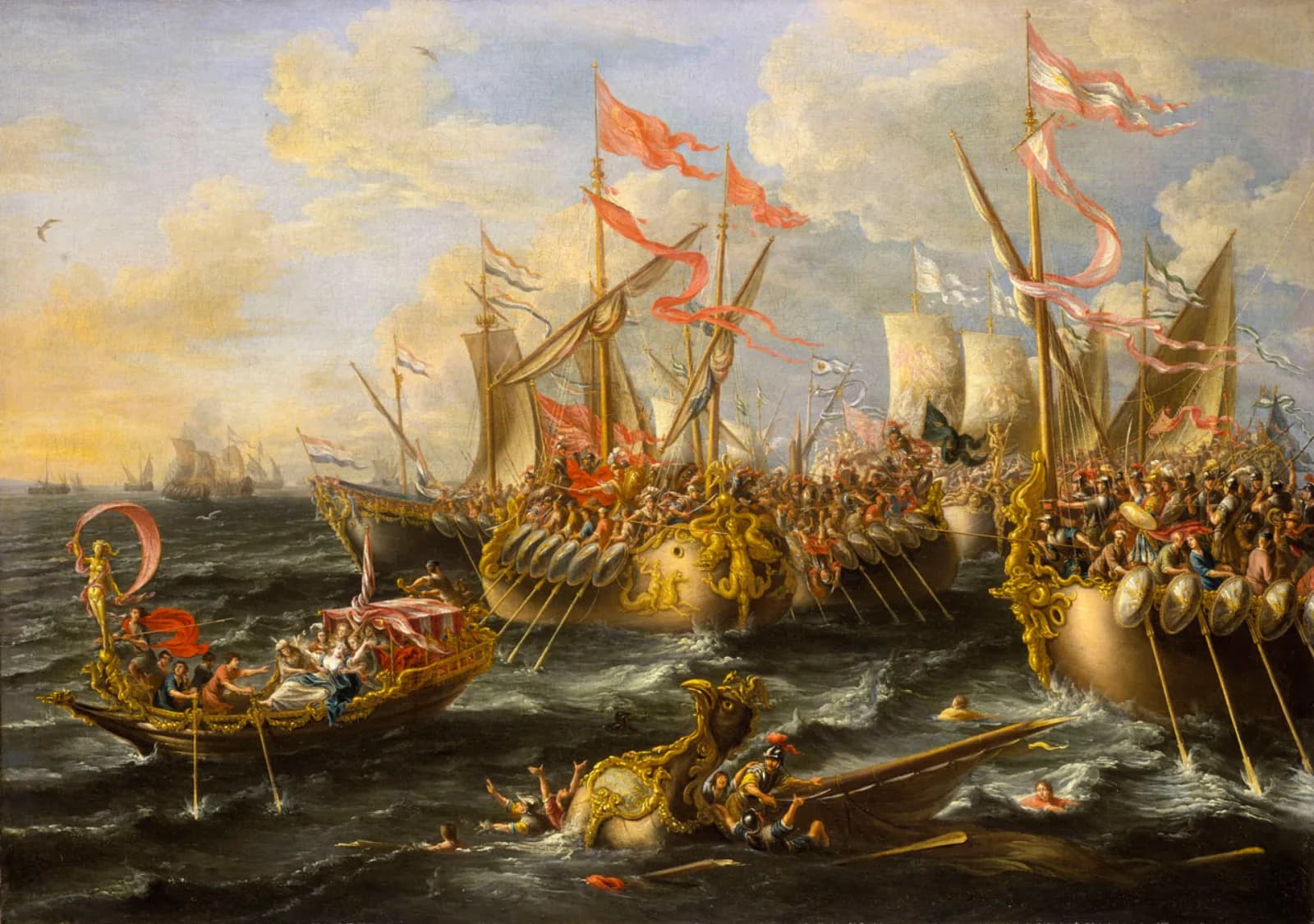
Shakespeare does not stage the sea battle. He gives you Antony’s lieutenant Enobarbus and Scarus on a plain, listening to it and describing what they can see, and the description is the most brutal thing anybody says about Antony in the play. Cleopatra’s sixty ships turn and run. Then Scarus reports what Antony did about it.
“Claps on his sea-wing and, like a doting mallard, / Leaving the fight in height, flies after her. / I never saw an action of such shame.”
A mallard is a duck, and the point of the image is that it is not a heroic bird. Rome’s best soldier left a battle he was winning, in front of his own fleet, to follow a woman’s ships. In the next scene, Act 3 Scene 11, Antony gives the same verdict on himself, and it is the flattest sentence he speaks in five acts: “I have fled myself, and have instructed cowards / To run and show their shoulders.”
🏃 Then he loses the men, one at a time
The play compresses what followed. Plutarch, who wrote the account Shakespeare worked from, takes his time over it, and the detail is worse than the compression.
In section 63, Domitius, one of Antony’s own commanders, gets into a small boat with a fever on him and rows across to Caesar. Antony’s response is to send his baggage, his friends and his servants after him, against Cleopatra’s advice; Domitius dies shortly afterwards. Shakespeare turned that man into Enobarbus and gave the same gesture to the same effect, which this hub covers in full elsewhere. Plutarch adds, in one flat clause, that the kings Amyntas and Deiotarus went over as well.
The single cruellest fact in the whole record is in section 74. Antony wins a skirmish outside Alexandria, comes back in armour, kisses Cleopatra and presents the soldier who fought best that day. She gives the man a breastplate and helmet of gold. He takes them, and Plutarch finishes the sentence: he “went that very night and deserted to Caesar.”
By section 76 the end is a piece of choreography. Antony watches his own fleet row out to meet Caesar’s, and instead of a battle there is a greeting.
“His men saluted Caesar’s with their oars; and, on their responding, the whole body of the ships, forming into a single fleet, rowed up direct to the city.”
- Act 2 Scene 3. He is told he cannot beat Caesar, he agrees, and he sails for Egypt.
- Act 3 Scene 10.Actium. He follows Cleopatra’s ships out of a fight he was winning.
- Act 3 Scene 13.He calls for “one other gaudy night” and a party with his captains.
- Act 4 Scene 8. He wins a day, and it is the only scene in the play where nobody but he and Cleopatra speaks.
- Act 4 Scene 14. He falls on his sword and does not die.
🔥 What losing does to him
The decline is not only military, and Shakespeare tracks the second half of it in Antony’s conduct. In Act 3 Scene 13, Caesar sends an envoy named Thidias to negotiate privately with Cleopatra. Antony walks in on the man kissing her hand and orders him taken out and whipped, twice, with instructions to keep going until he whines aloud for mercy. Enobarbus watches and says it would be safer to play with a lion’s whelp than with an old one dying. His commander is the old lion in that sentence: still dangerous, and dying anyway.
The interesting detail sits in the middle of the tirade. Ordering the whipping, Antony reaches for her name and cannot produce it, asking “what’s her name / Since she was Cleopatra?” The man who threw away an empire for a specific woman is now unsure what to call her. Later, in Act 4 Scene 12, convinced she has sold him to Octavius, he gets as far as “The witch shall die” before the scene ends.
Neither moment is the behaviour of the general in Act 1, and neither is excused by the play. What the play does instead is put them next to the gentleness he shows Eros, the generosity he shows the officer who deserts, and the last order he gives about Cleopatra’s safety. The decline does not turn him into a worse person. What it turns him into is an unpredictable one, as the ground gives way under him.
🗡️ Weak, or beaten by one specific man
The simple reading is that Antony is a great soldier ruined by self-indulgence, and the play keeps supplying evidence against it. He wins the fight in Act 4 Scene 8 outright and comes home through Alexandria with trumpets. His men love him well enough that his best officer dies of shame rather than of a wound. He is capable, in the same act, of the quietest line in the play, spoken to a servant while taking off his armour: “Unarm, Eros. The long day’s task is done, / And we must sleep.”
And then the death, which Shakespeare stages as an ordinary, humiliating mess. Antony asks Eros to kill him and Eros kills himself instead. Antony falls on his own sword and survives it, and what he says next is the whole argument of the second half of the play in ten words.
“How? Not dead? Not dead? / The guard, ho! O, dispatch me!”
He tells the men who come in that he has done his work ill and asks them to finish it. They answer in three words each, in turn: “Not I.” “Nor I.” “Nor anyone.” Then they leave him there.
That is not a weak man being punished. It is a large man being outlasted by a smaller one who never gave him a fight he was good at, exactly as he was warned in Act 2. Antony’s last hours, and the words he gets to say in them, are taken up in the essay on this play’s most quoted lines. Both sources are free: the play at Project Gutenberg and Plutarch at Project Gutenberg #674.
Sources
- Antony and Cleopatra (Project Gutenberg text) — Project Gutenberg
- Plutarch's Lives, Dryden translation revised by A. H. Clough — Project Gutenberg
- Plutarch, Life of Antony (Perrin translation, with section numbers) — LacusCurtius, University of Chicago
Frequently asked questions
- Why does Antony lose after Actium?
- Because he loses it in instalments. Sixty of Cleopatra's ships turn at Actium and he follows them out of a sea battle he is winning. The land army goes without a fight. In Act 3 Scene 10 his general Canidius says he will render his legions and his horse to Caesar, because six kings have already shown him the way of yielding.
- What does the Soothsayer tell Antony?
- In Act 2 Scene 3 he tells Antony that his guiding spirit is noble and unmatchable away from Caesar and becomes afraid whenever Caesar is near, so he should put distance between them. He backs it with household evidence: dice, cockfighting and quails. Then he leaves the play. The Soothsayer speaks in two scenes and is never seen again.
- Did the real Mark Antony's allies actually desert him?
- Plutarch records them going one by one, and the first two mattered most. Titius and Plancus, both of consular rank and both ill used by Cleopatra, went over to Caesar and told him what was in Antony's will. The commanders followed: Domitius rowed across with a fever on him, then the kings Amyntas and Deiotarus.
- Is Antony a weak character in Antony and Cleopatra?
- The text keeps supplying evidence against it. He wins the land fight in Act 4 outright and marches home through Alexandria with trumpets. In Act 4 Scene 8 he presents the officer who fought best to Cleopatra, and she gives him an armour all of gold, it was a king's. That officer is Scarus, who called him a doting mallard at Actium and stayed anyway.
- How does Antony die in the play?
- Badly, and at the third attempt. He orders Eros to kill him and Eros kills himself instead; Antony falls on his own sword and survives it. The cruellest piece of staging is a minor part. Diomedes exists in two scenes only, and his whole function is to arrive after the wound with Cleopatra's message that she is alive.
- Did Mark Antony have descendants?
- Plutarch closes the Life with the family tree. Antony left seven children by three wives; only the eldest, Antyllus, was put to death, and Octavia raised the rest alongside her own. Following the line down, Plutarch ends on the emperor Nero, whom he calls Antony's descendant in the fifth generation.
Enjoyed this one?