Was Cleopatra Beautiful? Plutarch, Shakespeare and the Case That It Was Never About Her Face
Plutarch, the historian Shakespeare worked from, stops his own narrative to say that Cleopatra's beauty was not the remarkable thing about her. What he puts in its place is a voice like an instrument of many strings, and a list of seven nations she answered without an interpreter.


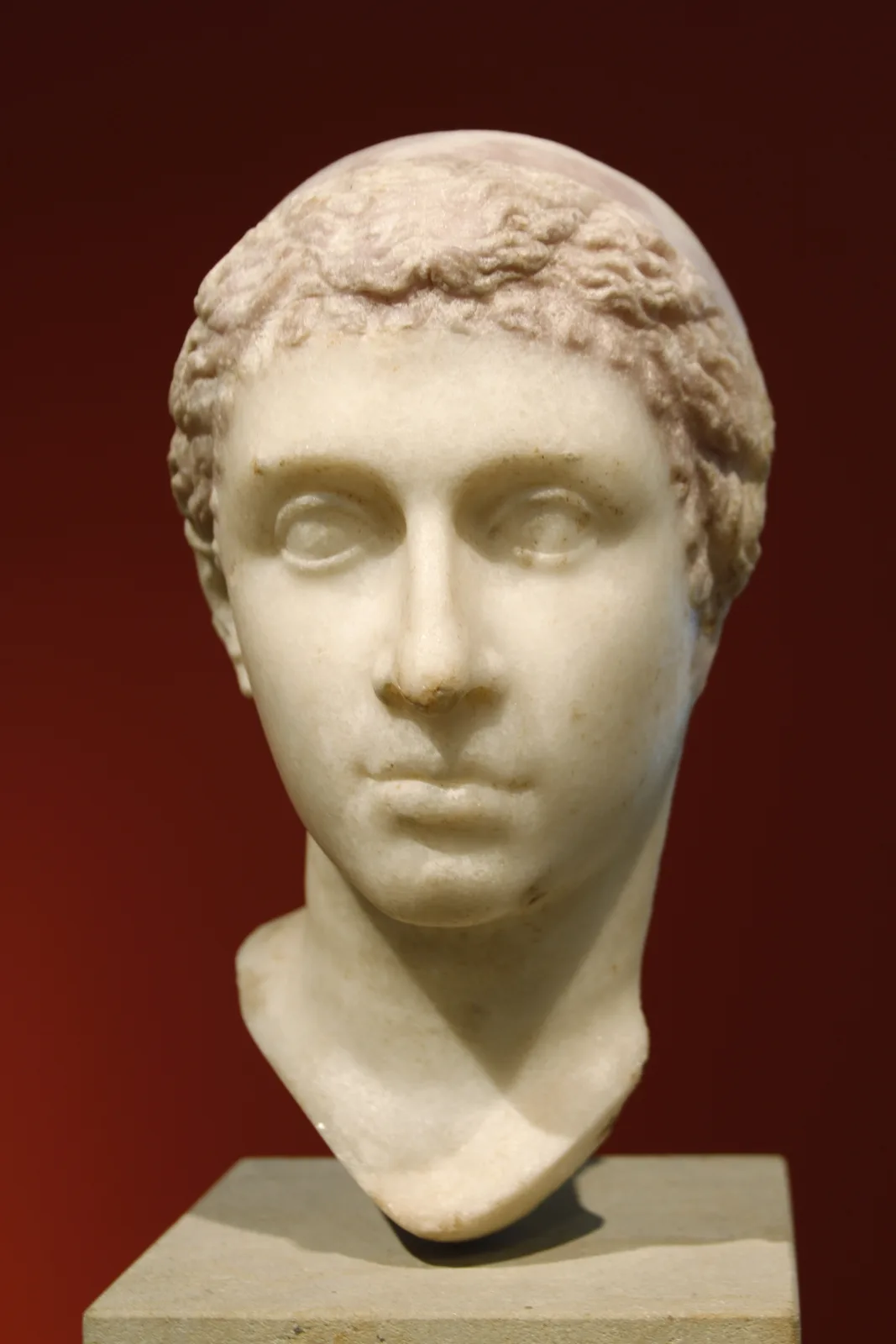
Ask what made Cleopatra Cleopatra and almost everybody answers with her face. The two people best placed to know disagreed. The historian who wrote the account Shakespeare worked from says her looks were not the remarkable thing about her, and the play built on that account spends its time on her talk.
This is what the sources actually say, what the part actually contains, and why the argument about whether she was calculating or sincere has never been settled. She is also playable: the Golden Court of Alexandria is the opening room in the playable Antony and Cleopatra.
📜 What the source actually says
Plutarch’s Life of Antony is where Shakespeare got this story, through Thomas North’s Elizabethan English. In section 27, just after the meeting at Cydnus — the barge arrival Shakespeare later gave to Enobarbus — Plutarch stops the narrative to explain the effect she had on people, and the first thing he does is rule out the obvious explanation.
“For her actual beauty, it is said, was not in itself so remarkable that none could be compared with her, or that no one could see her without being struck by it, but the contact of her presence, if you lived with her, was irresistible.”
That is a careful sentence and it is doing two jobs. It refuses the legend, and it names what replaced the legend: proximity. He goes on to the specific thing people remembered, which was the sound she made.
“It was a pleasure merely to hear the sound of her voice, with which, like an instrument of many strings, she could pass from one language to another.”
Then the receipts. Plutarch lists the peoples she answered without an interpreter: Ethiopians, Troglodytes, Hebrews, Arabians, Syrians, Medes, Parthians, and others. He adds the detail that makes it a political fact rather than a party trick, which is that most of the Ptolemies before her had not bothered to learn Egyptian, the language of the country they were ruling, and several had let their own Macedonian go. She was the one in her family who did the homework.
🗣️ About that “golden mouth”
There is a line that circulates constantly online, usually as the top comment on any thread about her: that Julius Caesar called her the woman with a golden mouth. It is a good phrase and it is not in Plutarch, who is the writer people are usually reaching for when they say it. Nothing in the Life of Antony, which is the source for almost everything else the internet knows about her, contains it.
What the phrase is a garbled memory of is the passage above, and the real version is better. Nobody in antiquity said her mouth was golden. Plutarch said the sound of it was the thing that could not be forgotten, and then listed seven nations she used it on without help. The internet has compressed a paragraph about competence into a compliment about prettiness, which is precisely the compression Plutarch was writing against.
🎣 The joke she plays on a general
Plutarch does not describe her wit in the abstract. He gives an example, two sections later, and it is the best short piece of evidence for what she was actually like to be around. Antony took her fishing in Alexandria, caught nothing, and could not bear to look foolish in front of her, so he had divers go down and hook already-caught fish onto his line. He pulled them up one after another. She saw it immediately.
What she did about it is the point. She said nothing, praised his skill loudly to the whole company, and invited everybody to come out and watch him again the next day. When the boats were full and his hook went down, one of her servants got there before his divers and attached a salted fish imported from Pontus. Antony felt the line pull and hauled up a preserved fish in front of an audience she had assembled for the purpose.
“Leave the fishing-rod, general, to us poor sovereigns of Pharos and Canopus; your game is cities, provinces, and kingdoms.”
She spent a day building the machinery of that joke, and the joke has a thesis: stop performing at me and go and be what you are. Plutarch files the story under Antony’s follies rather than her cleverness, which is a fair summary of how the ancient record treats her generally, and part of what Shakespeare corrected.
🎭 The size of the part
Shakespeare took the hint. Counted in the Project Gutenberg text of the play, Cleopatra has 689 lines in 204 separate speeches. Antony has more lines, 853, in 203 speeches. Fewer lines, one more separate speech: she is written to take the floor and give it back, in shorter turns than he gets. She also gets a whole scene, Act 2 Scene 5, in which she beats a messenger for delivering true news and then calls him back to hear it properly.
For scale, the same counter run over the Project Gutenberg Romeo and Juliet gives Juliet 546 lines. Cleopatra is a substantially bigger part than that, in a play where she shares the title, and the writing is almost entirely wit, temper, strategy and command. The scenes that would show off her beauty are the ones Shakespeare declines to stage: her famous entrance happens offstage and reaches us as a description, which is a whole essay of its own here.
- The first of her line to learn Egyptian. Plutarch says most of the kings before her scarcely troubled, and several let their own Macedonian go.
- Seven languages, no interpreter.Plutarch’s list, in section 27, of the peoples she answered herself.
- She beats a messenger and apologises to the message. Act 2 Scene 5, then “Some innocents ’scape not the thunderbolt.”
- She keeps an inventory. In Act 5 she produces a valuation of her own property, and her treasurer says out loud that she has held some back.
⚖️ Calculating, or in love
This is the fight readers actually have about her, and both sides are arguing from real evidence. On one side, the woman who says the thing nobody else in the play can say about what they had together.
“Eternity was in our lips and eyes, / Bliss in our brows’ bent.”
On the other, the queen who in Act 5 hands the winning general a full inventory of her estate, describes it as exactly valued, and is immediately contradicted by her own treasurer, Seleucus, who tells him she has kept things back. She then turns on Seleucus in front of Caesar and gives a performance of wounded loyalty. Whether that scene shows a broken woman caught lying or a negotiator running a play she has already planned is left open on purpose; the ending she chooses a few dozen lines later gets its own essay on this hub.
The play does not make you choose. Shakespeare wrote a woman who is genuinely in love and genuinely running a state, and let those two be true at the same time, which is the reason the part is still the one senior actresses want. Her habit of being remade by every era that touches her is a different subject, taken up in the essay on infinite variety. Both texts used here are free: the play at Project Gutenberg and Plutarch at Project Gutenberg #674.
Sources
- Plutarch's Lives, Dryden translation revised by A. H. Clough — Project Gutenberg
- Antony and Cleopatra (Project Gutenberg text) — Project Gutenberg
- Plutarch, Life of Antony (Perrin translation, with section numbers) — LacusCurtius, University of Chicago
- Cleopatra, queen of Egypt — Encyclopædia Britannica
Frequently asked questions
- Was Cleopatra actually beautiful?
- Plutarch, the closest ancient source, says her beauty was not in itself so remarkable that nobody could be compared with her. What he calls irresistible is the contact of her presence, her conversation and her voice. Shakespeare agrees by omission. She describes her own complexion in Act 1 Scene 5: with Phoebus' amorous pinches black, and wrinkled deep in time.
- Did Julius Caesar call Cleopatra “the woman with a golden mouth”?
- There is no ancient source for it. The phrase circulates online attributed to Caesar and credited to Plutarch, who does not say it. Search Dryden's translation and the word golden turns up four times: cups at a banquet, his father's chair, the two thrones at Alexandria, and the spindle she used to provoke an asp. Never her mouth.
- How many languages did Cleopatra speak?
- Plutarch names seven peoples she answered without an interpreter: Ethiopians, Troglodytes, Hebrews, Arabians, Syrians, Medes and Parthians. He then writes and many others, whose language she had learnt, so seven is a floor rather than a total. The list is all eastern and African. Latin does not appear in it, and Greek was already hers.
- How big is Cleopatra's part in the play?
- Counted in the Project Gutenberg text, she speaks 689 lines across 204 separate speeches. Antony has more lines, 853, but one fewer speech, so she takes the floor more often than he does. The part is also back-loaded. The longest scene in the play is Act 5 Scene 2 at 458 lines, and Antony is dead before it starts.
- Was Cleopatra manipulative or genuinely in love with Antony?
- The text supports both and refuses to choose. Act 1 Scene 3 shows the method with no gloss on it. She sends Alexas after Antony with instructions: if you find him sad, say I am dancing; if in mirth, report that I am sudden sick. Charmian tells her to her face that this is not how you hold a man.
- What did Cleopatra actually look like?
- Nobody knows in the way we know what a photographed person looks like. What survives is her profile on coins struck in her lifetime and a small number of marble heads, including the one in the Altes Museum in Berlin. Plutarch's paragraph about her presence is the closest thing to a description by someone who cared.
Enjoyed this one?