Best Translation of Les Misérables: Which One to Read
Every Les Misérables post on this site quotes Hapgood, because it is free and public domain. For a copy to buy, the reader guides name a different translator first.


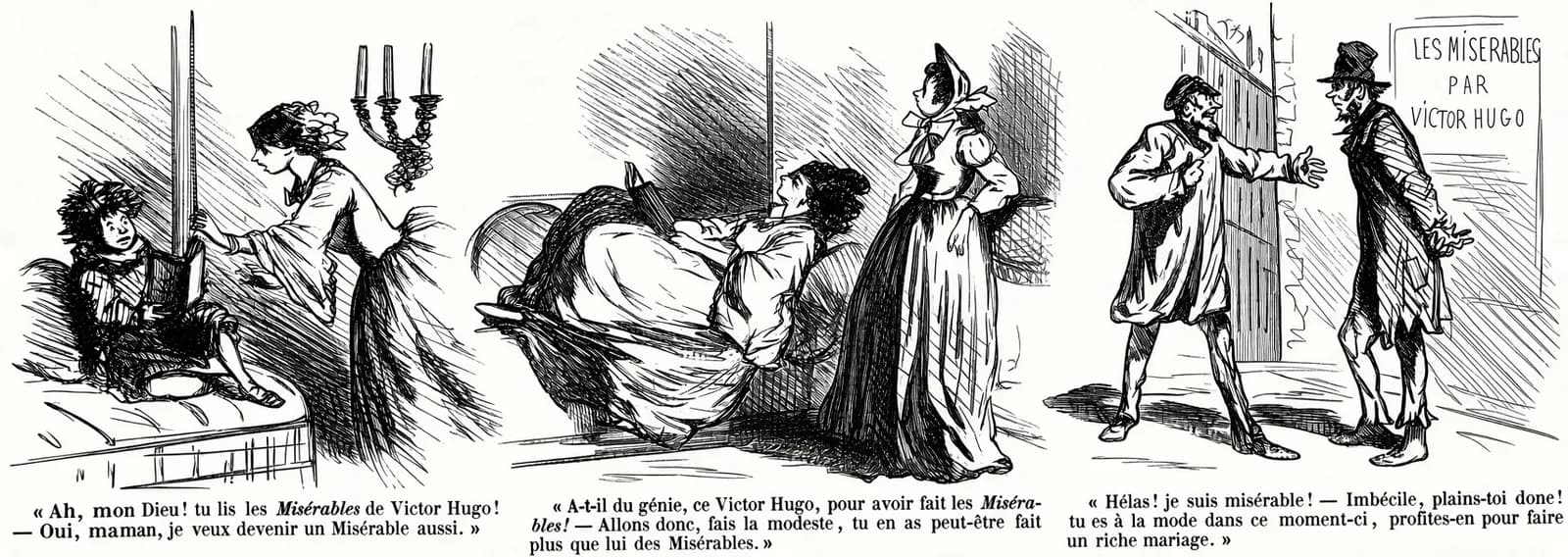
This post compares six English translations of Hugo’s novel, and they differ in age, in price and in how much they modernise. After a long opening on a provincial bishop, every one of them reaches the scene that is the first doorway in the playable Les Misérables: a released convict walking into a town that will not feed him.
📚 Which translation should you read?
Donougher, if you are buying one. Two independent guides that answer this exact question put her translation first. Marva Barnett, on her page answering readers’ translation questions, gives her reason in one line.
I find Donougher’s translation to be engaging, modern, and accurate.
The We Love Translations guide reaches the same pick and lists Hapgood, Fahnestock and MacAfee, and Rose as the alternatives. If you want the novel for nothing, the pick changes to Hapgood, covered below.
🗂️ How do the translations compare?
By date and publisher first, since that is what tells you which copy you are holding. The table lists each translator with the edition you are most likely to find.
| Translation | Publisher, year, and what to know |
|---|---|
| Christine Donougher | Penguin Classics, 2013. Named first by both guides above. Paid. |
| Julie Rose | Vintage Classics, 2008. Modern. Barnett also lists a Modern Library edition. |
| Lee Fahnestock and Norman MacAfee | Signet Classics, 1987. Paperback. |
| Norman Denny | Penguin, 1982. An earlier Penguin translation. |
| Isabel Hapgood | Thomas Y. Crowell, 1887. Public domain and free online. |
| Charles E. Wilbour | Published by Carleton. Nineteenth-century, public domain. |
🔖 Which translation do this site’s posts quote?
Hapgood’s. Every Les Misérables post on this site quotes Hapgood because her translation is public domain, so we can quote it at length and link the exact text. The choice is about licensing, and it says nothing either way about the prose.
In 1815, M. Charles-François-Bienvenu Myriel was Bishop of D——
Editions differ in small ways too. Hapgood prints Valjean’s galley number as 24,601, with a comma, which is one of the details the novel-versus-musical post checks. The picture at the top is from 1862 too: Cham’s cartoon for L’Illustration, where a child caught with the new novel answers a startled mother, in our rendering, “Yes, mama, I want to be a Misérable too.”
🆓 Where can you read it free?
In Hapgood’s translation, in two places. The Project Gutenberg edition credits her by name as translator, and Standard Ebooks publishes the same translation as a free download. For a free text, Hapgood is the pick: the Gutenberg file runs through all five volumes and costs nothing to try.
If you find the Victorian phrasing slows you down after the opening books, that is the moment to switch to Donougher instead of putting the book down.
🧭 Which one fits you?
For a first read on paper, take Donougher. For free, take Hapgood. If you want a second modern voice, try Rose. Whichever you choose, the question of an abridged copy is a separate one, and the post on whether the novel is worth reading answers it.
Sources
- Which translation of Les Misérables do you recommend? — Marva Barnett
- What's the best translation of Les Miserables? — We Love Translations
- Les Misérables, translated by Isabel F. Hapgood (Project Gutenberg #135) — Project Gutenberg
- Les Misérables (English translations section) — Wikipedia
- Les Misérables, translated by Isabel F. Hapgood, New York: Thomas Y. Crowell, 1887 — Internet Archive
Frequently asked questions
- Which translation of "Les Misérables" is considered the best?
- Christine Donougher's, by the two reader guides that answer the question directly. One of them, We Love Translations, points readers to the Penguin Classics Deluxe printing of her translation, and lists Hapgood, Fahnestock and MacAfee, and Rose behind it.
- What is the best version of Les Misérables?
- The unabridged novel by Victor Hugo, in a translation you will actually finish. Marva Barnett ranks five: Donougher first, then Julie Rose, then Lee Fahnestock and Norman MacAfee, then Norman Denny, then Charles E. Wilbour. The musical is a separate work with its own lyrics and cuts, so it cannot stand in for the book.
- Which version of Les Misérables is the best?
- For an e-reader, the free Hapgood translation is hard to beat on price. The Gutenberg record gives the translator's dates as 1850-1928, so she was in her thirties when her version appeared in 1887. For paper, Donougher's modern Penguin Classics translation is the stronger choice.
- How many volumes does Les Misérables have?
- Five. In the Gutenberg text they are titled Fantine, Cosette, Marius, Saint-Denis and Jean Valjean, each split into books and chapters. Check that a printed edition names all five before you buy it, since the musical's story runs to the end of the last one.
- Where can I read Les Misérables for free in English?
- Project Gutenberg and Standard Ebooks both offer the Hapgood translation as a free download. The Internet Archive also holds a scanned copy of the 1887 Thomas Y. Crowell printing, if you want to see the pages as first readers did. All three are legal because the translation is public domain.
Enjoyed this one?