Is Les Misérables Worth Reading, or Is the Musical Enough?
The musical made Les Misérables famous and also trained a generation to think they already know the story. The honest version: how long the book really is, which two books you can skip without losing the plot, and what the songs have no room to argue.


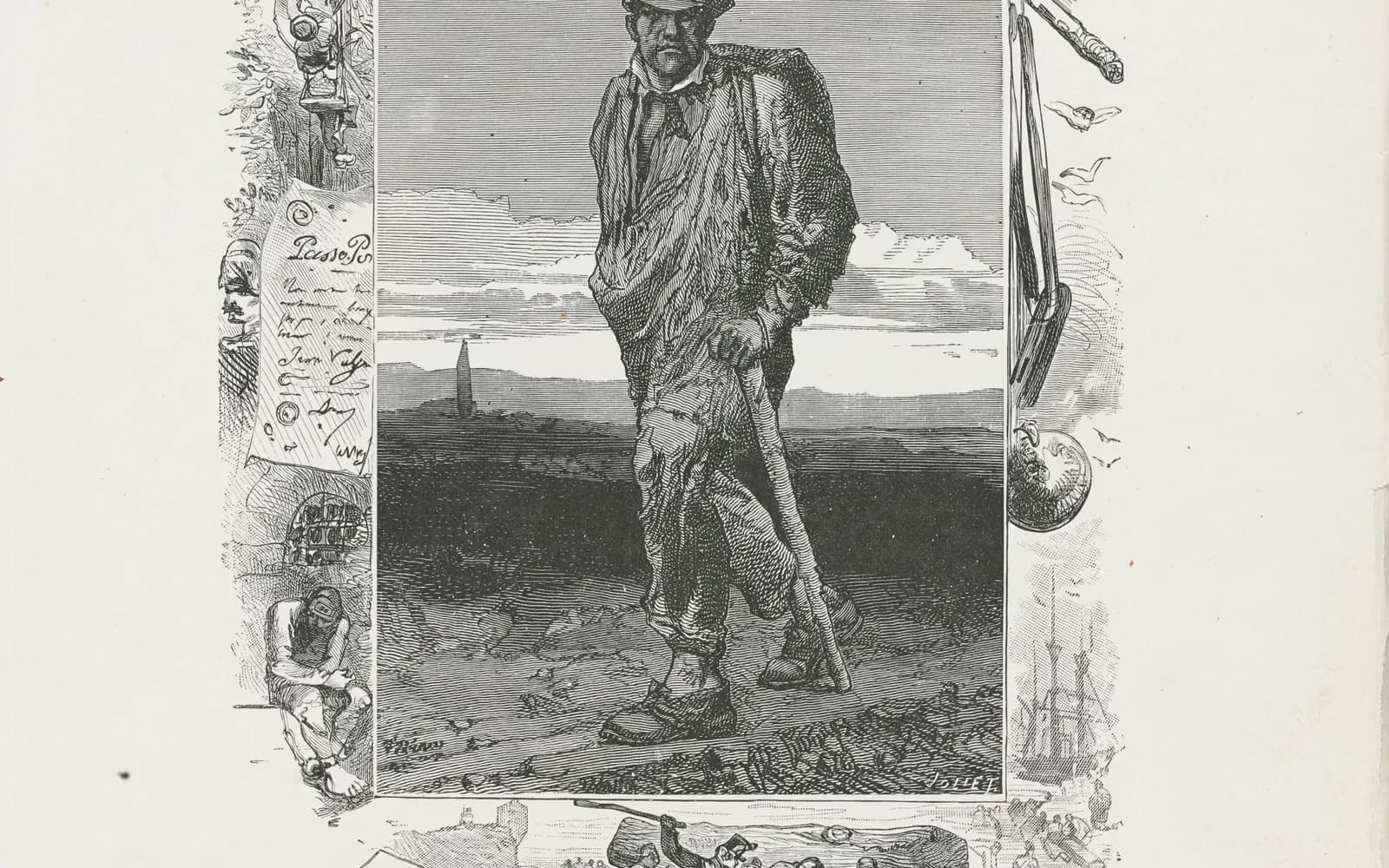
The musical made Les Misérables famous, and it also trained a large number of people to believe they already know the story. They know a convict, a bishop, a dying factory worker, a barricade and a policeman who jumps off a bridge. All of that is in Victor Hugo’s novel. So is a great deal else, and the else is the part worth arguing about.
What follows is the practical version of the question: how long the book actually is, which parts you may skip without guilt, and what the stage show has no room to carry. The same opening is a doorway in the playable Les Misérables, where you decide whether to take the bishop’s silver.
🎭 What the stage version has no room for
The musical is a compression, and a skilful one. What it compresses hardest is the thing Hugo spends his length on: the arguing. The novel stops constantly to make a case about convict labour, about prostitution as an economic outcome rather than a moral failure, about what a monastery is for, about slang as evidence of a buried nation. Those passages are not filler between the songs. They are the reason the songs have anything to be about.
Readers who have done both keep landing on the same verdict, and they put it more plainly than any review does: the tangents are the price and the tangents are also the point. A reader who finished the unabridged text described enjoying it thoroughly even with the hundred-plus pages of historical and architectural detour, which is close to the honest summary of the whole experience.
The second thing the stage cannot carry is interiority. Hugo gives his characters long private chapters in which nothing happens except a person deciding something. The most famous of them is the night before the trial at Arras, where a man who has rebuilt his life debates whether to destroy it to save a stranger. On stage that is a number. On the page it runs for chapters, and it is the best writing in the book.
“To this silverware must be added two large candlesticks of massive silver, which he had inherited from a great-aunt.”
That is the whole inventory of the Bishop’s wealth, set down a full book before Valjean steals any of it. Hugo builds the object first and the theft second, so the mercy in Volume I lands on something the reader has already been shown twice. Compression reverses that order by necessity, and the loss is real.
📏 The length problem, and the two parts you may skip
The unabridged novel is five volumes, 48 books and 365 chapters. Page counts vary by edition and translation and are a poor guide; the chapter count is the same in every complete edition, and it is the number worth knowing. Most people who abandon the book do not abandon it because of the plot. They abandon it inside a digression, roughly where Hugo stops the story to explain something.
There are two famous ones, and they behave differently, so the usual advice to “skip the boring bits” is worse than useless without names attached.
- Waterloo.Volume II opens with a self-contained book of 19 chapters on the battle, written from the field, before any of the novel’s characters arrive on it. Only the last one, “The Battle-Field at Night,” carries a plot connection: a looter robs a wounded officer named Pontmercy, and that transaction matters two volumes later. Read that chapter and skip the other eighteen if you like.
- The sewers of Paris.Volume V has a six-chapter book on the history and engineering of the Paris sewer system, titled “The Intestine of the Leviathan.” It is a genuine essay and genuinely skippable.
- What is not skippable.The book immediately after it, “Mud but the Soul,” runs 12 chapters and is the escape through the sewers with a wounded man on Valjean’s back. People who skip “the sewers” on someone else’s advice frequently skip that too, and it is one of the best sequences in the novel.
- The barricade.Volume V’s first book runs 24 chapters, the longest in the novel, and it is entirely plot. Do not let the reputation for digression make you flinch at it.
Abridged editions exist and they do work, but they solve the problem with a cleaver. If the digressions are what worries you, the unabridged text with two named books skipped gives you more of the novel than any abridgement will, and you keep the option of going back for Waterloo once you care about Marius’s father. Which English translation to read those chapters in is a separate choice, covered in the guide to Les Misérables translations.
🇫🇷 No, this is not the French Revolution
This is the single most common misunderstanding about the book, and the novel settles it in a heading. The uprising in Les Misérables is the June Rebellion of 1832, an anti-monarchist revolt against the government of Louis-Philippe that was crushed in two days. It is not the 1789 Revolution, which ended more than thirty years before the barricade goes up, and which Hugo treats as history his characters inherited rather than events they are living through.
Hugo does not leave this to inference. The book that brings the city to the barricade is titled with its own date, “The 5th of June, 1832,” and the trigger it names is a funeral. General Lamarque, a popular Napoleonic officer and an opposition voice in the Chamber, dies in the cholera epidemic; the question “Are you coming to General Lamarque’s funeral?” passes through Paris as an invitation that everyone understands. The procession traverses the city with official military pomp, the Faubourg Saint-Antoine comes out to meet it, and the shooting starts from there.
Knowing this changes how the barricade reads. These students never ride a revolution that is winning. They are a small, badly armed minority of a movement that has already been abandoned by the city it was raised for, and Hugo tells you the outcome before the first shot, because the outcome is not the point he is making.
📺 If you are going to watch instead
Watching is a legitimate answer, and it helps to know that the versions are not variants of one thing. The stage musical by Alain Boublil and Claude-Michel Schönberg, in the English version Herbert Kretzmer wrote for the 1985 London production, is a sung-through show that keeps the shape of the plot and replaces the argument with music. The 2012 film is that show, filmed, with the songs recorded live on set rather than mimed to a studio track. The anniversary concerts are the score without the staging.
None of those is the novel, and none of them pretends to be. What they share is that they must choose a plot and run it, which means the book they are all adapting keeps the parts none of them can use: the essay on the convict system, the chapters on the convent, the argument about what society owes the people it has already punished. If the songs are what you loved, the fair warning is that the book is slower and the payoff is different in kind.
A last practical note on the controversy the novel arrived with. Two years after publication, in 1864, the Catholic Church placed Les Misérables on the Index Librorum Prohibitorum, its register of forbidden books. Contemporaries were not gentle either; Gustave Flaubert found neither truth nor greatness in it. The complete text is free at Project Gutenberg if you want to judge the digressions for yourself.
Sources
- Les Misérables (Isabel Hapgood translation, Project Gutenberg #135) — Project Gutenberg
- Banned Literature: the Index Librorum Prohibitorum — Loras College Library
- Index Librorum Prohibitorum — Wikipedia
- Actors embrace 'Les Mis' live vibe — Variety
- Les Misérables: contemporary reception — Wikipedia
Frequently asked questions
- How long is Les Misérables?
- A complete edition runs five volumes, 48 books and 365 chapters. The volumes are titled Fantine, Cosette, Marius, The Idyll in the Rue Plumet and the Epic in the Rue Saint-Denis, and Jean Valjean. Page counts swing by hundreds between editions and translations, so the chapter count is the more useful measure.
- Is it okay to skip the Waterloo chapters on a first read?
- Yes, with one exception. The Waterloo book opens on a peasant woman naming the farm of Hougomont and stays on the field for eighteen chapters before any character from the novel appears. Read the nineteenth, which carries the only plot thread, and you lose nothing by leaving the rest for later.
- Is Les Misérables about the French Revolution?
- No. The rising in the novel is the June Rebellion of 1832, and Hugo dates it in the text to the two days of the 5th and 6th of June. The barricade itself stands in the Rue de la Chanvrerie, a real Paris street Hugo says had already fallen into profound obscurity by the time he wrote it up.
- Should I read the abridged or the unabridged version?
- Unabridged, because the skippable parts are findable by name and an abridgement decides for you. Beyond the two long ones this piece names, there is a third and much shorter digression the shortlists usually miss: an eight-chapter book in Volume II called Parenthesis, in which Hugo argues with himself about monasteries.
- Why was Les Misérables controversial when it was published?
- Partly the politics and partly the sympathy. The Church put it on its register of forbidden books in 1864 for its treatment of clergy and authority. Fellow writers were no kinder in private: Baudelaire called it repulsive and inept, and the Goncourt brothers judged it artificial and disappointing.
Enjoyed this one?