Les Misérables Ending Explained: What Happens to Jean Valjean
The musical ends on a barricade full of the dead, singing. The novel ends in a corner of a cemetery nobody walks through, at a stone with nothing written on it. Both are moving, and only one of them is Victor Hugo's.


The musical ends on a barricade full of the dead, singing. The novel ends in a corner of a cemetery nobody walks through, at a stone with nothing written on it. Both endings are moving and only one of them is Victor Hugo’s, and the difference is larger than a change of staging.
Everything below is quoted from the free Project Gutenberg edition of the Isabel Hapgood translation, with the volume, book and chapter attached. The same final week is a doorway in the playable Les Misérables, where you decide how much of the truth Valjean tells before the end.
Spoilers for the whole novel, including its last chapter and how it ends.
🕯️ What actually happens in his last hours
The final book of the novel is called “Supreme Shadow, Supreme Dawn” and runs six chapters. Valjean has removed himself from Cosette’s life on purpose, having told Marius what he is, and he is dying alone in a rented room when the two of them arrive. What kills him is not an illness the book names. Hugo tracks it as a withdrawal instead: one day he walks three steps down the street and sits on a post, the next day he does not leave the apartment, the day after that he does not leave the bed. His portress notices the food untouched and the water jug empty, and he tells her he is only hungry for water.
The scene that follows is domestic and almost entirely practical. He tells Cosette her mother’s name and asks her to kneel whenever she says it. He points at the two silver candlesticks on the chimney-piece and asks that they go to her. He gives instructions about money. He says one sentence about love that the whole book has been walking toward, and a separate essay quotes it in full and explains why it is not the line most people expect.
Then he says “I die happy,” asks them to come nearer so he can put a hand on each of their heads, and the hands stop moving. Hugo records the candlelight on his face, writes the three-word sentence “He was dead,” and allows himself exactly one line of consolation afterwards: the night is starless, and no doubt some immense angel was standing in the dark with its wings out, waiting. One sentence, hedged with “no doubt,” and then the chapter is over. That is the whole of the afterlife in this novel.
🪨 The grave, which is the real last scene
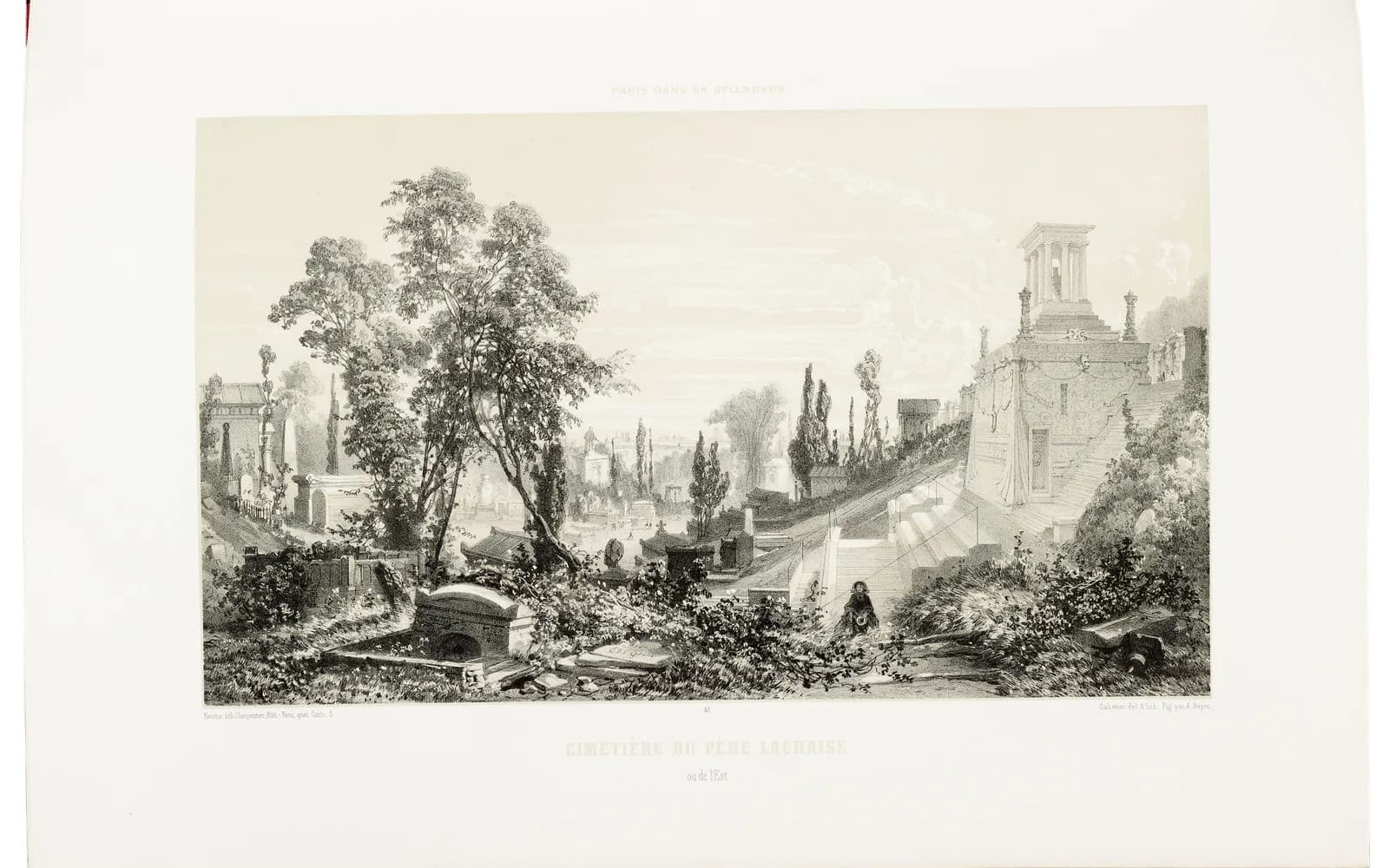
Most summaries stop at the deathbed. Hugo does not. He gives the book one more chapter, called “The Grass Covers and the Rain Effaces,” and spends it describing a location rather than a person. The stone is in the cemetery of Père-Lachaise, near the common grave, deliberately far from the fashionable quarter of that city of tombs, in a deserted corner beside an old wall under a yew tree. Nobody walks there because the grass is high and soaks your feet.
“This stone is perfectly plain. In cutting it the only thought was the requirements of the tomb, and no other care was taken than to make the stone long enough and narrow enough to cover a man. No name is to be read there.”
Someone did write on it, once, in pencil: four lines of French verse about a man who slept, who lived, and who died when he no longer had his angel. Hugo reports them and then reports that the rain and the dust have been working on them for years and that they are probably gone by now. Those four lines are the last words of the novel. The book closes on an epitaph in the act of disappearing.
This is a deliberate ending rather than a modest one. Hugo has spent five volumes arguing that society erases people, and the final image is the erasure happening to the man who beat it, on his own terms, in a corner he chose. It is the most severe thing in the book and it is completely unadaptable, which is why no staged version has tried.
🌊 Where Javert is, and why he is not at the bedside
A reasonable number of people finish an adaptation expecting Javert somewhere in the last scene, and the novel makes that impossible. He dies five books earlier, in Volume V, in a book titled “Javert Derailed” that contains exactly one chapter. It is the only single-chapter book in the entire novel, which is Hugo’s way of saying this is one continuous event with no room to breathe in it.
What the chapter describes is a man walking to the river. He leans on a parapet over the rapids, stands motionless for several minutes looking at the water, takes off his hat and sets it on the edge of the quay, and goes over. A passer-by at a distance would have taken the shape for a phantom. Then there is a splash, and Hugo says only that the darkness alone knew what happened to the form beneath the water.
- Order of events.Javert dies in Volume V, book four. Valjean dies in Volume V, book nine. Four books, and the whole of Marius and Cosette’s marriage, sit between them.
- No reconciliation scene. They never speak again after Javert lets him go. There is no forgiveness exchanged and no final confrontation, in either direction.
- Why he does it is the one genuinely arguable question in the book, and a separate essay makes the full case rather than compressing it into a line here.
🎼 Why the staged ending looks so different
The stage musical does not end at the stone. Its Epilogue brings the dead back: Fantine and Éponine appear to guide Valjean out, they sing him the line about seeing the face of God, and the company returns for a reprise of “Do You Hear the People Sing?” on a barricade. That sequence belongs to Herbert Kretzmer’s English version of the show, first staged in London in 1985, and the 2012 film inherits it rather than inventing it.
It is a good ending for a piece of theatre and it does something Hugo’s refuses to do, which is answer the question. The novel leaves you at a nameless stone with weeds on it and lets you decide whether the life was redeemed. The show tells you it was, out loud, in four-part harmony, and sends you home. Neither is a mistake; they are two different art forms solving the same last page.
One misreading worth clearing while we are here. Valjean’s devotion to Fantine is not romantic in the novel and never becomes so. She dies in Volume I, in a book called “A Counter-Blow,” after extracting one promise about her daughter, and the two of them never meet again. Everything Valjean does for the next four volumes is that promise being kept. The complete text is free at Project Gutenberg if you want to read the last two chapters straight through.
Sources
- Les Misérables (Isabel Hapgood translation, Project Gutenberg #135) — Project Gutenberg
- Les Misérables (musical): synopsis and Epilogue — Wikipedia
Frequently asked questions
- Does Jean Valjean die at the end of Les Misérables?
- Yes, in bed, of no named illness, with Cosette and Marius beside him. The chapter is titled "A Night Behind Which There Is Day," and the one after it leaves him in the ground. He is the last of the novel's principals to die and the only one who chooses the manner of it.
- Did Valjean fall in love with Fantine?
- No. They meet when he is the mayor of the town her factory is in and she is one of its dismissed workers, and she dies there without ever learning what he used to be. She had already left Cosette at an inn in Montfermeil and never saw her again. What follows is a promise kept, not a romance.
- What happens to Javert in the book?
- He drowns himself in the Seine hours after Valjean spares his life, and it happens five books before Valjean's own death. The books in between are ordinary domestic ones, starting with Grandson and Grandfather, in which a marriage is arranged. The novel simply moves on without him.
- Is Javert present when Valjean dies, the way some adaptations suggest?
- He cannot be. Valjean dies in a rented room at Number 7, Rue de l'Homme Armé, long after Javert is dead, and no adaptation that brings a policeman to that bedside is following the book. The figures the staged version returns at the end are women from earlier in the story, not Javert.
- What is the actual famous line at Valjean's death?
- Not the one people quote. The novel's real last words are four lines of French pencilled onto the stone by an unknown hand, beginning "Il dort" — he sleeps — which Hugo says the rain has probably already erased. The line everyone knows belongs to a lyricist, and a separate essay here traces it.
Enjoyed this one?