“To Love Another Person Is to See the Face of God”: Is This Line Actually in the Book?
It is printed on greeting cards and read at weddings, and Victor Hugo did not write it. That is not a gotcha about a bad adaptation. It is a remarkable thing to have happened to a novel, and the sentence Hugo put in the same place is worth knowing.


It is the most quoted sentence in Les Misérables, it is printed on greeting cards and read at weddings, and Victor Hugo did not write it. That reads like a gotcha about a bad adaptation, and it is something stranger: a fairly remarkable thing to have happened to a novel, and the sentence Hugo put in the same place is worth knowing.
The check below is mechanical and repeatable: a search of the complete free Project Gutenberg text of the Isabel Hapgood translation, joined across its line wraps so that no phrase can hide in a line break. The deathbed itself is a doorway in the playable Les Misérables, where what Valjean says last depends on what he admitted earlier.
Spoilers for the death scene, which is where the famous line is usually placed.
🎼 Whose line it actually is
The line closes the Finale of the sung stage version. In the show the dead return for the last number, and Fantine and Éponine are the ones who deliver it to Valjean as he goes; the 1985 English-language production is where it enters the story, with lyrics by Herbert Kretzmer working from Alain Boublil and Claude-Michel Schönberg’s French original.
Two things follow from that date. The first is that the 2012 film did not invent it; the film is a screen version of a stage show that had been closing on that couplet for twenty-seven years. The second is that anyone attributing it to Hugo is off by more than a century, which explains why it turns up in quotation collections filed under the novel and never with a chapter attached. There is no chapter to attach.
- The search.“Face of God” returns zero matches in the Hapgood translation, case-insensitive, with the text’s hard line wraps removed first so the phrase cannot be split across two lines.
- The control.The same scan finds Valjean’s convict number, printed as 24,601, three times, which is how we know the method is not simply failing to find things.
- The nearest real thing. Hugo does write about seeing God and about love in the same book, at length, and never in that formulation, and not at the deathbed.
🕯️ What Hugo wrote instead
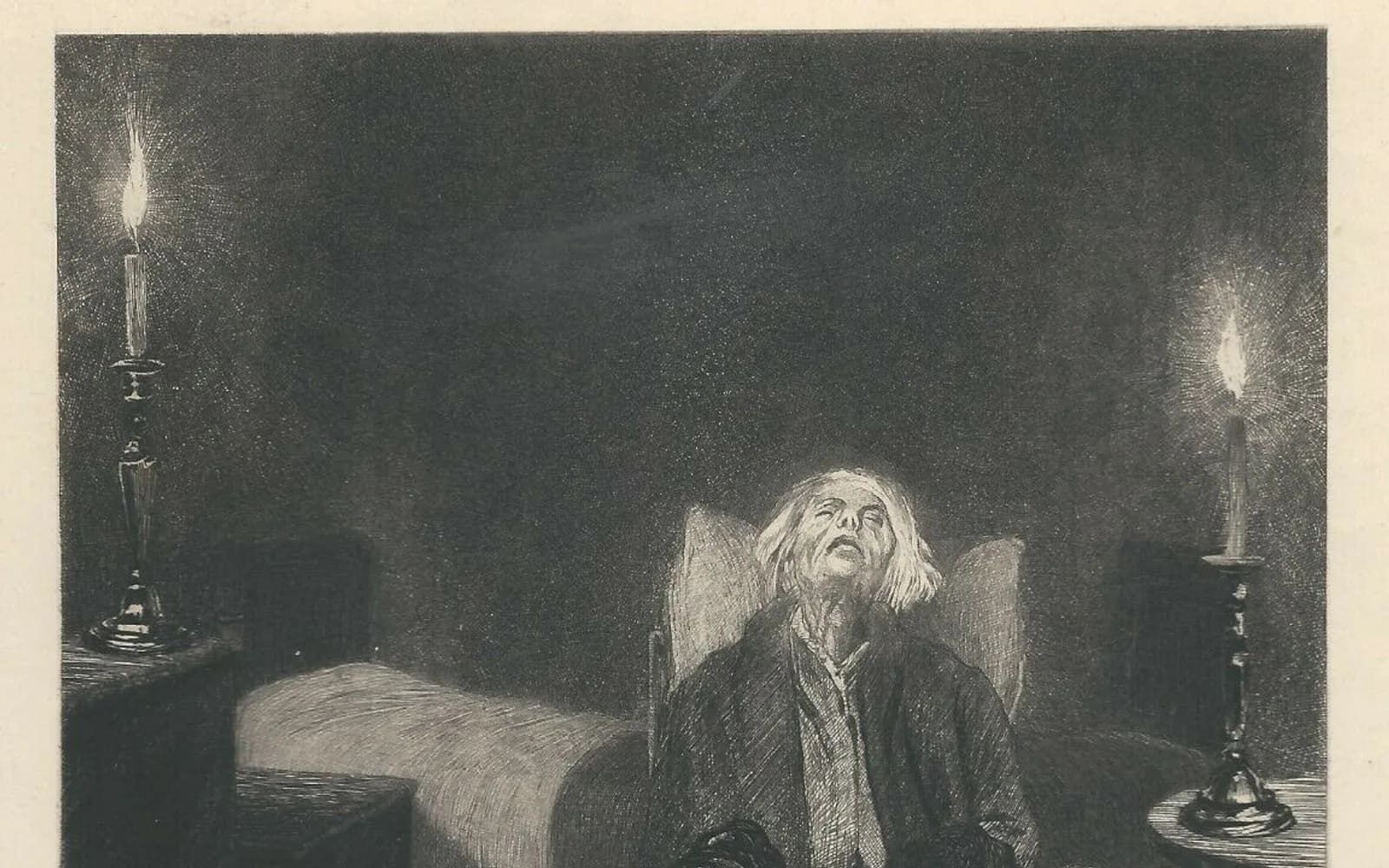
The real scene is in the fifth chapter of the novel’s last book. Valjean is dying in a rented room with the Bishop’s two silver candlesticks burning on the chimney-piece, and Cosette and Marius have arrived in time. He spends most of his last speech on practical things: the money, the candlesticks, where they came from. Then he tells Cosette her mother’s name, which she has never been told.
“Cosette, the moment has come to tell thee the name of thy mother. She was called Fantine. Remember that name—Fantine. Kneel whenever thou utterest it. She suffered much. She loved thee dearly.”
And then, a few sentences later, the line that does the work the famous lyric does, without any of the theology.
“I am on the verge of departure, my children. Love each other well and always. There is nothing else but that in the world: love for each other.”
Set the two beside each other and the difference is a claim. The lyric says that loving a person shows you God, which makes love evidence of something larger. Hugo’s dying man says there is nothing else in the world, which is not a route to anything; it is the destination, stated by someone with no time left to hedge it. He follows it with a request that they think of him sometimes, and then with “I die happy.”
The Kretzmer version is the better lyric, and it has to be. A sung finale needs a sentence that lifts, and “there is nothing else but that in the world” does the opposite of lifting. It closes down. Both are honest to the scene they belong to, and only one of them is Hugo.
📚 The Dostoevsky question
A second sentence circulates near this one and gets tangled with it: “To love someone means to see them as God intended them,” usually credited to Fyodor Dostoevsky. People searching for the Les Misérables line frequently land on that one instead, which is how the two came to be treated as versions of each other.
They are not the same sentence and they do not say the same thing. One is about love revealing God, the other about love revealing a person’s intended self. As for whether Dostoevsky wrote his, the honest position is that the attribution circulates everywhere and traces to no work, chapter or letter that this check could find. That is a statement about the available evidence rather than a verdict on the man.
What can be settled is the Les Misérables half, and it is settled above: the line is Kretzmer’s, the novel does not contain it, and the novel’s own deathbed sentence is on the record with a volume, a book and a chapter attached.
💬 Why it is still worth quoting
None of this makes the line a fraud. A great many works acquire sentences after the fact, and the test is whether the addition is faithful to what the original was arguing. This one is. Hugo spends five volumes on the proposition that a single act of undeserved kindness can rewrite a life, and the whole machine of the book runs on a bishop who hands a thief the silver he stole and two candlesticks he did not.
So quote it. Quote it at the wedding. The only correction worth making is the byline: it belongs to a lyricist in 1985 rather than a novelist in 1862, and the man in the novel says something quieter and arguably harder at the same moment. Both belong to the story now, and the essay on the ending covers what the novel does in the chapter after this one, which is stranger than either. The complete text is free at Project Gutenberg.
Sources
- Les Misérables (Isabel Hapgood translation, Project Gutenberg #135) — Project Gutenberg
- Les Misérables (musical): the Epilogue and its lyricists — Wikipedia
- Les Misérables (2012 film) — Wikipedia
Frequently asked questions
- Is “to love another person is to see the face of God” in the Les Misérables book?
- No. It is a lyric from the show's Finale. The show began as a French concept album in 1980 with words by Alain Boublil and Jean-Marc Natel, staged that year at the Palais des Sports in Paris, and Herbert Kretzmer wrote the English lyrics later. Hugo's novel predates all of it by more than a century.
- Where does the line actually come from?
- From the English-language stage production that opened at the Barbican in London in October 1985, where it closes the Finale. In performance it is delivered to Valjean by the dead rather than spoken by him, which is why so many people remember it as something said over him at the end.
- Did Dostoevsky say something similar?
- A sentence about seeing someone as God intended them circulates under his name, usually gestured toward Karamazov and never quoted with a chapter or a translator. We could trace it to no work, letter or edition, so this piece reports the confusion and declines to rule on the attribution.
- What does the real final chapter of the novel say?
- It describes a stone. The chapter is called “The Grass Covers and the Rain Effaces,” and it spends its length on weeds, lizards and a slab cut to no measurement except the length of a man. A separate essay here walks through that chapter and what the staged ending does instead.
- Is there anything similar to the quote in Hugo's actual text?
- Yes, a few sentences earlier in the same speech, and it is plainer: love each other well and always, because there is nothing else but that in the world. It sits in a chapter Hugo titles “A Night Behind Which There Is Day,” which is as close as the novel gets to the sentiment the lyric states outright.
Enjoyed this one?