Les Misérables: Novel vs. Musical — What the Show Left Out
"Nineteen years for a loaf of bread" is the headline everyone carries out of the theatre, and it is not the whole sentence. Hugo does the arithmetic out loud, twice, and the answer changes what Valjean's parole actually means.


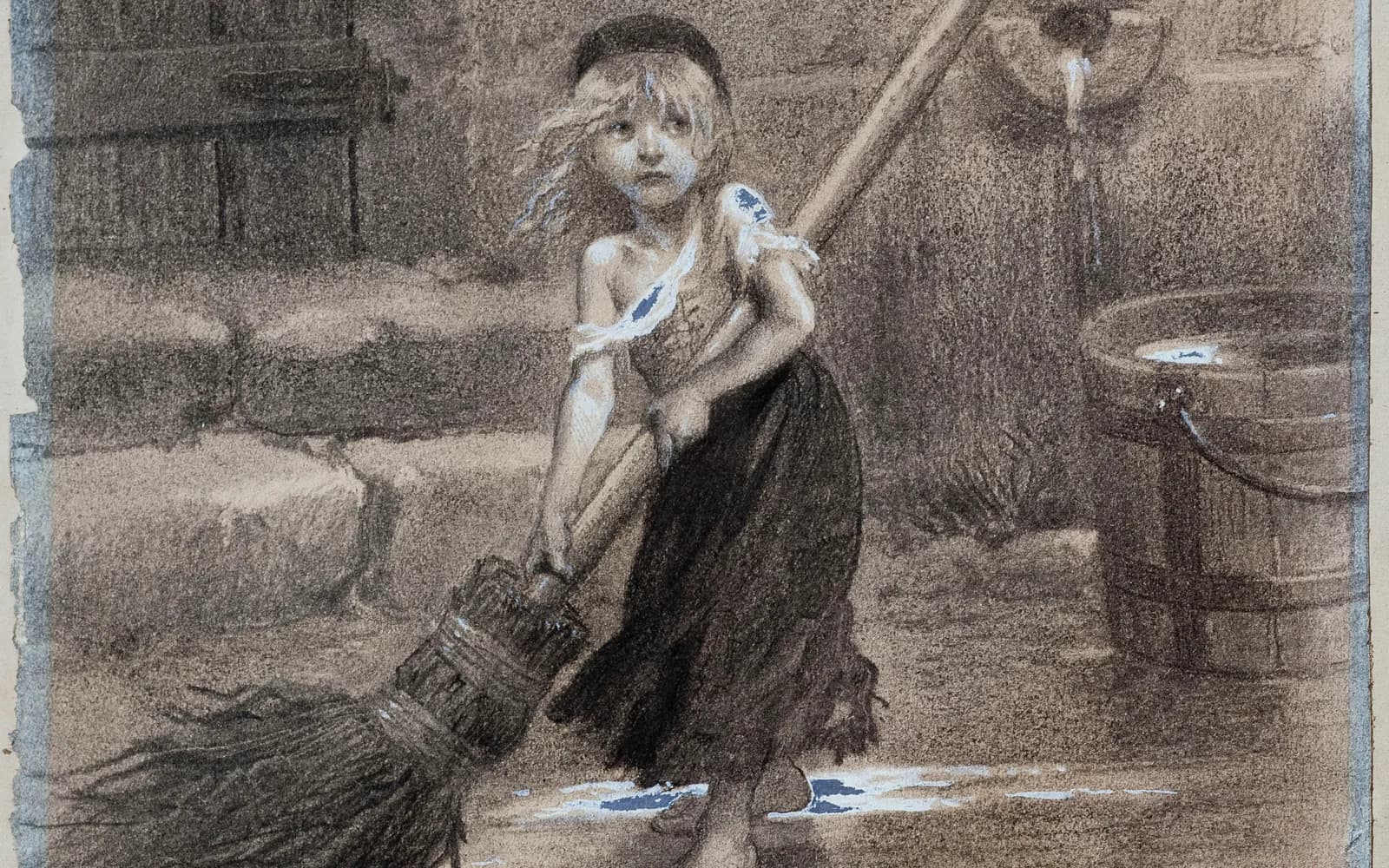
“Nineteen years for a loaf of bread” is the headline everyone carries out of the theatre. It is also not the whole sentence, and the missing part is the part that explains the man. Victor Hugo’s novel does the arithmetic out loud, twice, and the answer changes what Valjean’s parole actually means.
What follows compares the novel with the sung stage version and with the 2012 film, medium by medium, using the free Project Gutenberg text of the Isabel Hapgood translation for anything claimed about Hugo. The factory where the comparison starts is a doorway in the playable Les Misérables, where the dismissal is yours to sign or refuse.
Spoilers throughout, including the ending of both the novel and the show.
🔢 Why nineteen years, really
The original sentence is five years. Hugo states the charge precisely, and it is not a sentimental one: theft with breaking and entering an inhabited house at night. The mechanics of that charge are a broken window pane and a loaf of bread taken through it, for a widowed sister’s seven children. The law of the day did not care about the children, and the novel makes the coldness of that a whole page.
The other fourteen years arrive one attempt at a time, and Hugo does the sums in the text as if reading a ledger aloud.
- Year four. He escapes, wanders two days, is captured having neither eaten nor slept for thirty-six hours. Three years added. Eight in total.
- Year six. He escapes again, is found hidden under the keel of a ship under construction, and resists the guards who seize him. Escape and rebellion together carry five years, two of them in the double chain. Thirteen.
- Year ten. Another attempt, no better. Three more. Sixteen.
- Year thirteen. A last attempt, retaken after four hours of absence. Three years for those four hours. Nineteen.
By the time he walks out he is carrying a yellow passport that summarises the whole thing for any innkeeper who can read: nineteen years in the galleys, five for house-breaking and burglary, fourteen for having attempted to escape on four occasions, and a closing judgement that he is a very dangerous man.
“Jean Valjean, discharged convict… has been nineteen years in the galleys: five years for house-breaking and burglary; fourteen years for having attempted to escape on four occasions. He is a very dangerous man.”
The compressed version is not a lie, and it is a different story. A man given nineteen years for bread is the victim of one monstrous verdict. A man given five years for bread and fourteen more for refusing to serve them is something the novel is much more interested in: a person whose punishment is mostly a punishment for resisting punishment.
🏷️ 24,601 is Hugo’s number, and that surprises people
The number is so bound up with the stage show that it is regularly assumed to be an invention of it. It is not. Hugo assigns it on the day Valjean reaches Toulon, in a sentence about erasure: everything that made up his life was effaced, even his name, and he was no longer even Jean Valjean, he was number 24,601. Hapgood’s English prints it with a comma, which is why a careless search of the text misses it.
Hugo then does something the show has no room for. He gives Valjean a second number. After the recapture, one chapter of Volume II is titled “Number 24,601 Becomes Number 9,430,” and a later chapter is titled “Number 9,430 Reappears, and Cosette Wins It in the Lottery.” A man with two convict numbers is a man the state has filed twice, and the second filing is the one that frees Cosette.
So what did the staged version add? Repetition, and a speaker. In the novel the number appears twice in the whole book, and Javert never once says it out loud. In the sung version Javert uses it as a name, from the Prologue onward, and that single change does most of the work of turning a filing reference into a character-defining taunt. The show made the number famous by putting it in the mouth of the man Hugo deliberately kept it away from.
🧹 The Cosette the show has no time for
Readers who have done both keep making the same complaint, and the text supports them. Stage Cosette is a soprano in a garden. Book Cosette gets a childhood rendered in clinical detail, and the detail is what the songs cannot carry.
She becomes the Thénardiers’ servant before she is five. When Valjean first sees her she is nearly eight and looks barely six. Her eyes are described as almost put out with weeping, her hands are ruined with chilblains, and the corners of her mouth carry the curve Hugo says he has seen on condemned prisoners and the desperately sick. The neighbourhood calls her the Lark, he explains, because she is awake before anyone else in the house or the village and out in the street before daybreak. Then he adds the line the nickname exists for.
“Only the little lark never sang.”
That background is why the later Cosette reads differently on the page. Her happiness in the garden on the Rue Plumet is not a default setting she was born with; it is a skill she is acquiring late, with no practice, in a body that spent its first years being worked. A reader who only knows the show meets a girl in love. A reader of the novel meets someone recovering.
The other cut is harder. Hours after the Bishop hands him the silver and tells him to become an honest man, Valjean robs a small boy. Volume I has a chapter called “Little Gervais,” in which a Savoyard child drops a forty-sou piece, and Valjean puts his foot on it and will not lift it. The boy asks for his money, gives his name when asked, and is driven off crying. Then Valjean spends the rest of the chapter running across the plain shouting that name at nobody, asking strangers which village the child came from, unable to give the coin back. His conversion begins there, and it begins with him as the criminal the Bishop had just forgiven for something smaller.
🎬 What the stage and the screen genuinely added
Adaptations are allowed to invent, and it is worth being precise about which invention belongs to which version.
- The ending. The sung version closes with the dead returning to guide Valjean out and the company reprising the barricade anthem. Hugo closes at a nameless stone, and a separate essay walks through his actual last chapter.
- The famous last line.“To love another person is to see the face of God” is a lyric, not a sentence of Hugo’s, and the essay on that line traces where it came from and what Hugo wrote instead.
- The poster.The waif with the broom is not a design invented for the theatre. It is Émile Bayard’s drawing of Cosette for the novel’s own 1862 edition, adapted into the show’s logo more than a century later.
- The live vocals. The 2012 film had its cast sing on camera to a piano in an earpiece instead of miming to a studio track, which is a filmmaking choice with no counterpart in either the book or the stage show.
One frequently repeated production story has been left out of this post on purpose. The claim that the take of “I Dreamed a Dream” used in the 2012 film was the very first one recorded is repeated widely and could not be confirmed against any production source, so it is not asserted here. What is documented is that Anne Hathaway had her own hair cut off on camera for the scene in which Fantine sells it.
Read against each other, the pattern is consistent. The stage version keeps the plot and drops the argument; the novel keeps the argument and spends four hundred pages on things no stage can hold. The complete text is free at Project Gutenberg if you want to check the sentence arithmetic yourself.
Sources
- Les Misérables (Isabel Hapgood translation, Project Gutenberg #135) — Project Gutenberg
- Jean Valjean: the number 24601 in novel and musical — Wikipedia
- Les Misérables (Musical and Film) Logo — Fonts In Use
- Émile Bayard — Wikipedia
- Actors embrace 'Les Mis' live vibe — Variety
- Les Misérables (2012 film): production — Wikipedia
Frequently asked questions
- Why did Valjean serve 19 years, not just for stealing bread?
- Five years for the theft, fourteen added across four escape attempts. The original conviction is dated 1795 in the text, and the court heard that the accused was a tree-pruner who poached, which Hugo notes told against him. Most of his sentence is punishment for refusing to serve the rest of it.
- Is 24601 Valjean's real convict number in the book?
- Yes. The novel prints it with a comma as 24,601 and titles a chapter after the day it is replaced. Hugo reports that recapture through a mock press clipping dated 25 July 1823, quoted straight into the text. What the stage show added is Javert saying the number out loud, which Hugo never lets him do.
- Is Cosette a different character in the book than in the musical?
- Substantially, because the novel gives her a documented childhood first. Hugo titles his whole fourth volume The Idyll in the Rue Plumet and the Epic in the Rue Saint-Denis, yoking her private life to the coming rising in one heading, and then cuts between the two for three hundred pages.
- Did they actually cut Anne Hathaway's hair in Les Misérables?
- Yes, on camera, for the scene in which Fantine sells it. The performance won her the Academy Award for Best Supporting Actress. A widely repeated story that the take used for her big number was the first one recorded could not be confirmed against any production source, so we do not repeat it.
- What is the biggest thing the musical leaves out?
- The second crime. Hours after Monseigneur Bienvenu gives him the silver, Valjean robs a child of a coin and cannot give it back, and that failure is what actually converts him. The show has the mercy and skips the relapse, which turns a two-step conversion into a single moment of grace.
Enjoyed this one?