Is Javert a Villain or a Tragic Figure in Les Misérables?
Javert never breaks a rule in five volumes. He is honest, incorruptible, and when he decides he has wrongly denounced his own mayor he demands to be dismissed for it. That record is exactly what kills him.


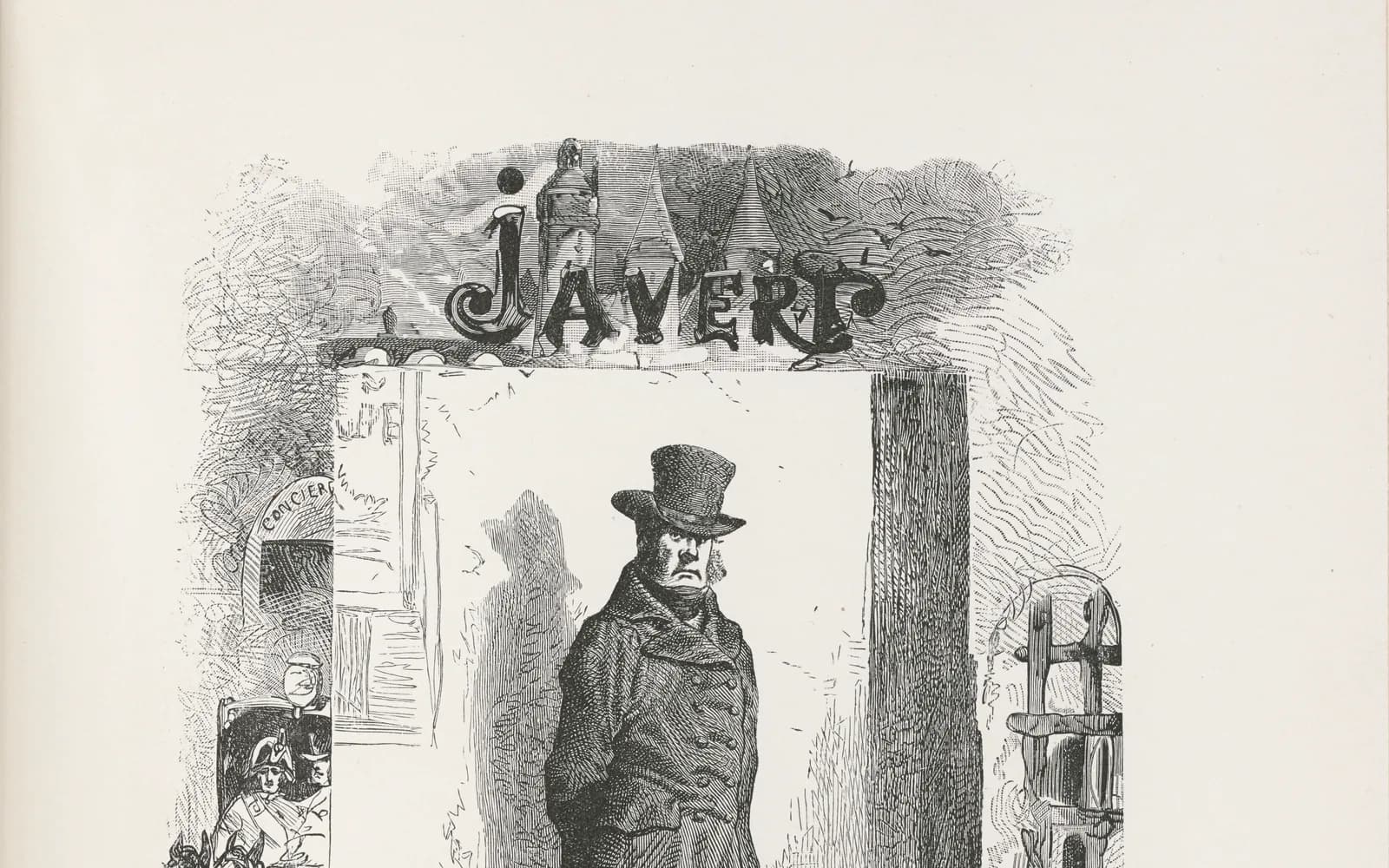
Javert never breaks a rule. Not one, in five volumes. He is punctual, honest, incorruptible, and when he decides he has wrongly denounced his own mayor he walks into that mayor’s office and demands to be dismissed for it. That record is exactly what kills him, and it is why the villain question has never settled.
Everything below is quoted from the free Project Gutenberg edition of the Isabel Hapgood translation, with the volume and book attached. The night on the quay is a doorway in the playable Les Misérables, where you can walk him away from the parapet or let him stand there.
Spoilers for the inspector's last night, including how his story ends.
🐕 The short answer, in Hugo’s own terms
Hugo does not leave the reader to infer Javert’s moral architecture. He states it, in a passage in Volume I that reads like a specification sheet. Javert, he writes, was composed of two very simple and two very good sentiments, which he rendered almost bad by exaggerating them: respect for authority, and hatred of rebellion. In his eyes murder and robbery are only species of the second one.
“He was absolute, and admitted no exceptions. On the one hand, he said, ‘The functionary can make no mistake; the magistrate is never the wrong.’ On the other hand, he said, ‘These men are irremediably lost. Nothing good can come from them.’”
Those two sentences are a working definition of a villain and a working definition of a saint at the same time, depending on whether the machine he trusts is a good one. Hugo’s Javert is not a sadist in a uniform; he is a man who has handed his conscience to an institution and genuinely believes that is the humble thing to do. The narrator calls him a watchdog when serious and a tiger when he laughs, and notes that the laugh was rare.
⚖️ Why it was never personal
The pursuit reads as a grudge and the novel says otherwise, in one sentence that explains the entire character. Javert was born in a prison, to a fortune-teller whose husband was in the galleys. He grew up understanding that society permanently excludes two kinds of people, those who attack it and those who guard it, and that he had a choice between exactly those two and nothing else.
He chose the guard. Then he spent a career hunting the class he came out of, carrying what Hugo calls an inexpressible hatred for the people he was sprung from. No personal slight drives any of it. He has to keep proving, arrest after arrest, that the line he crossed was real and that he is standing on the correct side of it.
Which is why Valjean is unbearable to him specifically. A convict who becomes a mayor, runs a factory, endows a hospital and is loved by a town stops being a fugitive and becomes a refutation. Every year Valjean stays free and good is a year in which the sentence “nothing good can come from them” is false, and Javert built a life on that sentence being true.
🌉 The night the system fails
The break happens at the barricade, and Valjean does it with a clasp-knife and three words. Javert has been captured by the students and tied up; Valjean asks for the job of shooting him, takes him into an alley, cuts the cord at his neck, his wrists and his feet, and says “You are free.” Then, because that is apparently not enough, he tells Javert where he lives, by street and house number, in case Javert wants to come and collect him later.
Javert does come, hours later, and finds Valjean carrying a wounded man out of the sewers. He puts him in the hired carriage he arrived in and rides home with him, then pays the driver four napoleons to go. Then he walks away from the door he is supposed to knock on, and Hugo gives him a book of his own to do it in. “Javert Derailed” is the only book in the novel that contains a single chapter, and the compression is the point: one man, one night, no way out.
He stops at the Seine between the Pont Notre-Dame and the Pont au Change, at a stretch of rapid the narrator notes is dreaded by mariners, where men who fall in never reappear and the best swimmers drown. He leans on the parapet and works the problem. Hugo puts the collapse in six words: for several hours, Javert had ceased to be simple.
“Was this to be endured? No. There were only two ways of escaping from it. One was to go resolutely to Jean Valjean, and restore to his cell the convict from the galleys. The other....”
And then he does the most revealing thing in his entire life, which almost every adaptation cuts. He does not go to the river. He goes to the police post at the Place du Châtelet, sits down at the standard-issue table with the standard-issue inkstand, and writes a memorandum headed “A Few Observations for the Good of the Service.” It runs to ten numbered items.
- Item two. Prisoners are made to stand barefoot on flagstones while they are searched, and many of them cough afterwards. He notes that this creates hospital expenses.
- Item four. The prison of the Madelonettes forbids a prisoner a chair, even one he offers to pay for, and Javert writes that this is inexplicable.
- Item six. Prisoners who call other prisoners to the visiting room extract two sous for saying the name clearly. He writes, flatly, that this is a theft.
- Item seven. The weaving shop withholds ten sous for a broken thread. He calls it an abuse by the contractor, on the grounds that the cloth is none the worse for it.
He signs it Inspector of the 1st class, dates it the seventh of June, 1832, about one in the morning, dries the ink, folds it like a letter, seals it, writes Note for the administration on the back and leaves it on the table. Then he walks back to the same paving-stone on the parapet and finishes. The final act of the most rigid man in French literature is a list of ways to treat prisoners slightly better, which is not the paperwork of a villain.
💬 The reading that keeps coming up
Ask about Javert online and one question arrives within three replies: was he in love with Valjean. It is worth answering rather than pretending it is not asked. The novel supplies no basis for it. What it supplies is a fixation that Hugo describes exclusively in the language of law, category and system, and a man who explicitly cannot separate his feelings about Valjean from his feelings about the penal code.
The reading survives because the emotional intensity is real and the stated cause looks too small to carry it. That mismatch is genuinely in the text; the explanation Hugo gives for it is professional rather than romantic, and the argument in his own words is the one above. A reader is free to find that insufficient. The book does not offer a second account.
As for a redemption arc, there is none, and its absence is deliberate. Javert is granted the insight and killed by it in the same night. He never gets a scene in which he says he was wrong, and the essay on the ending covers why he cannot be present at Valjean’s deathbed, in the novel or anywhere else. The complete text is free at Project Gutenberg if you want the memorandum in full.
Sources
- Les Misérables (Isabel Hapgood translation, Project Gutenberg #135) — Project Gutenberg
Frequently asked questions
- Why does Javert kill himself?
- Because Valjean's mercy makes both of his available options impossible: arresting a man who saved him, or letting a convict go. The memo he writes first ends on a tenth item objecting that a woman keeps the wicket to the secret cells at the Conciergerie, which he calls unworthy of a great civilisation.
- Is Javert a villain in the book?
- Genuinely contested, and the novel is on the side of no. He is an antagonist without malice, formed by years in the convict establishments of the South before he ever joined the police. Readers split because he causes enormous harm while never once enjoying it, which is not how villains are usually built.
- Did Javert hate Valjean personally?
- No, and his own origin explains why. Hugo sets out the whole character in Book Fifth of Volume I: a man born in a prison who spent a career proving he belonged on the guard's side of the wall. Valjean is unbearable to him as evidence rather than as a person, which is colder than a grudge.
- Was Javert in love with Valjean?
- The novel gives no basis for it. Hugo spends his one descriptive passage on a face, noting that the inspector had "very little skull and a great deal of jaw", and describes the fixation itself only in the language of law and category. The reading persists because the intensity is real and the stated cause looks small.
- Does the novel give Javert a redemption arc?
- No, and it denies him even a scene of aftermath. His death reaches the story as a newspaper item: Valjean later reads in the Moniteur that a police inspector named Javert had been found drowned. He is given the insight and killed by it inside one chapter, and the book files the result.
Enjoyed this one?