Is Scrooge the Villain of A Christmas Carol, or Just Its Victim?
The book hands its cruellest description to a man and then hands its real accusation to two children standing under a spirit’s robe.


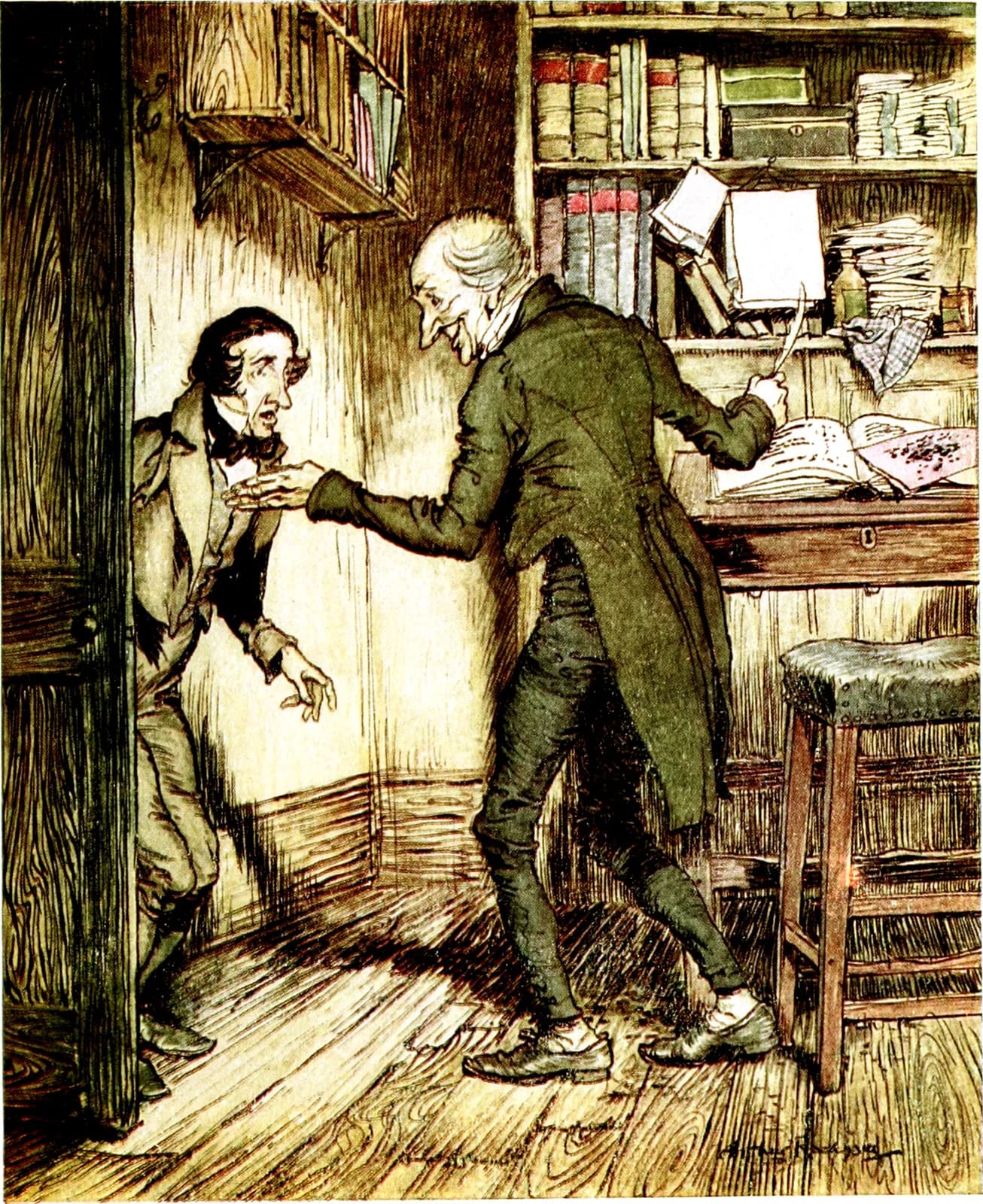
Search for this question and the results split, which is unusual for a book this famous. Part of the confusion comes from the adaptations, where a miser is easier to stage as a monster, and part of it comes from the fact that the reader of the playable A Christmas Carol spends four of its five staves inside the head of the man they are supposed to be condemning.
🧊 What the book actually says about him
The famous opening description is a list of six adjectives and then a weather report. Dickens calls him a squeezing, wrenching, grasping, scraping, clutching, covetous old sinner, and then spends longer on the physical cold he carries around than on anything he has done to anybody, so the charge that paragraph actually lays against him is one of temperature.
He carried his own low temperature always about with him; he iced his office in the dog-days; and didn’t thaw it one degree at Christmas.
“Sinner” is the strongest word in the sentence, and it is theological vocabulary, which matters for a story that ends in forgiveness. A villain in the ordinary sense wants something at somebody else’s expense and schemes to get it. Scrooge’s whole programme is the refusal of exchange, and the book’s reference entry in the standard account of the character describes him as the novella’s protagonist, which is the part the plot actually gives him: he is the one the story changes, and everyone else is there to change him.
🕯️ He hoards money he will not spend on himself
This is the detail most screen versions flatten, and it is the one that decides the question. A greedy man buys things. Scrooge takes his melancholy dinner in his usual melancholy tavern, climbs a dark staircase because darkness is cheap and he likes it, and sits in rooms warmed by a fire the narrator describes as very low indeed on a bitter night.
- No luxury. Nothing in Stave I shows him enjoying a single thing his money could buy, which is why the fortune never looks like a motive: it reads as a symptom of the condition the first paragraph spends its whole length describing.
- No accomplices. He has no gang, no rival and no plot; the only relationship the book gives him is an employee and a nephew, and both of them keep trying to include him.
- No plan.He is not withholding the clerk’s coal in pursuit of anything, and the narrator’s own explanation for it is habit, and the cold that comes with him.
A man who denies himself as thoroughly as he denies everybody else is being described as damaged, and the book confirms that reading in Stave II by sending him back to a schoolroom and a sister before it sends him anywhere near a grave.
The Counting-House Threshold is a doorway in the playable A Christmas Carol: the fire is low, the clerk is hoping out loud for his one day off, and you can play the man who says no, the clerk who asks anyway, or the visitor who tries to argue him out of it. Role-play A Christmas Carol →
👧 Dickens gives his real antagonist a face, and two names
Halfway through Stave III the Ghost of Christmas Present opens his robe and produces two children who have been travelling under it the whole time. They are the only figures in the book the narrator describes with real disgust, and the spirit’s speech about them is the closest thing the novella has to a thesis statement.
“This boy is Ignorance. This girl is Want. Beware them both, and all of their degree, but most of all beware this boy, for on his brow I see that written which is Doom, unless the writing be erased.”
The line just before that one settles the ownership question. Asked whose children they are, the spirit answers that they are Man’s, and that they cling to him appealing from their fathers, which puts the blame on a whole society, and on the fathers those children are appealing from. Wikipedia’s account of the novella records that the pair were inspired by children Dickens had seen at a ragged school, which means the two figures under the robe began with children Dickens had seen in a real classroom.
🔁 The sentence the spirit throws back at him
Scrooge tells the charity collectors in Stave I that the poor who would rather die had better do it and decrease the surplus population. The Ghost of Christmas Present repeats that sentence back to him in Stave III at the Cratchits’ table, moments after telling him that the child will die if the shadows remain unaltered, then closes the Ignorance and Want scene by returning the other half of his performance, the demand to know whether there are prisons and workhouses, and the narrator marks the move as turning on him for the last time with his own words.
Nothing is added to the wording. Dickens simply moves the line into a room where its consequences are visible, and the effect is to convict Scrooge of repeating a sentence he had never once examined. Where those phrases came from, and what they meant to a reader in 1843, is the subject of its own essay.
⚖️ Why the verdict is still split
The honest answer is that the book supports a harder reading than the one this essay has made, and a reader who wants it can find it. Scrooge does real damage in the present tense of the story: an underheated office, a refused invitation, a family counting coins on Christmas Eve because of what he pays. A novel that asks its audience to forgive a man inside five short staves has to make the offence visible before it asks for anything.
What it never does is give him the equipment of a villain. He does not deceive anyone, he does not enjoy the suffering he causes, and the two figures Dickens actually asks the reader to beware are a boy and a girl with nothing, held up by a spirit who says they belong to everybody in the room, including the reader.
Sources
- A Christmas Carol (Project Gutenberg eBook #46, 1843 text) — Project Gutenberg
- Ebenezer Scrooge — Wikipedia
- A Christmas Carol — Wikipedia
- Charles Dickens — Wikipedia
Frequently asked questions
- Is Scrooge considered a villain?
- Rarely, in the reference literature. He is usually treated as a study of a recognisable type, drawn from men who existed: the standard account of the character names the miser John Elwes, whom Dickens mentioned in his letters, alongside Daniel Dancer and the Gloucester banker Jemmy Wood as figures the portrait may have drawn on.
- Is Scrooge an antagonist or protagonist?
- Protagonist. The whole book is arranged around his point of view, and there is no rival character working against him at any point. The measure of how completely he carries the story is that his surname entered English as a byword for greed and misanthropy, which is not something that happens to a supporting villain.
- How might someone describe Scrooge?
- Dickens does it in one sentence and the images are all about hardness and isolation: hard and sharp as flint, from which no steel had ever struck out generous fire, and secret, self-contained, and solitary as an oyster. Every adjective in it describes a closed surface, which is the argument the description is making: the man is shut, and the greed is a consequence of that. The same paragraph then turns the cold outward: “The cold within him froze his old features, nipped his pointed nose, shrivelled his cheek, stiffened his gait; made his eyes red, his thin lips blue.”
- What is the significance of Ignorance and Want?
- They turn a personal fault into a public one. After the spirit names them Scrooge asks whether they have no refuge or resource, and the answer is his own question from Stave I handed straight back, which converts the scene from a lesson about one man's meanness into an indictment of the system he has been quoting. The spirit finishes by turning on the reader as well: “Slander those who tell it ye! Admit it for your factious purposes, and make it worse. And bide the end!”
- What does 'this boy is Ignorance, this girl is want' mean?
- That society manufactures both of them, and then walks past the result. Dickens describes the pair as “Yellow, meagre, ragged, scowling, wolfish; but prostrate, too, in their humility”, so the reader is asked to find them frightening and pitiable in the same breath.
Enjoyed this one?