A Christmas Carol Characters Guide: Every Ghost, Explained
One of the four spirits in this book is given no dialogue at all, and the silence is doing more work than the skeleton hand ever does.


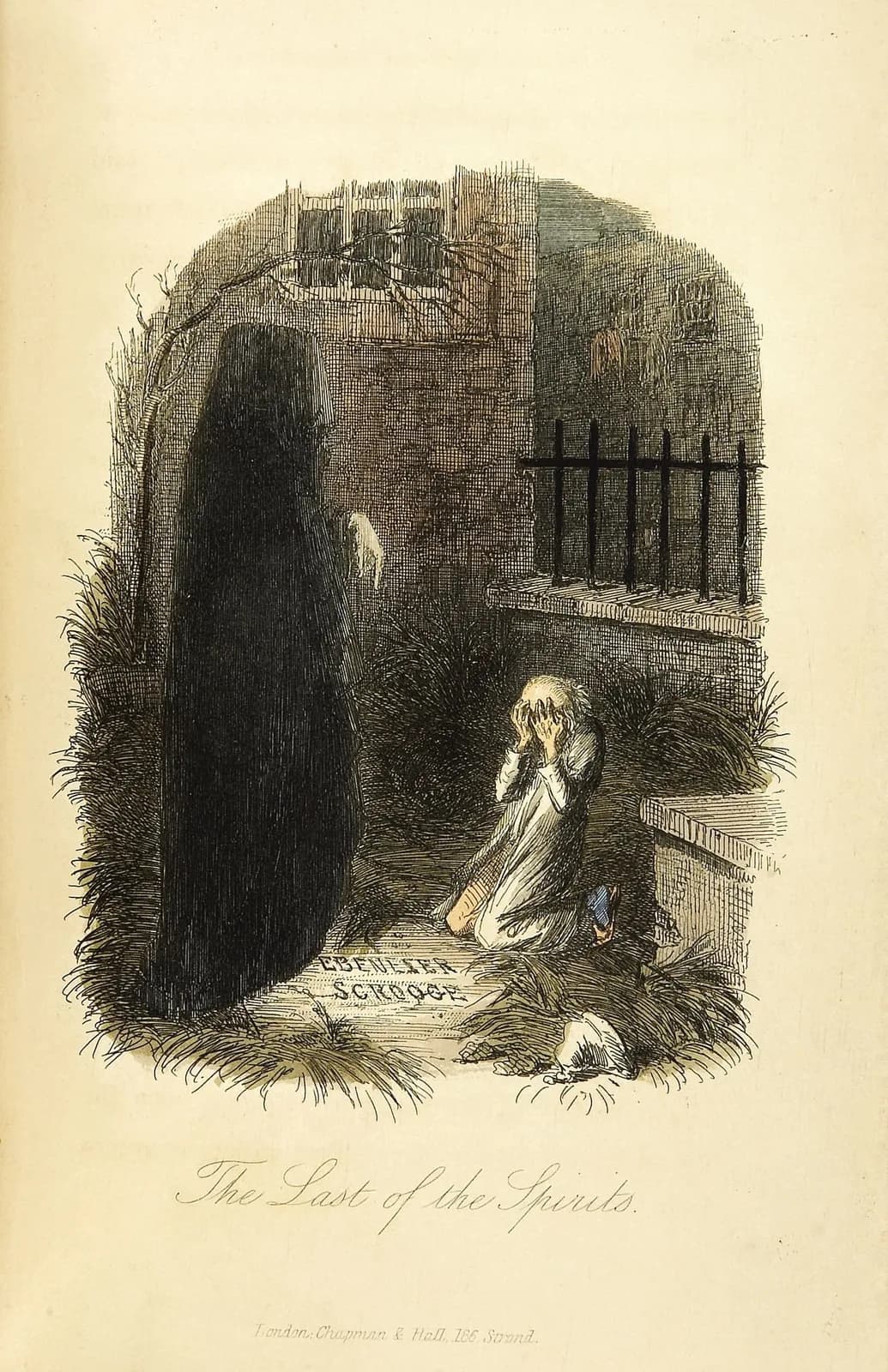
Most guides to this book list the ghosts by what they show. It is more useful to sort them by how they behave, because the behaviour is what Dickens actually varies, and the reader of the playable A Christmas Carol meets each of them as a different kind of company rather than as a different slide in a presentation.
⛓️ Jacob Marley, the one who is not a Christmas spirit
Marley is the warning, delivered by a former colleague rather than by an allegory. The book opens by establishing that he has been dead for seven years, to the night, and the narrator spends an entire paragraph insisting on it before anything else can happen. Scrooge’s first sight of him includes a detail he had not noticed before: a folded kerchief bound about the phantom’s head and chin.
That bandage is the most-searched detail in the book and the answer is grim domestic practicality. It is a corpse-binding, tied to keep the jaw of a dead body closed, and Dickens uses it twice for effect: the spirit removes it as if it were too warm to wear indoors and its lower jaw drops onto its breast, then ties it back on before leaving, and Scrooge hears the smart sound its teeth make as the jaws come together.
🕯️ The Ghost of Christmas Past, who argues
The first of the three is deliberately impossible to picture, and Dickens makes the difficulty part of the description.
It was a strange figure—like a child: yet not so like a child as like an old man, viewed through some supernatural medium, which gave him the appearance of having receded from the view.
This is the spirit that talks back. It contradicts Scrooge, presses him on what he is seeing, and picks the two scenes that do the most damage: his sister Fan arriving at the school to fetch him home, and Fezziwig clearing the warehouse for a ball that runs until the clock strikes eleven. It also shows him Belle years later, married, in a room full of children who are not his.
The Unbidden Guest is a doorway in the playable A Christmas Carol: the knocker has already changed once, the bells are ringing on their own, and something is coming up the stairs. You can bolt the door, sit down and wait for it, or tell it to its face that you do not believe in it. Role-play A Christmas Carol →
🔥 The Ghost of Christmas Present, who carries something
The second spirit is the one adaptations enjoy most, and the text gives them a lot to work with: a jolly Giant, glorious to see, sitting on a throne heaped out of turkeys, geese, sausages, chestnuts and punch, holding a torch shaped like a horn of plenty. He is generous, loud and easy company for most of a stave, which is precisely the setup for what he does at the end of it.
Then he opens his robe. The two children he has been carrying the whole time are named in the flattest sentence in the book, and the standard account of the novella records that Dickens drew them from children he had seen on a visit to a ragged school, which is why the pair read less like symbols than like two people he could not stop thinking about.
“This boy is Ignorance. This girl is Want.”
Naming them that flatly is the point. The spirit hands the two children over as Scrooge’s business rather than as one more scene he is being shown, and the stave ends a few lines later with the bell striking twelve.
🖤 The Ghost of Christmas Yet To Come, who says nothing
The fourth spirit is a hooded shape with one hand showing, and it never answers anything. Scrooge asks it directly whose presence he is in, and what he gets back is the only line in the whole stave that touches on the question of its voice.
The Spirit answered not, but pointed onward with its hand.
A speech-verb scan across the entire stave returns that one sentence and nothing else, so the silence is total rather than merely atmospheric. The reference entry on the character describes a solemn Phantom, draped and hooded, with a single outstretched hand, points out that it communicates only by pointing, and reads it as a personification of Death, which is the reading the costume invites. What that silence does to the shape of the ending is the subject of its own essay.
👨👩👧 The living, briefly
- Bob Cratchit. The clerk in the Tank, who asks for Christmas Day off as a favour rather than as a right, and who is the only person in the book Scrooge has any daily power over.
- Tiny Tim.The youngest Cratchit, given the book’s most famous line at the dinner table and its most painful scene in the unaltered future, and treated by the family as a subject they handle carefully in front of each other.
- Fred.Scrooge’s nephew, who keeps inviting him, and who runs a party game of Yes and No in which the answer turns out to be his own uncle before he proposes a toast to him anyway.
- Fezziwig and Belle. The generous employer Scrooge worked for and the woman who released him from their engagement, who exist in the book to establish that he was not born like this and had somewhere else to end up.
Sorted this way the cast stops looking like a list and starts looking like a case being assembled, with each living character standing for a version of Scrooge that was available to him and each spirit responsible for a different way of putting the evidence in front of a man who has spent the whole book refusing to look at it.
Sources
- A Christmas Carol (Project Gutenberg eBook #46, 1843 text) — Project Gutenberg
- Ghost of Christmas Yet to Come — Wikipedia
- A Christmas Carol — Wikipedia
- Jacob Marley — Wikipedia
Frequently asked questions
- What are the four ghosts in Scrooge?
- Jacob Marley first, then Christmas Past, Christmas Present and Christmas Yet To Come. Only Marley was ever a person, and his chain says so: Scrooge looks at it closely and finds it “made of cash-boxes, keys, padlocks, ledgers, deeds, and heavy purses wrought in steel”, which is a working life rendered as jewellery.
- How is Marley's ghost described in A Christmas Carol?
- As his old business partner, dressed exactly as he used to dress: pigtail, usual waistcoat, tights and boots, with the tassels bristling. The one thing wrong with him is that he is see-through. Looking through the waistcoat, Scrooge “could see the two buttons on his coat behind”.
- Why was Marley's jaw tied up?
- It is a corpse-binding: a cloth tied under the chin of a dead body to hold the jaw shut, and Marley is still wearing his. Dickens plays the whole visitation for nerves and comedy at once, having Scrooge invite the ghost to sit down mainly because he dreads the embarrassment of a spirit too transparent to manage a chair. The comedy stops when the phantom takes the bandage off and its jaw drops onto its breast: Scrooge falls on his knees and says “Mercy! Dreadful apparition, why do you trouble me?”
- Why does the Ghost of Christmas Yet to Come remain silent?
- Because the silence is the characterisation. The reference literature places this spirit in the tradition of Gothic literature rather than in the warm, talkative mode of the two before it, and a figure in that tradition works by withholding: the gloom, the concealment and the refusal to explain are the whole performance.
- Does the Ghost of Christmas Yet to Come represent death?
- The text stops just short of saying so, and Scrooge does not. His opening address to it is an admission rather than a greeting: “Ghost of the Future! ... I fear you more than any spectre I have seen.” He agrees to follow only because he knows its purpose is to do him good and hopes to live to be another man.
Enjoyed this one?