A Christmas Carol’s Ending, Explained: How Scrooge Actually Changes
The famous change of heart opens as a negotiation with a figure that never answers, and the last stave exists to test whether the promise survives daylight.


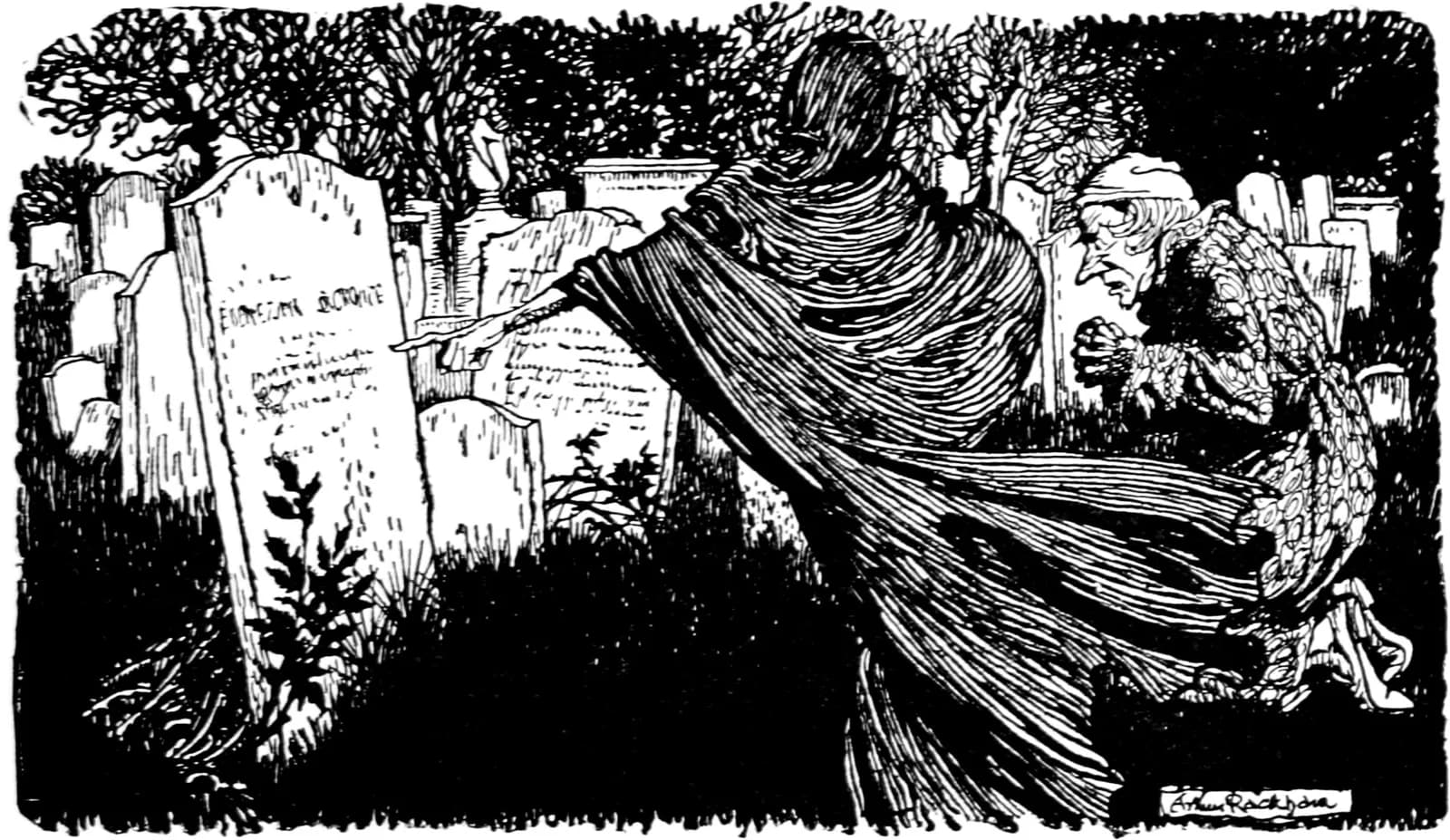
Most summaries of this book stop at “he sees his own grave and changes”, which skips the part that makes the ending work. The graveyard scene in the playable A Christmas Carol is a negotiation, and Dickens then spends an entire stave testing whether a promise made in that position is worth anything the next morning.
🪦 The vow is a bargain, and Scrooge knows it
Before the spirit will let him near the headstone, Scrooge tries to get the terms clear. The question he asks is a lawyer’s question, and he asks it because everything he has been shown so far has been presented to him as already true.
“Are these the shadows of the things that Will be, or are they shadows of things that May be, only?”
He gets no answer. He reads his own name on the neglected grave and only then makes the promise, and the promise arrives with a condition attached to it: he will honour Christmas in his heart and keep it all the year, and in return he asks to be told he may sponge away the writing on this stone. A man offering terms is still arguing, which is why the last stave has to exist at all.
🖤 The ghost that changes him never speaks
The three earlier visitors all talk. Marley delivers a long warning, the Ghost of Christmas Past argues with him about his schooldays, and the Ghost of Christmas Present throws his own opinions back at him in his own words. The fourth one is given no dialogue at all, and a speech-verb scan across the whole of Stave IV turns up exactly one relevant line, which is a statement that it said nothing. The reference entry on that spirit records the same thing, describing a hooded figure that communicates by pointing and calling it ominous and silent.
That silence is what makes the bargain one-sided. Scrooge has to supply both halves of the conversation, guess at the meaning of everything he is shown, and volunteer his own sentence, which is a far more uncomfortable position than being told what to do by a spirit in a green robe. The mechanics of that choice belong to the guide to all four ghosts, which takes the silent one seriously as a character.
The Final Reckoning is a doorway in the playable A Christmas Carol: you stand in front of the neglected grave with a spirit that will not answer you, and you can ask for terms the way Scrooge does, refuse to read the stone, or say nothing and see how long the silence holds. Role-play A Christmas Carol →
🦃 Proof one: he acts before he explains himself
A reformed miser in a weaker book would give a speech. Dickens gives his instead a morning of errands, and the order of those errands is the argument. Scrooge shouts out of his own window at a boy in Sunday clothes to find out what day it is, sends him to buy the prize turkey hanging in the poulterer’s, pays for the bird and the cab and tips the boy, chuckling at every stage of the transaction.
Nobody at the Cratchit house is told who sent it. The gift goes out anonymously, before Scrooge has apologised to anyone or announced that he is a changed man, and a reader who wants to know whether the conversion is real gets to watch him spend money on strangers while nobody is watching him do it.
💼 Proof two: the raise arrives inside a prank
The second test is harder, because it involves the one person who has absorbed the worst of the old Scrooge. Bob Cratchit turns up on the following morning a full eighteen minutes and a half behind his time, and his employer stages an entire fake scolding, growling in his accustomed voice as near as he can feign it, before delivering the actual news.
“And therefore I am about to raise your salary!”
The joke matters more than the money. A man who can tease his clerk has stopped being frightened of him, and Dickens follows the raise with a promise to assist Bob’s struggling family and to discuss his affairs over a bowl of smoking bishop that same afternoon, which converts a single act of charity into an ongoing relationship between two people who have worked in the same room for years without one.
🕯️ Does Tiny Tim die at the end
He does not, and the confusion is honest, because the book does show a household mourning him. In the unaltered future the Ghost of Christmas Yet To Come walks Scrooge through a quiet Cratchit parlour where the mother hides her reddened eyes, Peter reads by candlelight, and she remembers something about the way her husband used to walk home.
“I have known him walk with—I have known him walk with Tiny Tim upon his shoulder, very fast indeed.”
That scene is a shadow of a thing that may be, which is precisely what Scrooge asked about before he read the stone, and the narrator settles the matter in the last paragraph of the book in capitals of Dickens’s own choosing: Scrooge became a second father to Tiny Tim, who did NOT die. The 2009 motion-capture version directed by Robert Zemeckis is one of many screen retellings that keep the mourning scene intact. The Cratchits mind enormously, and that is why Dickens puts their parlour in the same stave as the other death. When Scrooge asks the spirit to show him any person in the town who feels emotion caused by the death of the man under the sheet, what he is shown is a couple who are relieved, because the debt has passed to someone who may give them more time to pay.
- The condition is stated, not implied.Scrooge asks whether the visions are of things that Will be or things that May be, and the spirit’s refusal to answer leaves the question open until the narrator closes it.
- The proof is in the order of events.Turkey first, apology to the charity collector second, dinner at his nephew’s third, and the raise on the following morning, with no announcement of a change in front of any of them.
- The horror was never the dying.What the fourth spirit shows Scrooge about his own death is a room of traders joking that they will only attend the funeral if a lunch is provided, and a charwoman, a laundress and an undertaker’s man selling his effects to a rag-and-bone dealer.
Sources
- A Christmas Carol (Project Gutenberg eBook #46, 1843 text) — Project Gutenberg
- List of adaptations of A Christmas Carol — Wikipedia
- A Christmas Carol — Wikipedia
- Ghost of Christmas Yet to Come — Wikipedia
- Ebenezer Scrooge — Wikipedia
Frequently asked questions
- What happens to Tiny Tim at the end of a Christmas carol?
- He lives, and the narrator goes further than that. Scrooge becomes as good a friend, as good a master and as good a man as the good old city knew, has no further intercourse with Spirits, and lives ever afterwards upon what Dickens calls the Total Abstinence Principle, which is a joke about drink and about ghosts at the same time.
- Did Scrooge save Tiny Tim?
- The book never stages a rescue; it stages a change of terms. The first thing Scrooge does after buying the turkey is chase down one of the charity collectors he refused the day before, name a sum in his ear, and insist on it: not a farthing less, with a great many back-payments included. Stave V reports the outcome instead of staging the rescue: “Scrooge was better than his word. He did it all, and infinitely more; and to Tiny Tim, who did NOT die, he was a second father.”
- What were Tiny Tim's final words?
- There are none, because he does not die in this book. His best-known line lands in Stave III, at the family dinner table, and Dickens repeats those same words himself in the last sentence of the story. Readers who remember final words are remembering a vision the fourth spirit shows and the narrator afterwards cancels.
- What is Scrooge's best quote?
- By use it is the vow at the grave, and the full version is longer than the one on the mugs. He promises to live in the Past, the Present and the Future, says the Spirits of all Three shall strive within him, and adds the clause that always gets cut: he will not shut out the lessons that they teach.
- What quotes show Christmas in A Christmas Carol?
- Three carry most of the weight. Fred defends the season as a kind, forgiving, charitable, pleasant time when people open their shut-up hearts. The narrator says Scrooge iced his office in the dog-days and didn't thaw it one degree at Christmas. Bob Cratchit toasts Mr Scrooge as the Founder of the Feast, and his wife says what she thinks of that.
Enjoyed this one?