What “God Bless Us, Every One” Really Means in A Christmas Carol
Five words travel from a crowded dinner table to the last sentence of the book, and the distance between the two is the whole design.


The sentence is printed twice in A Christmas Carol and the two printings do opposite jobs. The first belongs to a small boy at a crowded table who has no idea he is saying anything that will outlive him. The second belongs to the narrator of the playable A Christmas Carol’s source text, who has watched the entire story happen and picks those exact words to end it, and that second placement is what turned a toast into a line people quote without remembering where it sits.
🎩 “Humbug” is an argument, not a mood
Scrooge uses the word six times in the opening stave and never again afterwards. It arrives first as a flat refusal to his nephew’s greeting, and returns when he cannot think of a better answer. It comes back twice more while he is alone in his rooms, arguing with the ghost of Jacob Marley, his dead business partner, whom he has decided not to believe in. Those last two land in the same breath, when he tells Marley he will not be persecuted by a legion of goblins of his own creation.
“Bah!” said Scrooge, “Humbug!”
Read together, those six uses read less like a bad temper than like a position Scrooge is defending: that generosity is a confidence trick, that Christmas is a way of picking a man’s pocket, and that anything which cannot be entered in a ledger has been made up by somebody who wants his money. His nephew hears it as a position too, which is why Fred repeats the word back at his own party two staves later, still amazed that his uncle believed it.
🕯️ The one time he cannot finish the word
Stave I ends on a small piece of stagecraft that most readers pass straight over. Scrooge checks the door, finds it still double-locked with the bolts undisturbed, and reaches for the word he has used all evening to make the night go away. The sentence Dickens writes instead is the first evidence in the book that anything has changed inside him.
He tried to say “Humbug!” but stopped at the first syllable.
No spirit has shown him anything yet. Nothing has been explained to him, nobody has argued him out of his position, and the three promised visitors have not arrived. All that has happened is that the word stopped working, and Dickens puts that failure at the end of a stave so a serialised reader would carry it around until the next one.
The Family Gathering is a doorway in the playable A Christmas Carol: you arrive at the Cratchits' table on the night of the toast, and you can raise a glass with them, stay silent, or say out loud what the family is carefully not saying about the smallest child. Role-play A Christmas Carol →
🍽️ The toast, the first time it happens
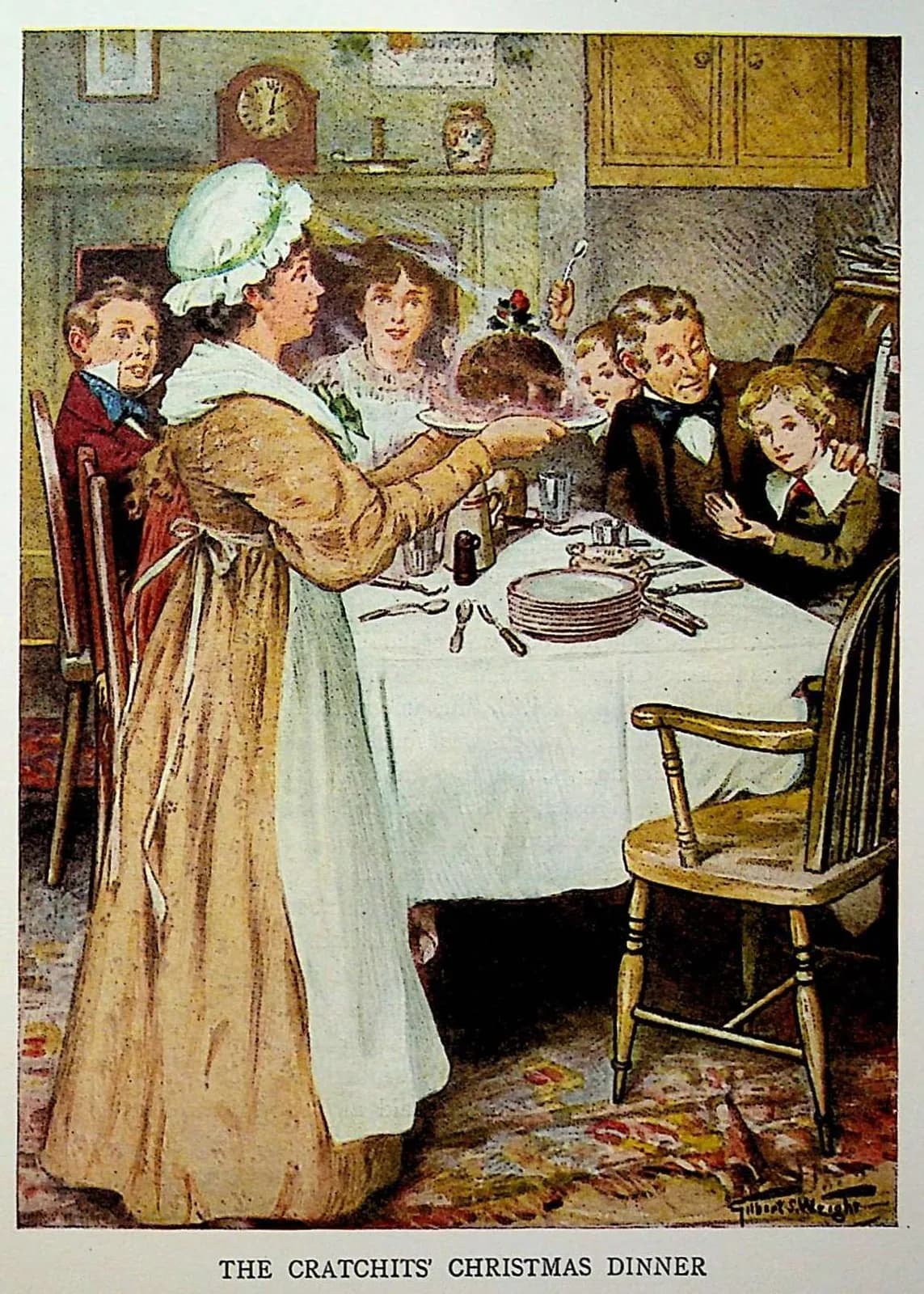
The line belongs to a scene about scarcity. The goose is small, the pudding is a household emergency, the gin and lemons are measured, and the family has been counting Bob’s wages out loud all evening. Bob raises the first toast, and the youngest child at the table finishes it with a blessing that takes in everybody present, including the employer who is the reason the meal is as thin as it is.
“A Merry Christmas to us all, my dears. God bless us!” ... “God bless us every one!” said Tiny Tim, the last of all.
Dickens gives the sentence to the person at the table with the least reason to say it and the least power to make it true, and he gives it to him last, after everyone else has spoken. The phrase reaches the reader already attached to a child whom Bob has taken beside him in a tiny corner at the table a few lines earlier.
📖 Dickens gives the line the last word, literally
The final paragraph of the book is a narrator’s summary: Scrooge kept his word, became a second father to Tiny Tim, and was afterwards said to know how to keep Christmas well. Dickens could have ended there. Instead he reaches back into Stave III, lifts the child’s toast out of it, and hands it to the reader as the book’s literal last sentence.
That is the whole trick, and it is why the line survives detached from the story. In Stave III the words are a blessing on a room of eight people. In Stave V they are a blessing on whoever is holding the book, because the narrator has stepped out of the fiction to say them, and a sentence that can be addressed to a stranger travels further than one that belongs to a scene.
🔍 The word is ninety years older than Scrooge
A Christmas Carol did not coin “humbug”, though it is now almost the only place the word is used in ordinary speech. The Online Etymology Dictionary dates it to 1751, in Oxford and Cambridge student slang, meaning a trick or a hoax, and notes that it was a vogue word whose origin people were already speculating about at the time. Wikipedia’s entry on the word independently gives the same earliest printed source, the periodical The Student, and adds a 1754 jest-book.
- 1751, not 1843. The word was student slang for a hoax roughly ninety years before Dickens put it in a counting-house, which is why Scrooge can use it without explaining it to anybody in the room.
- It means fraud, not grumpiness.Calling Christmas a humbug is an accusation about other people’s honesty rather than a report on your own mood, and the whole of Stave I is Scrooge defending that accusation.
- Dickens never lets him say it again.After the failed syllable at the end of Stave I the word only reappears in his nephew’s mouth, quoting him, which is a quiet way of marking that the position has been abandoned.
Sources
- A Christmas Carol (Project Gutenberg eBook #46, 1843 text) — Project Gutenberg
- humbug (etymology) — Online Etymology Dictionary
- Humbug — Wikipedia
- A Christmas Carol — Wikipedia
- Ebenezer Scrooge — Wikipedia
Frequently asked questions
- What did Scrooge mean when he said Bah Humbug?
- He meant fraud. Humbug was slang for a hoax, so calling Christmas a humbug accuses everybody keeping it of running a swindle at his expense. He argues the case twice in one stave, in two separate visits. His nephew gets the fullest version first: every idiot who goes about with Merry Christmas on his lips, Scrooge tells him, “should be boiled with his own pudding, and buried with a stake of holly through his heart.” Two charity collectors are let in as the nephew is let out, and they get the colder version, that the poor who would rather die had better do it and decrease the surplus population.
- Is Bah Humbug rude to say?
- In the book it works as an accusation rather than as a curse, which is why nobody treats it as obscene: his nephew answers it with a dinner invitation and keeps issuing that invitation every year. Modern use has softened it into a joke about disliking tinsel, while the dictionaries still define the noun itself as a hoax or an impostor.
- What is the most famous line from A Christmas Carol?
- Two compete. “Bah! Humbug!” is the one shouted at Christmas trees, and “God bless us, every one!” is the one printed on cards. The second has the better claim to the title, because Dickens gave it the final sentence of the story and signed his preface in December 1843 hoping his ghostly little book would haunt readers' houses pleasantly.
- Why does Tiny Tim say God bless us everyone?
- Because he is answering his father's toast, and Dickens gives the last word at that table to the child with the least reason to bless anybody. A few lines earlier the same boy has beaten on the table with the handle of his knife and feebly cried Hurrah at the arrival of the goose, which is the register the blessing is spoken in.
- What does Tiny Tim symbolize in A Christmas Carol?
- Less a symbol than a test the book applies to everyone inside it. He is the figure through whom the second spirit shows Scrooge a vacant seat in the poor chimney-corner and a crutch without an owner, carefully preserved, adding that the child will die if these shadows remain unaltered by the Future.
Enjoyed this one?