Every Water Margin Adaptation, Ranked for Faithfulness: 1998, 2011, the 1973 Japanese Series and Suikoden
A Ming emperor banned it, the Qing kept trying, Edo Japan turned it into a tattoo craze, and a Japanese game company borrowed its title and kept the number 108. Ranked by how much of the book each one keeps.


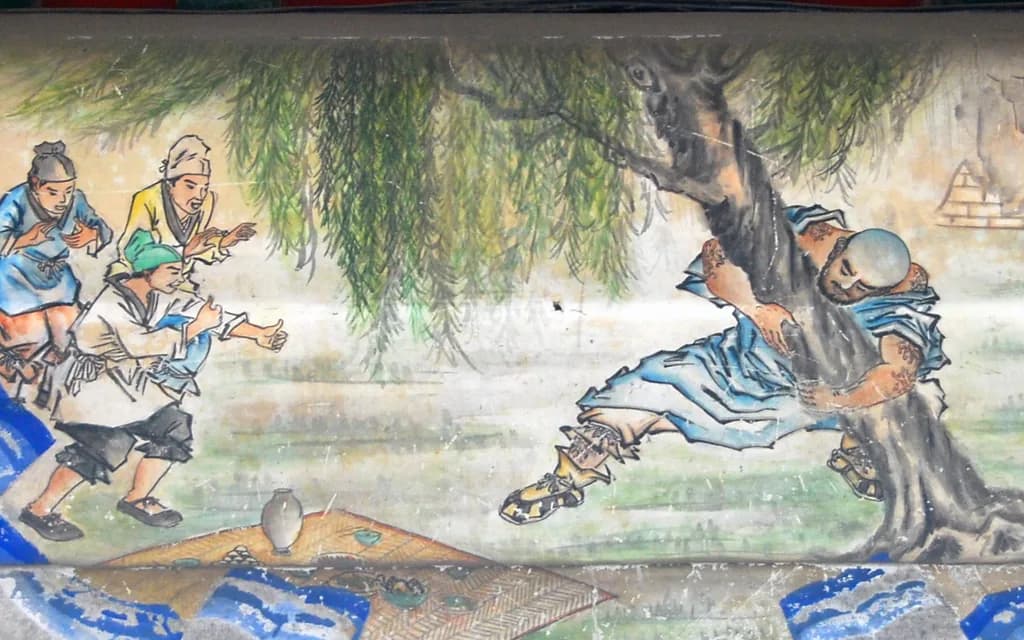
A Ming emperor banned this book. The Qing kept trying and failed. Eighteenth-century Japan translated it, nineteenth-century Japan turned one print series based on it into a national tattoo fashion, a Korean king quoted it at his own ministers, and in 1995 a Japanese games company took its title outright and built a franchise on one number from its prologue. Very few novels have been adapted this often by people who disagreed this violently about what it meant.
- Start with the 1998 CCTV series if you want the book on screen.
- The 1973 version is Japanese, which is why half the internet is unsure what nationality this story is.
- The films are episodes, not adaptations. Chang Cheh filmed pieces of it at Shaw Brothers rather than the whole.
- Suikoden is not an adaptation at all. It takes the title and the number one hundred and eight and invents everything else.
Ranked below by how much of the novel each one actually keeps. If you would rather be in it than watch it, the playable Water Margin runs from the sealed hall in the prologue to the ranking of the hundred and eight.
| Version | How close it stays |
|---|---|
| 1. The Water Margin (CCTV, 1998) | The full-scale Chinese television treatment, produced by Zhang Jizhong with fight choreography by Yuen Woo-ping. The closest thing to reading it. |
| 2. Outlaws of the Marsh (1983) | The earlier Chinese television version, and a Golden Eagle Award winner. Less spectacular than 1998 and, for a generation of Chinese viewers, the definitive one. |
| 3. All Men Are Brothers (2011) | A modern remake directed by Kuk Kwok-leung, with a cast drawn from mainland China, Hong Kong and Taiwan. Covers the story; softer than the book. |
| 4. Chang Cheh's Shaw Brothers films (1972 onward) | Faithful to individual chapters and indifferent to the whole. Excellent on the fights, silent on the politics. |
| 5. The Water Margin (Nippon TV, 1973) | A Japanese reinvention that keeps the names and the marsh and rewrites much of the rest. The version most British viewers of a certain age actually saw. |
| 6. Suikoden (Konami, 1995 onward) | Not an adaptation. A borrowed title, a borrowed number, and an entirely original set of wars. |
One honest note before the detail. Readers searching for a new English-language screen version will find rumours; we could not verify any active production when we checked in September 2026, so this piece makes no claim about one in either direction. Everything ranked above exists and can be watched.
📺 The 1998 CCTV series
This is the version Chinese audiences argue about the way English-speaking audiences argue about a famous television novel adaptation: not whether it is good, but which casting choices were correct. It was produced by Zhang Jizhong, who spent the following decade making large-scale television versions of Chinese literature, and its fights were choreographed by Yuen Woo-ping, whose name most Western viewers know from the wire work in Hollywood action cinema of the same era.
The reason it tops the list is scope. A hundred and eight characters is a structural problem that only a long-running television series can solve, because the novel's method is accumulation: one recruitment story, then another, then another, until the mountain is full. A two-hour film has to choose a protagonist, and every film version of this book that has chosen one has quietly become a different story. The series does not have to choose.
🎬 The 2011 remake
All Men Are Brothers, directed by Kuk Kwok-leung, takes its English title from the 1933 translation and its cast from across mainland China, Hong Kong and Taiwan. It is the better-looking production and the more comfortable watch, and those two facts are related.
Where it loses ground against 1998 is tone. This is a novel in which sympathetic characters run a tavern that serves human flesh, and in which the hero of its most famous chapter cuts the heart out of a woman at a funeral altar. A glossier production has to decide what to do with that material, and softening it is the ordinary answer. If you want to see the novel's actual moral temperature, the older series holds it better.
🇯🇵 The Japanese series Britain dubbed
Nippon Television made a Water Margin series in 1973, and it travelled further than anyone involved can have expected. It was released outside Japan and reached British television in 1976 in an English dub, where it became a cult object for a generation of viewers who had no idea they were watching a Chinese novel at all.
The British Film Institute holds it in its database; the South China Morning Post, writing about the book's influence in 2021, described it simply as a mid-1970s Japanese series that was also popular in the West. It is fourth on faithfulness because it is a reinvention rather than a rendering. Names, setting and outlaw ethic survive; the plotting is substantially the series' own. It is also the single largest source of the most common question about this story, which is what nationality it is. A Chinese novel, adapted by a Japanese broadcaster, dubbed into English for British television, and later lending its Japanese title to a game franchise, is genuinely confusing if you meet it in the wrong order.
🥋 Chang Cheh's Shaw Brothers films
Hong Kong's Shaw Brothers studio made most of the film versions, and Chang Cheh, the director who did more than anyone to invent the modern martial-arts film, went to this novel three times. He made The Water Margin and The Delightful Forest in 1972, the second of them starring Ti Lung as Wu Song, and followed with a sequel, All Men Are Brothers, which sources date to either 1973 or 1975.
The same year brought Pursuit, a separate Shaw film built entirely around Lin Chong with Yueh Hua in the part, and a decade later Li Han-hsiang made Tiger Killer, with Ti Lung playing Wu Song again. Ranking these for faithfulness is slightly unfair, because none of them is trying to adapt the novel. They are doing what the novel does at chapter scale: taking one man's self-contained crisis and filming it end to end. On that measure they are extremely faithful, and the choice of episodes tells you which parts of the book working filmmakers thought were the good parts. It is always the recruitment stories, never the campaigns.
That inheritance is the durable one. Writing in the South China Morning Post, the critic Richard James Havis argued that the novel's habit of sketching each fighter through his own separate adventure is prototypical, and that those episodes already contain the seeds of the fighting styles and mannerisms of later martial-arts heroes. A century of Hong Kong cinema is downstream of a structural decision made in the fourteenth century.
🎮 Suikoden, and the older Japanese craze behind it
Konami released the first Suikodenon 15 December 1995, taking the Japanese reading of this novel's title, and every game in the series since has been built on 108 recruitable characters called the Stars of Destiny. That number and the idea that the roster is fated rather than assembled come straight out of the novel's prologue, in which a court official breaks a Daoist seal and releases a hundred and eight imprisoned spirits.
Nothing else carries over: the wars, the castles and the cast are the games'. What most players do not know is that they are the third Japanese wave, not the first. Japanese translations of the novel were being printed by at least 1757. In 1805 Kyokutei Bakin published an illustrated version with pictures by Hokusai, which was a hit and set off the original Suikoden craze in Edo Japan. And in 1827 a publisher called Kagaya Kichibei commissioned Utagawa Kuniyoshi to make a print series of the hundred and eight heroes.
That commission had a consequence nobody planned. Several of the outlaws are tattooed in the novel itself, and Kuniyoshi drew them in loving detail. The series made him famous and set off a fashion for multicoloured pictorial tattoos covering the entire body from the neck to the mid-thigh, which is a recognisable ancestor of Japanese tattooing as it exists today. The print at the top of our guide to the editions is from that series. Later artists followed him, and by the 1860s Yoshitoshi was producing fifty designs of his own, darker than Kuniyoshi's and full of ghosts.
🚫 Banned, on and off, for four hundred years
The best evidence of what this book does to readers is who has tried to stop them reading it. In the late Ming, a vice minister of war called Zuo Maodi argued that the novel taught people to be criminals and that leaving it in circulation would damage the moral atmosphere, and the Chongzhen Emperor banned it on his advice.
The Qing tried repeatedly and comprehensively failed; the book was too popular and too easy to reprint. The pattern that makes the whole history legible is what happened on the other side. Emperors and Confucian officials banned it for teaching rebellion, and the people planning rebellions loved it for exactly the same content: the Taiping rebels in the nineteenth century, and Communist revolutionaries in the twentieth. A book that both sides read accurately, and drew opposite conclusions from, is doing something more interesting than either camp admits. The strangest chapter of that story is the 1975 campaign in which the novel was attacked for the opposite reason, because its hero surrenders, and we cover that with the ending.
It travelled as a political object too. King Yeongjo of Joseon Korea is the first Korean monarch to leave explicit records of having read it, and he did not read it privately: he quoted its plots and its characters at his ministers during court discussions, to the point that scholars trace a tangible influence on Korean state business. A novel about outlaws became, for a while, a shared reference for the people running a neighbouring government.
The adaptation and reception facts above come from Wikipedia's sourced article and from the South China Morning Post, and were checked again this month. If you want the book rather than the versions of it, the edition guide is here, and the single scene worth reading first is the tiger fight.
Sources
- Water Margin — Wikipedia
- What martial arts storytelling owes to The Water Margin, wuxia novel from 14th century adapted for Japanese TV and by Chang Cheh for cinema — South China Morning Post
- Suikoden — Wikipedia
- The Water Margin (1973 TV series) — Wikipedia
Frequently asked questions
- Was Water Margin ever banned in China?
- Repeatedly, and by both sides of the argument. Emperors and Confucian officials banned it for teaching rebellion; the Taiping rebels in the nineteenth century and Communist revolutionaries in the twentieth honoured it for exactly the same content. A book that gets banned and adopted for identical reasons is usually being read accurately by everybody.
- What is the best screen adaptation of Water Margin?
- The 1998 CCTV series, for coverage and casting. There is a whole animated branch that screen rankings ignore entirely: Giant Robo: The Animation (1992) and Hero: 108, a 2010 series shown on Cartoon Network that reworked the hundred and eight for children. Neither is faithful, and both show how far the roster travels on its own.
- Is Water Margin Chinese or Japanese?
- Chinese, from the fourteenth century. The confusion is old and reasonable: the title read aloud in Japanese is Suikoden, Japanese translations were being printed by at least 1757, and two of the most widely seen adaptations — a 1973 television series and a video-game franchise — are Japanese productions carrying that Japanese name.
- Has Water Margin been adapted outside China and Japan?
- It travelled as a book long before it travelled as a film. It was translated into Thai in 1867, running to eighty-two volumes in the traditional format, and printed in Western style in 1879 by an American missionary in Siam. Jacques Dars translated the seventy-chapter version into French in 1978, and it has been reprinted several times since.
- Why did Water Margin start a tattoo craze in Japan?
- Because of one print series. In 1827 the publisher Kagaya Kichibei commissioned Utagawa Kuniyoshi to illustrate the hundred and eight heroes, several of whom are tattooed in the novel itself. The prints made Kuniyoshi famous and set off a fashion for multicoloured pictorial tattoos covering the whole body from the neck to the mid-thigh.
- Did Water Margin influence martial-arts films and wuxia?
- Heavily, and the mechanism is structural. Writing in the South China Morning Post in 2021, Richard James Havis argued that the novel's habit of sketching each fighter through his own separate adventure is prototypical, and that those episodes already contain the seeds of the fighting styles and mannerisms of later wuxia characters.
Enjoyed this one?