Is Water Margin Worth Reading? Yes, and Which Translation and Edition to Pick
A hundred and eight outlaws, three editions that stop in three different places, and four English versions that quietly disagree about which book you are holding. The honest case for it, and the one that gets you through.


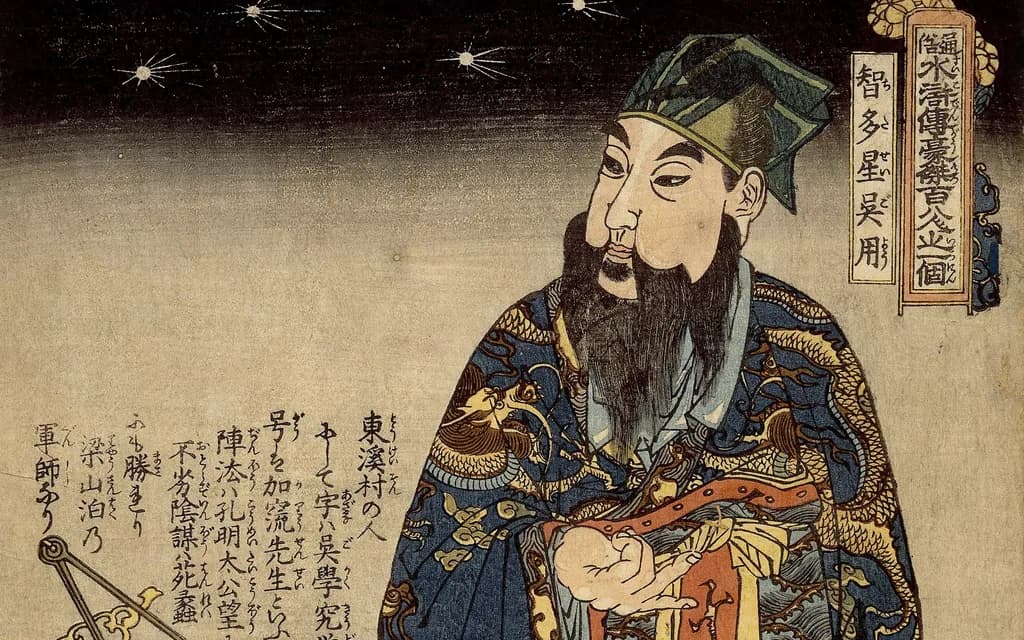
Most English-speaking readers meet this book sideways. You recruited a hundred and eight characters in a Konami role-playing game, or you saw a tattooed man on a woodblock print in a museum, or somebody told you it was the violent one out of the four famous Chinese novels. Then you go looking for the source and hit a wall that nobody warns you about: there are three different versions of this book, they end in three different places, and the four English translations quietly disagree about which one you are holding.
- It is about a hundred and eight outlaws who are driven, one by one, out of respectable life and into a marsh fortress by the state that was supposed to protect them.
- It is episodic to a fault. Each man gets his own arrival story, and the best of them are self-contained novellas you could read on their own.
- The edition decides your ending. Seventy chapters ends in triumph. A hundred and twenty ends in a body count.
- No English version is free, which is unusual for a book this old, and it changes the practical advice.
Everything below is about that choice. If you would rather walk into the marsh than read about it, the playable Water Margin opens where the novel opens, with a court official in a locked hall who has been told very clearly not to open the door in front of him.
🐯 Is it worth it, or is the game doing the work?
It is worth it on its own terms, and the reason is the recruitment. This is a book about how a hundred and eight separate people each lose their place in society, and the pleasure is watching the mechanism repeat with different men. A monk breaks a butcher's face over a singing girl's debt and has to flee. A weapons instructor is framed by his commanding officer.
A guard loses an imperial shipment and has nowhere to go. Every one of them starts inside the system, and every one of them is pushed out by it. That repetition is what earns the assembly scene at the end of the short edition. By the time the roster is read out, you have watched a hundred and eight refusals of the ordinary world, and the mountain reads less as a hideout than as the only functioning institution in the book. The prologue has already told you what they are: thirty-six heavenly spirits and seventy-two earthly fiends, a hundred and eight demon kings sealed under a stone tablet by a Daoist patriarch and let out by a court official too self-important to listen to a warning.
Open when Hong comes.
Those four characters are carved on the back of the tablet, and the marshal named Hong reads them as permission rather than prophecy. The whole novel is the consequence of one official deciding that a warning was addressed to him personally as an invitation.
The thing that makes a hundred and eight people navigable, once you are inside, is that almost every one of them carries a nickname as well as a name, and the nicknames are doing real work. Lin Chong is the Panther Head. Lu Zhishen is the Flowery Monk, because he is covered in tattoos. Li Kui is the Black Whirlwind. Sun Erniang is the Ogress, and she has earned it. Song Jiang himself is Timely Rain, which tells you his whole method before he opens his mouth. Once you stop trying to memorise names and start collecting epithets, the cast list turns from an obstacle into the pleasure, which is the same trick every ensemble story since has borrowed.
The honest warnings are two. The first is violence: this book is casually, sometimes cheerfully brutal, including toward bystanders, and the narrator rarely flinches or apologises. The second is that the outlaws are not clean. Readers who arrive expecting a Chinese Robin Hood find a gang that also robs travellers, runs a tavern that serves human flesh, and slaughters a household to force one man to join. Both objections are ancient. The Qing writer Yu Wanchun thought the book encouraged rebellion and endangered the state; the critic C. T. Hsia found its endorsement of savagery genuinely disturbing; and there is a long scholarly argument about how it treats women, which we take apart separately. None of that is a reason to skip it. It is a reason to know what you are opening.
📏 Seventy chapters, a hundred, or a hundred and twenty
Decide this before you decide the translator, because it changes the story more than any prose style does. Three recensions circulate. The short one ends at the moment of triumph. The two long ones keep going into a pardon, four military campaigns, and an ending that most readers describe as devastating rather than satisfying.
| Edition | What you get |
|---|---|
| 71 chapters (Jin Shengtan, 1640s) | A prologue plus seventy numbered chapters, ending with all hundred and eight ranked at the Hall of Loyalty and Righteousness. The seventeenth-century critic who cut it here did so on purpose, and he was right about where the book peaks. This is the text on Project Gutenberg and the one the playable version follows. |
| 100 chapters | The same story, then the imperial pardon, then campaigns against the Liao invaders and the rebel Fang La. This is where the famous unhappy ending lives. |
| 120 chapters | The hundred-chapter version with two more campaigns spliced in, against the rebels Tian Hu and Wang Qing. Longest, most complete, and the most padded in the middle. |
The practical advice is to read seventy first and decide afterwards whether you want the rest. The short version is not an abridgement of a longer story; it is a deliberate editorial argument that the story is over once the hundred and eight are together, and the ranking scene it ends on is genuinely the emotional summit of the book. What the long versions add is an answer to a question the short version never asks, which is what happens to men like this when the government offers them their old lives back. If that question interests you, the amnesty ending is explained here.
One thing worth knowing before you buy: the pardon is not a twist the long editions spring on you. In the seventy-chapter text the outlaw leader is already campaigning for it, out loud, to anyone who will listen, from about a third of the way in. The word for it turns up fifteen times in the short edition without the thing ever happening.
📚 Which English translation should you pick?
Take Shapiro unless you have a reason not to. Buck is the alternative if you want the prose of the 1930s, and Dent-Young is the only route to all hundred and twenty chapters. No free option and no obvious winner, and the readers who argue about it in public are mostly arguing about tone.
| Translation | What you are getting |
|---|---|
| Sidney Shapiro, Outlaws of the Marsh (1980) | The default recommendation and the smoothest read. Shapiro was an American lawyer who took Chinese citizenship, and he worked from a blend of the seventy- and hundred-chapter texts, so it runs past the short ending. Published in Beijing by the Foreign Languages Press, and almost unnoticed at the time. |
| Pearl S. Buck, All Men Are Brothers (1933) | The first complete English version of the seventy-chapter text, in two volumes, revised in 1937. Buck translated the Chinese phrasing very literally, which some readers find beautiful and others find unreadable. Lu Xun disliked even the title, on the grounds that "brothers" misses what the book is doing. |
| J. H. Jackson, Water Margin (1937) | A seventy-chapter version edited by Fang Lo-Tien, running to roughly 365,000 words, and long out of print in its original form. Edwin H. Lowe restored and updated it in 2009, which is the edition you will actually find in shops. |
| Alex and John Dent-Young, The Marshes of Mount Liang (1994–2002) | Five volumes, the full hundred and twenty chapters, from the Chinese University Press in Hong Kong. The only English route to the complete arc, and priced like a set of academic volumes because that is what it is. |
All four are in copyright, which is the practical difference between this book and its famous neighbours. Other novels of its age have a free public-domain English text sitting on Project Gutenberg; this one has never had one. English readers first got a partial version in 1872 and 1873, serialised in a Hong Kong journal called The China Review, and no complete translation has aged out of copyright since. The Chinese original is free and easy to find. The English is not.
🎮 Why you already know half these names
If you have played a Suikoden game you have already absorbed this book's central structure without being told. Konami released the first one on 15 December 1995 and named it with the Japanese reading of this novel's own title.
Every game in the series is built on 108 recruitable characters called the Stars of Destiny, and that number, and the idea that the roster is fated rather than chosen, is lifted directly from the prologue you read about above. What the games do not take is the plot. There is no Song Jiang in Suikoden, no marsh, no pardon; the wars, the castles and the cast are Konami's inventions. What carries over is the shape of the pleasure: a slow accumulation of odd, specific people into one household, each with their own reason for having nowhere else to be. If that is the part of those games you loved, the novel is the thing that invented it.
Arriving that way puts you ahead rather than behind. The genuine difficulty in this book is the cast list, and a reader who already accepts that a story can hold a hundred-odd named people, most of whom carry a nickname as well as a name, has done the hardest part of the onboarding. The Japanese connection is also much older than the games. Translations were being printed in Japan by 1757, and the print at the top of this page is from a series that made its artist famous in the 1820s. Post six covers that whole afterlife, ranked.
The Chinese text is free at Project Gutenberg, and the longer editions are on Chinese Wikisource; both are where every chapter number in this series was checked. If you want to start with the one scene everybody knows, the tiger fight is taken apart here, and the character most first-time readers end up defending is the framed weapons instructor.
Sources
- 水滸傳 (Chinese text, 71-chapter Jin Shengtan recension) — Project Gutenberg
- Water Margin — Wikipedia
- 水滸傳 (120回本), 第八十二回 — Chinese Wikisource
- Suikoden — Wikipedia
Frequently asked questions
- Is Water Margin worth reading?
- Yes, and it is the rowdiest of its group. It is one of the Four Great Classical Novels of Chinese literature, and it is much older in print than most readers assume: the earliest surviving complete printed edition dates to 1589. It reads as a chain of self-contained crimes and escapes rather than one continuous plot, so it survives being read twenty pages at a time.
- Which English translation of Water Margin is best?
- Sidney Shapiro's Outlaws of the Marsh, unless you have a specific reason to want another. What surprises most people is that none of the four English versions is free. The first partial English translation was serialised in the Hong Kong journal The China Review in 1872 and 1873, and no complete English text has ever fallen out of copyright since.
- How long is Water Margin, and which edition should I read?
- Start with a seventy-chapter edition. That is roughly 365,000 words in J. H. Jackson's English, which is long but finite, and it ends on the scene the whole book has been building toward. The full hundred-and-twenty-chapter version runs to five volumes in the Dent-Young translation, and the last third is a military campaign rather than an outlaw story.
- Is the video game Suikoden based on Water Margin?
- It borrows the frame rather than the plot. Konami released the first Suikoden on 15 December 1995, and every game in the series since has been built around 108 recruitable characters, the Stars of Destiny, taken directly from this novel's hundred and eight. The characters, the setting and the war are the game's own inventions.
- What does Suikoden mean in Japanese?
- It is simply this book's title read aloud in Japanese. The Chinese 水滸傳 becomes Suikoden in Japanese pronunciation, and the connection is much older than the games: Japanese translations of the novel go back to at least 1757, when the first volume of an early Suikoden was printed.
- What are the criticisms of Water Margin?
- Three, and they are old. The Qing writer Yu Wanchun thought it encouraged banditry and threatened the state. The critic C. T. Hsia called its endorsement of savagery and sadism disturbing. Liu Zaifu called the book cultural poison. The other long-running argument, about how it writes women, is a genuine scholarly split rather than a settled verdict.
Enjoyed this one?