Pan Jinlian and the Women of Water Margin: Is the Book Misogynist, or Only Its Heroes?
Three women in this book get to fight. The rest are mostly there to be killed by men the book admires. Scholars have been arguing about what that means since the 1960s, and they have not settled it.


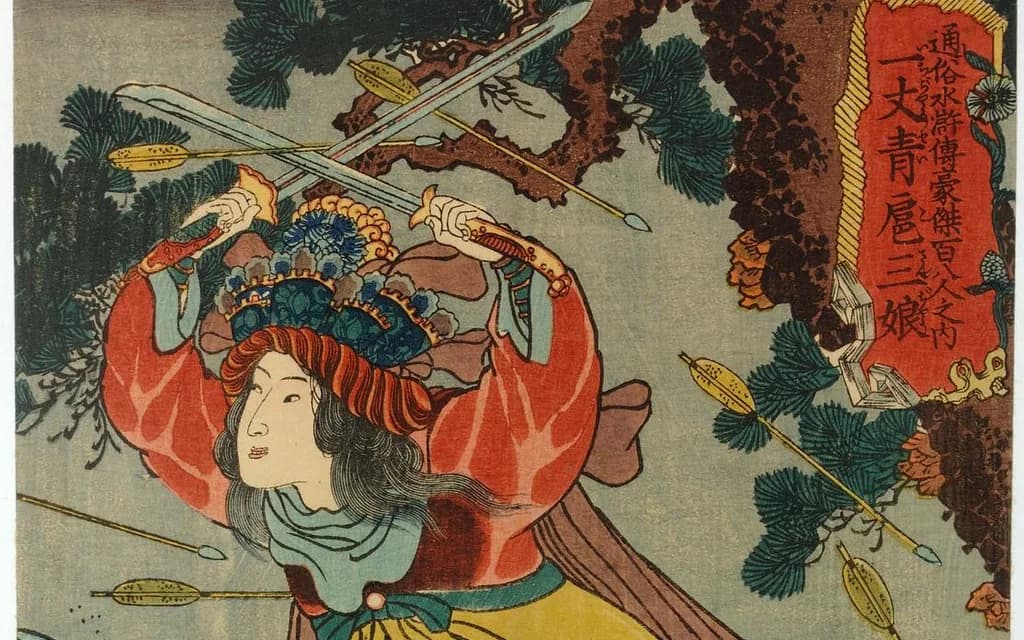
Three women in this novel get to fight alongside the men, and several more exist mainly to be killed by them. Readers notice this within about two hundred pages, and it is the second thing anyone searching for criticism of the book runs into. What is less well known outside Chinese-language scholarship is that this has been a live academic argument for sixty years, with serious critics on both sides, and that it has not been settled.
- The critics are genuinely split, and both positions are held by people who know the text far better than any summary of it.
- The novel has one word that it uses at the moment it kills a woman, and it uses that word eighty-eight times.
- Three women are heroes, and the book describes them almost entirely in the vocabulary it reserves for men.
- The counter-case is not a defence of the book. It is an argument about what exactly the hostility is aimed at.
This piece lays out both cases and the text they are arguing about, and does not hand down a verdict. If you want to meet these characters rather than read about them, the playable Water Margin includes the chapters where most of this happens.
📚 The short answer: the critics are split
The case against the book was put most systematically by the literary historian Zhang Peiheng, who argues that it celebrates male heroes by diminishing women, and that its female characters come in only two varieties. There are the masculinised ones, Sun Erniang, Hu Sanniang and Gu Dasao, and there are the wanton ones, Pan Jinlian, Pan Qiaoyun and Yan Poxi. His sharpest point is not about the categories.
It is that the novel writes the second group as innately lecherous, ignores the social pressure that produced them, and then presents their killings as admirable, which he calls the book's principal historical limitation. The essayist Zhou Zuoren put the same objection in one sentence in his 1964 memoir, and it remains the most quoted line in the argument: here, he wrote, the author seems to let something slip without meaning to, namely the degree of his loathing for women. It is a remark about tone rather than plot, and anybody who has read the killing scenes knows what he is pointing at.
The counter-case, which we come to at the end, does not deny that the book is hostile. It disputes what the hostility is aimed at.
🏮 Pan Jinlian, and what the book does to her
She is the most notorious adulteress in Chinese fiction and she occupies three chapters. Her story is that she is married to Wu Song's much older brother, is seduced by a wealthy local man with the help of a neighbour, poisons her husband with arsenic, and is killed by her brother-in-law at her husband's memorial altar.
Wu Song cuts her open, and then goes to find the lover and cuts his head off too. The detail worth having in front of you when you read the critics is how she got married in the first place, because the novel supplies it and then never mentions it again. She was a servant in a rich household; the master pressed her and she went to his wife and refused him; and he took his revenge by paying her dowry himself and handing her, free of charge, to the poorest and least prepossessing man he could find. That is the text's own account, in chapter 23, of how a young woman ends up married to a man she has no reason to want.
Both sides of the argument can use that paragraph, which is what makes it useful. It weakens the claim that the book is blind to the social machinery, since the machinery is right there on the page. It strengthens the claim about the book's priorities, since having supplied her with a motive in one sentence, the narration drops it entirely and spends the next two chapters calling her by a word that means, roughly, wanton woman. That word appears eighty-eight times in the seventy-chapter text, and it tends to arrive just before a knife does.
Her afterlife is larger than her part. She became a byword, then a stock figure of opera, and then the subject of a whole separate novel: the late-sixteenth-century Jin Ping Mei takes her and her lover out of these three chapters and builds an enormous domestic book around them. Whatever this novel intended, the culture that received it decided she was the most interesting thing in it.
Wu Song's own fame rests on the chapter before, and the tiger fight is taken apart here.
⚔️ The three women who get to fight
Hu Sanniang, Sun Erniang and Gu Dasao are the counterweight, and the way the book handles them is more complicated than either camp usually allows. All three are formidable, all three are described with the compliments the narration otherwise gives to men, and all three finish the novel with real jobs in the roster.
| Who | What the book does with her |
|---|---|
| Hu Sanniang, "Ten Feet of Green" | The best fighter on the field at the Zhu Family Manor, using paired sabres on horseback. A short outlaw called Wang Ying charges her precisely because he has heard she is a woman and expects an easy capture, and she takes him apart. In the final roster she and Wang Ying are the army's two mounted scouts. |
| Sun Erniang, "the Ogress" | Runs a roadside tavern with her husband where the meat is not what the customers think it is, drugs Wu Song, and nearly serves him. She ends the book running one of the four tavern outposts that watch the roads into the marsh. |
| Gu Dasao, "the Tigress" | Runs a tavern and a gambling den, and the text says twenty or thirty men cannot get near her and that her husband loses to her as well. She organises a jailbreak in chapter 48 while the men around her are still discussing it, and takes the second tavern outpost. |
This is the evidence the counter-case leans on, and it is real evidence. It is also where Zhang Peiheng's objection bites hardest, because the price of admission for all three is that they stop reading as women in the narration at all. Two of them carry animal nicknames. The book's highest compliment for a woman is that she fights like a man, and there is no version of a woman in it who is neither a warrior nor a wife.
The clearest single illustration is what happens to Hu Sanniang after her capture. She is the most dangerous fighter the outlaws have faced in twenty chapters. Song Jiang, having previously promised the short lecherous outlaw a wife and never delivered, hands her to him in chapter 49 as the settlement of that debt. Nobody asks her. The novel presents this as a piece of good leadership, a promise honoured, and moves on to the banquet.
🔍 The counter-case, made in 1973
In the first issue of the Hong Kong journal Renditions, Phillip S. Y. Sun published an essay arguing that the standard reading gets the target wrong. His claim is that the book does not hate women in general; it hates carnality, and the women it destroys are destroyed for what they do rather than what they are.
To be accurate, the world of The Water Margin does not hate the female sex as a whole. What is detested here is lascivious thought and behaviour.
His supporting evidence is textual and checkable. The men in these affairs are killed too: Pan Jinlian's lover has his head cut off in the same hour she does, and the monk in the Pan Qiaoyun episode is killed too, in the street, a chapter before she is. Sun points out that in the medieval European stories that get compared to this one, the adulteress usually walks away, and argues that killing both parties is, in its own grim way, the more even-handed arrangement. He also concedes the cost: because the book finds physical appetite distasteful, its women almost never get to be beautiful and good at the same time.
Two things sit awkwardly with that reading, and an honest piece has to say so. The first is the manner of the killings. The men are dispatched; the women are opened. The second runs across two chapters. In chapter 33 Song Jiang, having already had his enemy killed, says out loud that his anger is still not out of him because the wife is alive; in chapter 34 one of his followers obliges by cutting her in half. That is a scene about a grievance being satisfied by a woman's death, and it is hard to file under distaste for appetite.
The other standing counter-argument is Yenna Wu's, from 1996, and it works at a structural level rather than a moral one. She argues that this is the first major Chinese novel to use extended dream sequences as a deliberate literary device, and that those dreams push against the book's own misogyny, both through their feminine symbolism and through the positive female figures who appear inside them. The most famous of those dreams is the one that ends the seventy-chapter edition, which is also where our piece on the ending begins.
So there is no verdict here, and pretending otherwise would misrepresent the state of the argument. What can be said flatly is the list. Yan Poxi, Song Jiang's own mistress, in chapter 20; Pan Jinlian in chapter 25; Liu Gao's wife in chapter 34; Pan Qiaoyun in chapter 45; and Lu Junyi's wife Jia, killed by her own husband, in chapter 66: five women killed by men the book admires, each introduced with the same word, across a novel where the brotherhood's own code holds that a man who spends himself on women is a joke. Readers can weigh that against Sun's argument themselves, which is exactly what Chinese critics have been doing since the 1960s.
Sun's essay is free at the Chinese University of Hong Kong, Yenna Wu's is in Chinese Literature: Essays, Articles, Reviews, and every chapter number above was checked against the Chinese text at Project Gutenberg. If you are deciding whether to read the book at all, start with the edition question.
Sources
- 水滸傳, 第二十三回–第二十五回, 第四十六回–第四十九回 (Chinese text) — Project Gutenberg
- The Seditious Art of The Water Margin — Misogynists or Desperadoes? Renditions no. 1 (1973), 99–106 — Renditions, Chinese University of Hong Kong
- Outlaws' Dreams of Power and Position in Shuihu zhuan, CLEAR 18 (1996), 45–67 — Chinese Literature: Essays, Articles, Reviews
- Woman Warriors of the Classic Chinese Novel Shuihu Zhuan — University of Florida
- Water Margin — Wikipedia
Frequently asked questions
- Is Water Margin misogynistic?
- Scholars genuinely disagree, which is not the same as nobody minding. The essayist Zhou Zuoren put the case against it in one line in his 1964 memoir: here, he wrote, the author lets something slip without meaning to, namely the degree of his loathing for women. Others read the same scenes as hostility to sexual appetite rather than to women.
- Who is Pan Jinlian in Water Margin?
- Wu Song's sister-in-law, and the most notorious adulteress in Chinese fiction. Her afterlife is bigger than her part: the late-sixteenth-century novel Jin Ping Mei takes her and her lover Ximen Qing out of these three chapters and builds a whole book of its own around them, which is how she became a byword rather than a character.
- Are there any strong female characters in Water Margin?
- Three, and their nicknames tell you how the book files them. Gu Dasao is the Mother Tiger, using the same word the novel uses for the animal Wu Song fights; Sun Erniang is the Ogress; Hu Sanniang alone is named for her fighting reach rather than a beast. Two of the three are introduced running taverns rather than commanding troops.
- Do scholars agree that Water Margin is anti-woman?
- No. Beyond the two main positions there is a third: Yenna Wu argued in 1996 that this is the first major Chinese novel to use extended dream episodes as a deliberate device, and that those dreams work against the book's own misogyny, both through their feminine symbolism and through the positive female figures inside them.
- Which women does Water Margin kill?
- At least five, and the killers are almost never strangers. Song Jiang kills his own mistress; Wu Song kills his sister-in-law; Yang Xiong kills his wife; Lu Junyi kills his. Only Liu Gao's wife is killed by a man unrelated to her, and he does it to settle someone else's grievance. The novel reserves its intimate violence for households.
- What happens to Hu Sanniang?
- She is married off in chapter 49 to Wang Ying, the lecher she had beaten and captured on the battlefield, because Song Jiang had promised him a wife and needed one. She dies in the last campaign of the long edition and is posthumously made a Lady of Huayang Commandery, which is the sort of honour the book hands out after it has stopped listening.
Enjoyed this one?