Wu Song and the Tiger: the Most Famous Scene in Chinese Literature, Explained
A drunk man walks up a hill past a warning notice he has decided not to believe. Ten minutes later he is kneeling on a tiger in a mud pit with his weapon in two pieces.


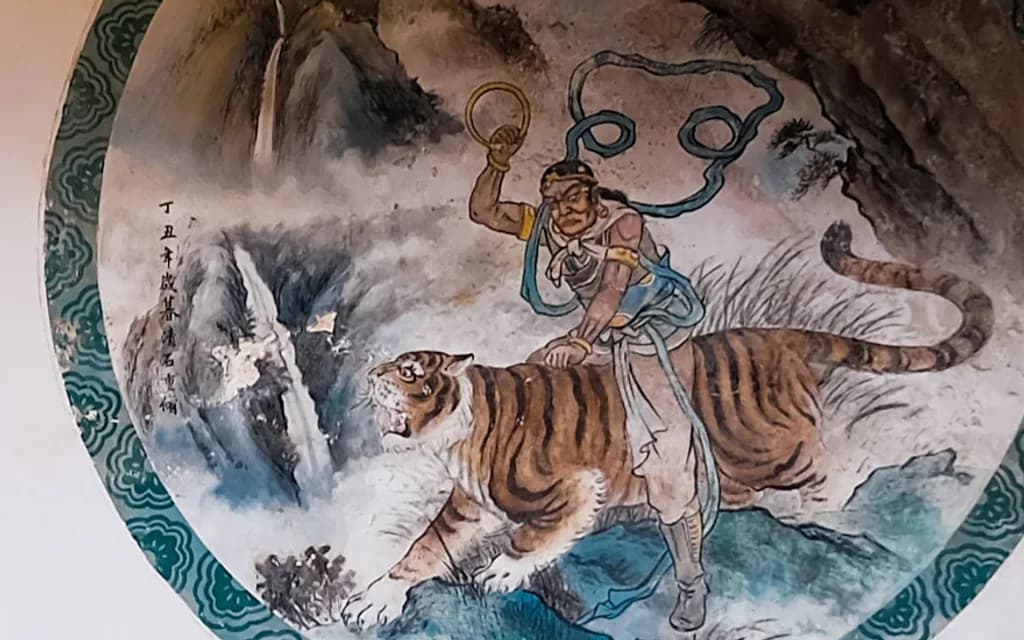
There is a hill in Shandong called Jingyang Ridge, and a tavern at the bottom of it with a five-character banner outside promising that three bowls of the house wine will stop you getting over the top. A large man walks in, drinks eighteen, argues with the barman about the warning notice, and climbs the ridge at dusk with a wooden staff and no intention of being sensible. The scene that follows is probably the single most reproduced fight in Chinese literature, and almost every retelling gets the same detail wrong: the staff never lands.
- It is chapter 22 of the seventy-chapter edition, and the chapter title announces it: Chai Jin keeps guests in Henghai, and Wu Song beats the tiger on Jingyang Ridge.
- The eighteen bowls are literal. The text counts them, and the sign said three.
- His weapon fails. The staff snaps in half on the first real swing, and everything after that is done with hands and feet.
- The reward is the point. He is handed a thousand strings of cash and gives every coin away in the same scene.
If you would rather do it than read about it, the playable Water Margin has this exact scene as a doorway, and the interesting choice is not the fight. It is whether you read the notice on the shrine door and go back down.
🐅 What actually happens on Jingyang Ridge
The build-up is longer than the fight and does more work. The barman refuses to keep pouring; Wu Song threatens to take the place apart; the barman pours six more and stops counting. On the way out the barman runs after him with the county's warning: there is a white-browed, upward-glaring beast on the ridge that has killed twenty or thirty grown men, and travellers are supposed to cross in groups, in daylight.
Wu Song decides this is an innkeeper's trick to sell him a room for the night, and walks. Halfway up he passes a tree with the bark scraped white and writing on it, and then a collapsing shrine to the mountain spirit with an official notice pasted to the door, stamped and sealed. He reads it standing there and understands that all of it was true. He also works out, in the same breath, that going back down means the barman laughing at him, and that this is unacceptable. Every version of this story that treats him as fearless misses the actual line of thought, which is embarrassment.
Then he lies down on a flat blue-green boulder to sleep it off, and the wind picks up. The tiger comes out of the scrub behind him. The book is unusually technical about what happens next: the animal has three attacks, a pounce, a heave of its haunches and a lash of its tail like an iron bar, and the narrator tells you flatly that when all three miss, half its fight has already gone out of it. Wu Song dodges all three, mostly by accident, and his drunkenness comes out of him as cold sweat.
His swing with the staff snaps it in two, and he is left holding half a stick in front of an angry tiger. What follows is the least heroic and most convincing violence in the novel. He catches the loose skin on top of its head, pushes the head down, kicks it repeatedly in the face and eyes while it scrabbles a hollow in the dirt, then holds its muzzle in that hollow and hits it with his right fist somewhere between fifty and seventy times, until blood comes out of its eyes, mouth, nose and ears. Then he picks up the broken half of the staff and beats it again, because he is not sure it is dead.
The detail that sells the whole thing is what happens after. He tries to drag the carcass down the hill and cannot lift it, because his arms and legs have stopped working. He sits back down on the rock.
🍶 The eighteen bowls, and the sign that said three
The wine is not decoration, and the number is exact. The banner outside the tavern carries five characters, and the barman explains them when Wu Song asks: anyone who drinks three bowls of his wine gets drunk enough that they cannot get over the ridge ahead. It is a boast dressed as a warning, and it is also, the text implies, a fair description of the wine.
Three bowls, and you don't cross the ridge.
Wu Song drinks three and asks why he is not drunk. The barman keeps refusing and keeps pouring, and the count lands at eighteen. On his way out he laughs at the sign on his way past it, which is the joke the scene has been setting up for two pages.
The bowls matter because they make the fight a near-miss rather than a display. A sober man with an intact weapon might have handled a tiger. This one is drunk enough to lie down outdoors on a hill he has just been told is lethal, and his advantages are gone by the second exchange. The novel puts a man in the worst possible condition for the most dangerous situation available and then has him win by sheer refusal, which is the template for every Wu Song scene afterward, including the one where he takes on a champion wrestler while deliberately drinking his way there.
🔎 Was Wu Song a real person?
No, and the honest answer is more interesting than a flat denial. There was a real bandit called Song Jiang in the early twelfth century, and by the thirteenth century Chinese writers were listing his thirty-six companions by name, two hundred years before this novel existed. Wu Song's name attaches itself to that growing legend early, alongside Lin Chong, Lu Zhishen and Yang Zhi.
What he does not have is a biography. The tiger, the brother, the eighteen bowls and the revenge are storytelling that accumulated around a name. The book itself is careful to make him physically plausible rather than superhuman. When his brother appears in the next chapter, the narrator pauses to measure them both: Wu Song is eight feet tall with the strength of hundreds of men, and his elder brother is under five feet, so ugly that the town gave him a nickname about it. The pair are introduced as a biological joke, which is what makes the rest of their story land.
That story is where the tiger leads. Wu Song's reward for the ridge is a constable's post in the county where his brother happens to live, and everything that follows, including the killing of his sister-in-law at his brother's memorial altar and, an hour later, of her lover at a wine-house by Lion Bridge, comes out of that appointment. The novel's treatment of the sister-in-law is the most argued-over thing in the book, and we give it its own piece.
🏛️ Why this fight, out of a hundred fights
Because it is the one scene in the novel that works with nothing else attached. You do not need to know who Wu Song is, what Liangshan is, or why the empire is rotting. A man, a hill, a tiger, and a bad decision about wine: it survives being told in four sentences at a dinner table, and almost nothing else in this hundred-and-eight-character book does.
So it stopped being a chapter and became a picture. It is painted on temple walls, staged as opera, printed as woodblock, and taught to children who will never read the surrounding novel. The mural at the top of this page is on a temple wall in Tainan; there is another version of the same moment on the Long Corridor at the Summer Palace in Beijing, painted in the nineteenth century, along a walkway thousands of people pass every day without knowing which chapter they are looking at.
For a measure of how much the fame is about the telling rather than the deed, set it beside chapter 42. Li Kui, on his way home with his blind mother, leaves her on a rock to fetch water and comes back to find her eaten. He goes into the cave and kills four tigers in one night with a knife: two cubs, the tigress, and finally the male. It is a bigger feat, it is far more upsetting, and outside China almost nobody can tell you it happens. The difference is that Wu Song's fight has a joke, a sign, a countable number of drinks and a punchline, and Li Kui's has a dead mother.
The last beat is the one adaptations cut, and it is the reason readers stay fond of him. The village carries the tiger and the man down together in a sedan chair. The magistrate hands over the bounty, a thousand strings of cash, and Wu Song points out that the local hunters have been beaten with rods for failing to catch this animal, and asks that the money be split among them instead. He walks out of the most famous fight in Chinese literature with the same amount of money he walked in with.
The Chinese text of chapter 22 is free at Project Gutenberg, and it is where the eighteen bowls, the broken staff and the count of punches in this piece were checked. If you want the version of the book that lands hardest on first-time readers, it is the framed weapons instructor, and if you are deciding which edition to buy, start here.
Sources
- 水滸傳, 第二十二回 (Chinese text) — Project Gutenberg
- Water Margin — Wikipedia
- 水滸傳 (120回本), 第一百十九回 — Chinese Wikisource
Frequently asked questions
- What happens when Wu Song fights the tiger?
- He kills it with his bare hands after his staff breaks. The chapter carries the fight in its own title — chapter 22 of the seventy-chapter edition is headed with Chai Jin entertaining guests and Wu Song beating the tiger on Jingyang Ridge. The book never uses the ordinary word for tiger in the fight; it calls the animal a dachong, a great beast.
- Is Wu Song the only person who kills a tiger in Water Margin?
- No, and the comparison is unkind to him. In chapter 42 Li Kui kills four tigers in a single night on Yiling Ridge, with a knife, after they eat his blind mother. It is a bloodier scene and almost nobody outside China can name it, which says something about why the Wu Song fight travelled and the other did not.
- Is Wu Song based on a real person?
- There is no historical Wu Song behind this. The Song Jiang band itself has a documentary trace, and the earliest surviving lists of his companions were written in the thirteenth century, two centuries before the novel; Wu Song's name is attached to that legend early. The tiger, the brother, the eighteen bowls and the revenge are storytelling, not record.
- What happens to Wu Song at the end of Water Margin?
- In the long edition he loses an arm in the last campaign, refuses the emperor's honours, and stays on at the Liuhe Temple in Hangzhou as a monk, where the text says he lived to eighty. He is one of the few who ends better than the men who accepted the promotions. That whole arc lies past the point where the shorter edition and the playable version stop.
- Is tiger style kung fu connected to Wu Song?
- Not in any documented way. Tiger styles are a real family of southern Chinese martial arts with their own lineages, and this is a scene in a novel in which the hero uses no style at all: he kicks, he holds the animal's head down with one hand, and he punches it with the other. The two things share an animal and nothing else.
- Why is Wu Song fighting the tiger so famous in China?
- Because it stopped being a scene in a book and became a picture. It is painted in temples and on garden walls, restaged as opera, and taught on its own: the mural at the top of this page is on a temple wall in Tainan, and there is another version of the same moment on the Long Corridor at the Summer Palace in Beijing.
Enjoyed this one?