Lin Chong: Why Water Margin's Most Wronged Hero Is the One Readers Love
He is the most decorated soldier in the book and he does nothing wrong. That is the point: the empire spends nine chapters proving that being blameless is not protection.


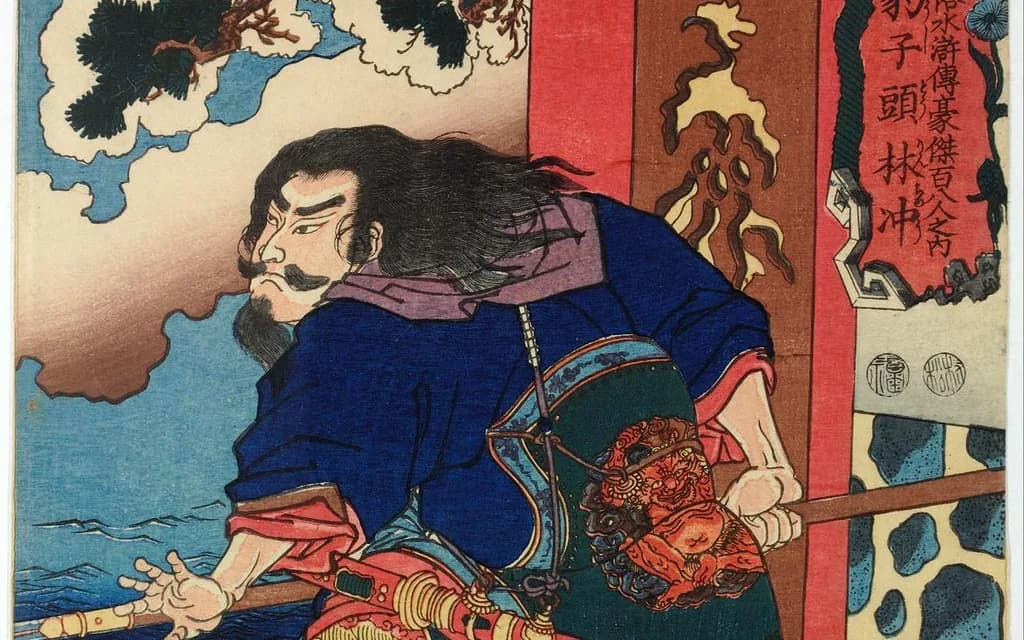
Ask people who have read this book which outlaw they think about afterwards and a surprising number say the same name, and it belongs to neither the leader nor the tiger-killer. It belongs to a mild-mannered fencing instructor who is polite to everybody, does absolutely nothing wrong, and is destroyed anyway across four of the best chapters in the novel. Lin Chong is the book's argument in one man: that in a corrupt state, being blameless is not protection, it is an invitation.
- He starts at the top. Arms instructor to the imperial guard, married, respected, with a career and something to lose.
- The cause is a nuisance, not a war.A marshal's adopted son wants his wife, and the machinery of the state does the rest.
- His best friend sells him. The man who lures him out of the house is the one the text calls his closest.
- He is charged with a fire he did not set. The inversion is the moment the story stops offering him a way back.
The reason readers hold on to him is that all of this happens to a man who keeps trying to behave well. If you would rather live it than read about it, the playable Water Margin carries his whole collapse as three consecutive doorways, and the interesting decisions in it are all about how long you stay reasonable.
🐆 Who Lin Chong is, and why readers name him first
His title in the text is arms instructor to the eight hundred thousand men of the imperial guard, which is a formula rather than a headcount, and it means he is the man who teaches the capital's soldiers to fight. He is good enough that when he first appears he is watching a tattooed monk swing a staff and admiring the technique.
He is also, unusually for this book, happy: married, employed, drinking with a new friend, with no grievance at all. The turn comes at a temple. His wife is accosted on the stairs by a young man who will not let her pass; Lin Chong runs up, spins him round by the shoulder, draws back his fist, and recognises the face. It is the adopted son of his own commanding officer. The text gives the moment four characters: his hand goes soft. He lets go, and the young man, who has not realised whose wife he was blocking, complains about being interrupted.
That single gesture is why the character lasts. Lin Chong has no cowardice in him, and the book never suggests otherwise. He is a man with a career, a wife and a rank calculating in real time what hitting his superior's son will cost his household, and arriving at the answer everyone reading has arrived at in some smaller room. What follows is the novel demonstrating that the calculation was wrong, and that restraint bought him nothing at all.
⚖️ The frame-up, in three chapters
The plan does not come from the marshal. A hanger-on called Fu An designs it, having worked out that the direct approach fails because Lin Chong is dangerous, and that the state can be used instead: exile him if you are being gentle, kill him if you are not. The first attempt is a decoy.
Lin Chong's closest friend, an officer named Lu Qian, invites him out drinking while a man sent round to the house tells his wife that her husband has collapsed and she should hurry. The narrator records Lu Qian's reasoning in eight characters: he could not, in the end, take his friendship into account. The second attempt is the one that works, and it is beautifully constructed. A stranger appears in the street with a fine sabre for sale, complaining loudly that nobody in the capital knows a good blade. Lin Chong, a professional, cannot help himself. He buys it, takes it home, hangs it on the wall, gets up before dawn to look at it again, and says that he will compare it with the one in the marshal's collection. The next morning two orderlies arrive to say the marshal has heard about the sword and wants to see it.
They walk him through the residence and leave him waiting under an eave. He looks up and reads four blue characters on the lintel: White Tiger Council Hall. It is where military business is discussed, and entering without a summons is a capital matter. He turns to leave and hears boots behind him. Gao Qiu comes in, sees a serving officer standing inside the council hall holding a naked blade, and asks the only question the scene needs, which is whether Lin Chong has come to murder him.
He is sentenced to be tattooed on the face and marched two thousand li to Cangzhou. The part adaptations leave out is what he does before he goes. He calls his father-in-law and his wife to the prison gate and dictates a document.
His wife being young, he freely sets down this writ: she may remarry as she pleases, and there shall never be any dispute.
He divorces her for exactly one reason, and it is not the one it looks like. A woman married to a convicted man in exile has no future, and this is the only thing left that he can still give her. Her father refuses to accept it and swears he will not marry her to anyone. On the road, Lu Qian pays the two escorts ten taels of gold to kill him quietly; they scald his feet with boiling water so he cannot run, and tie him to a tree in the Wild Boar Forest. The tattooed monk from the temple has been following at a distance the whole way, and comes out of the undergrowth with a staff.
❄️ The snowstorm at the mountain shrine
In exile he is given what looks like a promotion: guard the great army fodder depot, fifteen li outside the city, a post with a small income attached. It is a trap and the reader knows it two pages before he does.
A blizzard sets in, the hut he has been given starts to come apart under the snow, and he walks out for wine, which is the only reason he is not inside the depot when it goes up. He shelters in a broken shrine to the mountain spirit and pushes a stone against the door. Three men stop outside to watch the fire, and because the door is shut they speak freely: how many torches they set, whether the job is eight-tenths done, that even if the man escaped the flames, losing a military depot is a capital charge on its own. One of the voices is Lu Qian.
What he does next is the most violent thing in his part of the book and the most controlled. He kills the warden's runner in the doorway, chases Lu Qian down in the snow, opens his friend's coat and cuts the heart out of him, then goes back for the third man. There is no speech and no hesitation, and it is the only time in nine chapters that he acts before he thinks.
Chapter 10 then does the thing that makes this whole sequence stick. The camp administration files its report, and the warrant that goes out names him for three murders and for setting fire to the great army fodder depot, with three thousand strings of cash offered for his capture. He is now, officially, an arsonist. The fire that was lit to kill him has become his crime, and there is no version of events he can tell that anybody is obliged to believe.
🗡️ Why "wronged" lands harder than "heroic"
Because the book gives him no revenge on the man at the top. Lin Chong does get one moment of decisive action: Liangshan, when he arrives, is run by a small-minded chief called Wang Lun who turns away every man better than himself, and in chapter 18 Lin Chong cuts him down at a banquet and hands the seat to someone worthier.
It is the only time he moves first, and the chapter is titled for it. It changes the mountain. It does not touch the marshal. Then chapter 19 delivers the answer to the question he has been carrying since the prison gate. He sends two men to the capital to bring his wife up to the mountain. They come back with the news that she was pressed to marry the marshal's son, that she hanged herself half a year ago, and that her father died of worry a fortnight before they arrived. The text gives Lin Chong one line of reaction: tears fall, and from then on he stops thinking about it. He never gets the man responsible. Nothing in the rest of the novel corrects the account.
The long edition is crueller still. In the hundred-and-twenty-chapter version he survives the final campaign, is paralysed by a stroke on the road home, and is left in a Hangzhou temple in Wu Song's care, where he dies half a year later. Gao Qiu is still in office. A reader who wants to know how the rest of that ending goes will find the amnesty explained here, and it does not improve.
This is why he is the character people name. A hero who wins teaches you about heroism; a decent man ground down by paperwork, a superior's nepotism and one friend's weakness teaches you about the world you actually live in. When the hundred and eight are finally ranked, Lin Chong is placed second among the Five Tiger Generals of the cavalry, near the very top of a hundred-and-eight-name list. The book gives him rank because it cannot give him justice.
Chapters 6 to 11 are free in Chinese at Project Gutenberg, and they are where the writ, the warrant and the reward figure in this piece were checked. For the scene that made the book famous instead of admired, see Wu Song and the tiger, and if you are still choosing an edition, the translation comparison is here.
Sources
- 水滸傳, 第六回–第十一回 (Chinese text) — Project Gutenberg
- Lin Chong — Wikipedia
- 水滸傳 (120回本), 第一百十九回 — Chinese Wikisource
Frequently asked questions
- Who is Lin Chong in Water Margin?
- The arms instructor of the imperial guard, nicknamed the Panther Head, and one of the very few outlaws who arrives at Liangshan with a career rather than a grudge. When the hundred and eight are finally ranked, he is listed second among the Five Tiger Generals of the cavalry, behind Guan Sheng and ahead of Qin Ming.
- Why does Lin Chong become an outlaw?
- Because a marshal's adopted son wants his wife, and the marshal frames him for attempted murder rather than be embarrassed. The state's own paperwork finishes the job: after the fodder depot burns, chapter 10 records the warrant against him for three killings and the arson, with a reward of three thousand strings of cash for his capture.
- What happens in the snowstorm at the mountain shrine?
- His enemies set fire to the depot he is guarding, expecting him to burn with it. He is sheltering in a roadside shrine when they stop outside to admire their work, and he hears them describe the plan. He kills all three. He is then charged with the fire they lit, which is the moment the book stops offering him a way back.
- Is Lin Chong based on a real historical figure?
- No frame-up like his is recorded. His name is attached to the Song Jiang legend in thirteenth-century sources, well before the novel, but the marshal, the wife, the depot and the shrine have no documentary basis. Gao Qiu, the marshal, was a real official at Huizong's court, which is part of why the story bites.
- Does Lin Chong kill Wang Lun?
- Yes, and it is the only time in the book he acts first. Chapter 18 is titled for it: Lin Chong makes a great blaze in the water fortress, and Chao Gai takes the stronghold. Wang Lun is the sitting chief of Liangshan who keeps turning talent away out of fear, and Lin Chong, who was turned away himself, cuts him down at a banquet.
- What is the moral of Water Margin?
- That a just order can stop being available to decent people. The outlaws fly a banner reading that they act on Heaven's behalf, which is a claim to legitimacy rather than a rejection of it, and the title itself points at a place rather than a cause: the water's edge, the margin of the marsh, the ground you are pushed onto when the law stops working.
- What happens to Lin Chong at the end of Water Margin?
- In the hundred-and-twenty-chapter version he never gets his revenge. He survives the last campaign, is paralysed by a stroke on the way home, and is left at the Liuhe Temple in Hangzhou in Wu Song's care, where the text says he died half a year later. The marshal who framed him is still in office.
Enjoyed this one?