Is Antony and Cleopatra a Love Story or a Political Play? Both, and the Octavia Marriage Proves It
One camp reads the greatest love story Shakespeare wrote; the other reads a study of power with a romance inside it. The scene list answers more clearly than either. Forty-two scenes, eleven with both leads speaking, one with nobody else talking, and a wedding negotiated like a treaty clause.


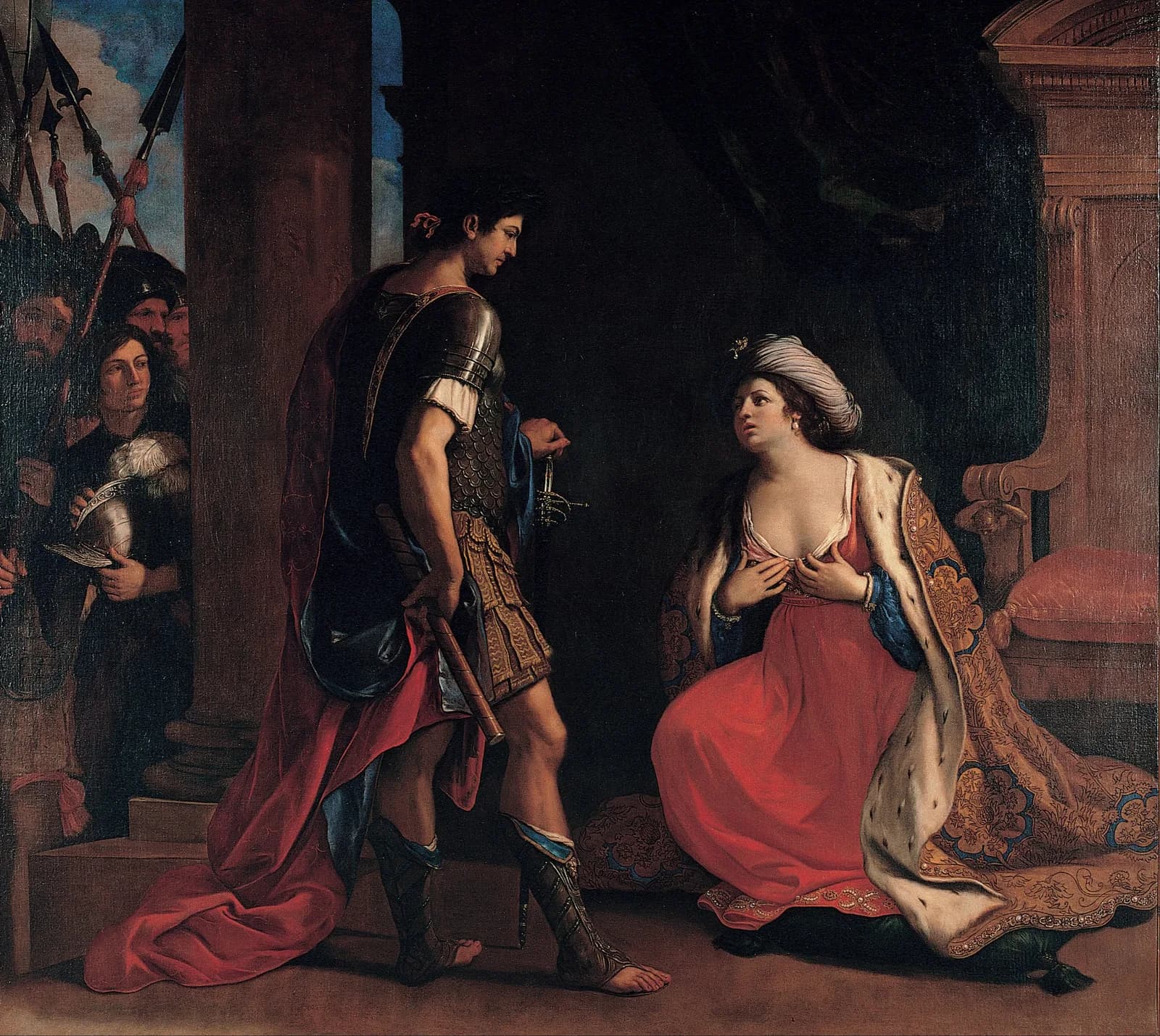
The argument about this play is old and it never settles. One side reads the greatest love story Shakespeare wrote. The other reads a study of power in which two heads of state ruin themselves and a third one collects. The play’s own construction gives a clearer answer than either camp usually admits, and you can count it.
What follows is the structural case, made with the scene list rather than with adjectives. The same politics run underneath the playable Antony and Cleopatra, where a letter from Rome arrives whether or not you want one.
🔢 Count the scenes and the argument changes
Antony and Cleopatra is built out of 42 scenes, which is a lot: five in the first act, seven in the second, thirteen in the third, fifteen in the fourth, two in the last. That shape has its own critical literature, and much of it treats the play as a structural problem to be excused. The complaint assumes the scenes are supposed to be about the lovers, and most of them are not.
Both of them have a line in eleven scenes of the forty-two. In fifteen scenes neither of them speaks at all: Pompey’s house in Messina, the galley at Misenum, a plain in Syria, two rooms in Athens, the ground between two camps, the camps themselves. More than a third of this play happens in rooms where the title characters are not present and are being discussed, invoiced, or planned around.
| Setting | Scenes |
|---|---|
| Alexandria, Egypt, the monument | 21 |
| Rome | 6 |
| Everywhere else: Messina, Misenum, Pompey's galley, Syria, Athens, Actium, the camps | 15 |
Egypt has half the scenes and never has the room to itself. Rome gets six. The second-largest block belongs to the ships, camps and provinces where the empire is being divided up while the affair goes on. Shakespeare wrote a love story and then buried it inside a map.
🕯️ They get one scene to themselves in the whole play
Run through the eleven scenes where both of them speak and check who else has a line. In ten of them the answer is Enobarbus, Charmian, a messenger, Eros, Scarus, a soldier, an attendant. In one scene, Act 4 Scene 8, nobody but Antony and Cleopatra speaks from beginning to end.
Even that is not privacy. The stage direction sends Antony on “in a march” with Scarus and a company of soldiers, and he spends his first speech thanking them for a day’s fighting. They are standing right there. They just never answer, and the scene ends with Antony ordering trumpets and drums through the streets of Alexandria. The one time the play lets these two talk without interruption, it is a victory parade.
That is a deliberate piece of construction, and it is why the love-story-only reading keeps running out of evidence. The play never gives these two the scene the genre depends on, which is two people alone in a room with the door shut. The nearest it comes has an army standing in earshot.
📨 The seventh-largest role is a job title
Count by speaking part and the same picture appears from another angle. Antony leads with 853 lines and Cleopatra follows with 689. Caesar — Octavius, not the murdered Julius — has 422, and Antony’s lieutenant Enobarbus 326, then Pompey with 138 and Charmian with 104. Seventh on that list, ahead of Lepidus, Agrippa, Menas, Eros and every other named Roman, comes a character with no name at all. The Messenger speaks 72 lines across 42 separate speeches, which happens to be one for every scene in the play.
Those entrances are the play’s actual engine. News from Rome interrupts the first scene before the lovers have finished their opening exchange. The report of his wife Fulvia’s death, in the second scene, is what makes Antony say he must break off from the queen and go home; a domestic bereavement arrives as a dispatch and functions as a summons. News of the Octavia marriage produces the scene in which Cleopatra beats a messenger for reporting it accurately, which another essay here reads as character and which works structurally as well: information keeps arriving, and every time it does, somebody has to choose between a person and a position.
A play whose seventh-largest role is a courier is a play about communication under pressure. Shakespeare could have written the interruptions as offstage summary and did the opposite, giving them bodies, entrances and lines, so that the audience watches the empire physically walk into the room again and again.
💍 The marriage that proves the case
The clearest evidence sits in Act 2, and it is a wedding. Caesar and Antony have patched up a quarrel and neither believes it will hold, so Agrippa proposes a fix, in the flat language of a treaty clause.
“To hold you in perpetual amity, / To make you brothers, and to knit your hearts / With an unslipping knot, take Antony / Octavia to his wife.”
Nobody in the room pretends this is about affection, least of all the man agreeing to it. Octavia is Caesar’s sister, the marriage is a knot meant to hold two rulers together, and Antony accepts before the scene ends. One scene later, alone with a soothsayer who has told him to go back to Egypt, he says what the marriage is for and what it will not change.
“I will to Egypt: / And though I make this marriage for my peace, / I’ th’ East my pleasure lies.”
Peace and pleasure, named separately, in one sentence, by the man doing both. A love story would have to call that hypocrisy. A political play calls it a treaty being signed by someone who has already read the clause he intends to break. When Antony does break it, Caesar’s public case against him in Act 3 Scene 6 is not about a broken heart at all; it is a list of provinces handed to a foreign queen and her children, and a sibling essay follows that.
💔 So is it a love story
Yes, and the politics is what makes it one worth reading twice. Every declaration in this play carries a price tag that somebody eventually pays: a province, a fleet, a legion, a sister. Shakespeare’s interest is not in whether the two of them mean it. He assumes they do. His interest is in what a private feeling costs when the two people having it are responsible for a third of the known world.
Read that way, the sprawl stops looking like a flaw. The cutting between Alexandria and a camp is the argument. If you want the version of the story that reads Antony’s first choice as clear-eyed rather than bewitched, this hub has an essay on exactly that. Every scene, heading and count above is from the free text at Project Gutenberg, cross-checked against the Folger edition.
Sources
- Antony and Cleopatra (Project Gutenberg text) — Project Gutenberg
- Antony and Cleopatra — Folger Shakespeare Library
- Antony and Cleopatra — the plot — Royal Shakespeare Company
Frequently asked questions
- Is Antony and Cleopatra a love story or a political play?
- Both, and the play refuses to rank them. The romance is never staged outside a political emergency. Count the appearances and the balance is plain: Antony speaks in twenty-two of the forty-two scenes and Cleopatra in sixteen. The title pair are outnumbered by the map they are losing.
- How many scenes are in Antony and Cleopatra?
- Forty-two, counted from the scene headings: five in Act 1, seven in Act 2, thirteen in Act 3, fifteen in Act 4, two in Act 5. Scenes are not the same as size. The play runs 3,535 spoken lines, and they fall 579, 850, 886, 694 and 526 by act, so the two-scene last act still carries 526 of them.
- Why does the play keep cutting back to Rome?
- To keep the cost of the affair visible. Twenty-one scenes are set in Alexandria or Egypt, six in Rome, and fifteen in the places where an empire is actually run. The separation is total: Caesar and Cleopatra speak in the same scene exactly once in the whole play, and it is the last one.
- Was Antony's marriage to Octavia political?
- Entirely, and the play says so out loud. Caesar asks for something to hold the two men together before anyone has named a bride, Agrippa proposes his sister as an unslipping knot, and one scene later Antony says he makes the marriage for his peace while his pleasure lies in the East. Octavia gets thirty-seven lines in four scenes and never appears again after Act 3 Scene 6.
- Do Antony and Cleopatra ever get a scene alone together?
- Not really. In only one scene of the forty-two, Act 4 Scene 8, does nobody else have a line, and even there the stage is full of soldiers Antony has just thanked. The play never lets anyone be alone for long. Its longest single speech is twenty-four lines, Antony's, in Act 4 Scene 12.
- Does the play take a side between love and duty?
- No, and it declines on purpose. Antony's choice is staged as both a genuine devotion and a catastrophic failure of office, with equally good evidence for either reading. The refusal goes to the end. The last new character Shakespeare introduces is a Clown, who walks into Act 5 Scene 2 with a basket of figs and a joke about the bite being immortal.
Enjoyed this one?