What the green light in The Great Gatsby really means — and why you've felt it (2026)
Gatsby stands on his lawn at midnight reaching for a tiny green light across the bay. Everyone reads it as romance. It's really about every thing you're never going to have — the ex's profile, the apartment you can't afford, the version of you that's always one summer away.


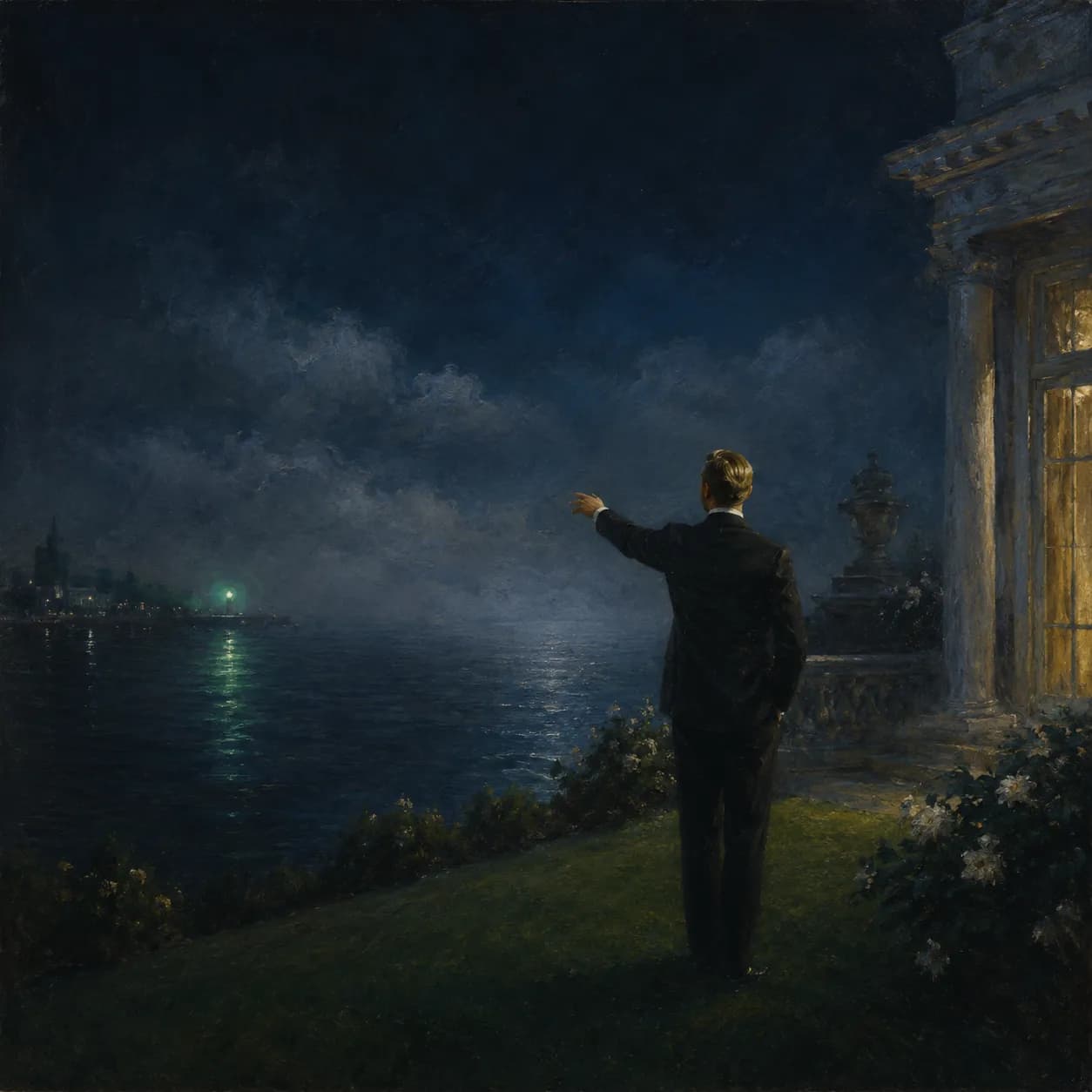
You've been sold The Great Gatsby as champagne and Leonardo DiCaprio — a glossy party movie about a rich man and the girl across the water. Then you actually look at the image the whole book is built on, and it's much smaller and much closer to home: a man alone on his lawn after midnight, reaching both arms across a dark bay toward one tiny green light on a dock he can't reach. If you've ever stood somewhere doing the human version of that — and you have — you've already read most of this book.
- The green light is a real dock light— a piece of boat equipment at the end of Daisy's dock that Fitzgerald turns into the most quoted image in the novel.
- It was never just Daisy. The last page widens it to any unreachable thing you keep straining toward.
- The closing line is the most-tattooed sentence in the book— and it's about longing, not romance, which is exactly why it scales.
- You have a green light right now.It's probably an open browser tab.
| The Gatsby you've been sold | The book Fitzgerald wrote |
|---|---|
| A glossy champagne party movie | A 50,000-word study of wanting what you can't have |
| The green light = Daisy | The green light = every unreachable thing, Daisy included |
| A sweeping romance | A story about longing, which is bigger than romance |
| A period piece about the 1920s | A description of your 11 p.m. browser tabs |
🌃 The scene everyone half-remembers
Strip away the soundtrack and the fireworks and the whole book reduces to one posture: Gatsby on his lawn, in the dark, reaching toward a small green dot across the water. The light is literal — it's an ordinary dock light at the end of Daisy's dock, the kind that stops boats hitting the pier at night. Fitzgerald took a piece of boating hardware and made it one of the most quoted images in American literature, which is part of the point: the thing you long for can be small and plain and still run your entire life.
Then you've already read most of The Great Gatsby, honestly. The whole novel is that posture, start to finish.
💚 The green light was never just Daisy
The green light was never really about Daisy — that's the part school flattens. “The green light symbolizes Daisy” is the answer everyone memorizes, and it isn't wrong — it's just thin. Gatsby isn't really staring at a woman. He's staring at the idea of her: Daisy, plus the life where he gets her, plus the version of himself that would deserve her. That's a lot of weight to hang on one small bulb.
Okay, here's the good part. He's not really staring at her. He's staring at the idea of her.
And on the final page Fitzgerald widens the light past Daisy entirely. He calls it “the orgastic future that year by year recedes before us” — the thing we run faster toward each year that never gets any closer. Read that way, the green light isn't a romance symbol at all. It's the universal mechanism of wanting, and Daisy is just the local instance of it standing on a dock.
🖋️ The line that left the book
The novel ends on the sentence people put on their forearms: “So we beat on, boats against the current, borne back ceaselessly into the past.” It's the most-liked Great Gatsby quote on Goodreads by a wide margin — nearly thirteen thousand readers have hearted it — and the single most-tattooed line in the book. The reason it travels is the same reason the green light does: it isn't describing a couple, it's describing the feeling of reaching.
Almost thirteen thousand likes on Goodreads, more than any other Gatsby quote there. It's the line that left the book.
People put it on their forearms because it isn't a romance line. It's a longing line — and romance is local, but longing is global.
📱 You've got a green light too
Once you see the mechanism, you can't un-see your own version of it. The ex's profile you keep refreshing late at night. The apartment listing you've bookmarked and will never afford. The job you almost got. The friend whose life is suddenly very online. Most of the internet, honestly, is just people standing on Gatsby's lawn in sweatpants, reaching for their own small green dot.
I do. Mine's a house listing on Zillow. Three bedroom, a small yard, a fence the dog would like. There's a porch swing in the photos. I cannot afford it. Last Tuesday, the pasta getting cold on the counter, the dog at my feet, and I open the tab. I wasn't pricing it. I wasn't planning. I was just visiting.
That's the whole trick of the book in one modern image. The essayist Marley E. Dias, writing on the novel's hundredth birthday, put it as “years of longing and what might have been” — the emotional weight behind the thing, not the thing itself. The green light isn't the enemy here. The bay is small; the light is small. The trap is staring at it forever instead of crossing the water.
Fitzgerald named the tab you can't close. A hundred years old and it's still your tab.
So if The Great Gatsby has been sitting in your memory as a high-school assignment about a rich man and a party, try it again as what it actually is: the most precise description of wanting ever written, disguised as a story about a green light. You already know the feeling. Fitzgerald just gave it a dock. Boats against the current.
Dickens built the same machine seventy years earlier and let his narrator find out where the money came from. The essays on Great Expectations follow a boy who remakes himself on somebody else's fortune and spends the last third of the book looking at what paid for it.
Sources
- The Great Gatsby (1925 text) — Project Gutenberg
- The Green Light and the Color Green — symbol analysis — LitCharts
- The Last Line of The Great Gatsby: "So We Beat On" — Book Riot
- We're All Gatsby Now — And That's a Problem — Marley E. Dias (THIRD SPACE)
- The Great Gatsby — reader reviews — Goodreads
Frequently asked questions
- What does the green light symbolize in The Great Gatsby?
- The green light at the end of Daisy Buchanan's dock is the novel's central image for longing — the gap between what Gatsby has and what he reaches for. On the surface it stands for Daisy and the future he wants with her, but Fitzgerald deliberately widens it in the final pages into something bigger: any unreachable thing a person keeps straining toward. It's why the image scales to the modern reader, who has a green light of their own.
- Is the green light just a symbol for Daisy?
- That's the version most people remember from school, and it isn't wrong — it's just thin. In the last paragraph Fitzgerald extends the light past Daisy to "the future that year by year recedes before us": the version of life you keep running toward that never gets closer. Daisy is one instance of the green light; the green light itself is the universal mechanism of wanting something you can't quite reach.
- What is the most famous line in The Great Gatsby?
- "So we beat on, boats against the current, borne back ceaselessly into the past." It's the closing sentence of the novel (Chapter IX) and the single most-quoted and most-tattooed line in the book — by a wide margin the most-liked Great Gatsby quote on Goodreads. People put it on their forearms because it isn't a romance line; it's a line about longing, and longing is universal.
- What does "boats against the current" mean?
- It means we keep rowing forward against a current that pushes us back into the past — straining toward a future we never quite reach while being carried back toward what we've already lost. It's Fitzgerald's image for the whole human predicament of wanting: the effort is real, the goal recedes, and we row anyway. The line closes the book on the same note as the green light it follows.
- Where is the green light in The Great Gatsby?
- It's a real dock light at the end of Daisy's dock across the bay from Gatsby's mansion in West Egg — literally a piece of boat equipment, a marker so boats don't hit the dock at night. Fitzgerald takes that ordinary green bulb and turns it into one of the most quoted images in American literature, which is part of the point: the thing you long for can be small and plain and still run your whole life.
- Why is The Great Gatsby still relevant today?
- Because the feeling at its center hasn't changed — only the dock light has. The green light is now the ex's profile you keep refreshing, the apartment listing you bookmark and can't afford, the job you almost got, the version of yourself that's always one summer away. Fitzgerald named that late-night wanting a hundred years ago, which is why a 1925 book reads like it was written about your open browser tabs.
Enjoyed this one?