War of the Worlds Characters Guide: The Narrator, the Curate, and the Rest of the Unnamed Cast
Five of the people this novel follows longest have no names at all, and the ones who do have names mostly have job titles instead of scenes.


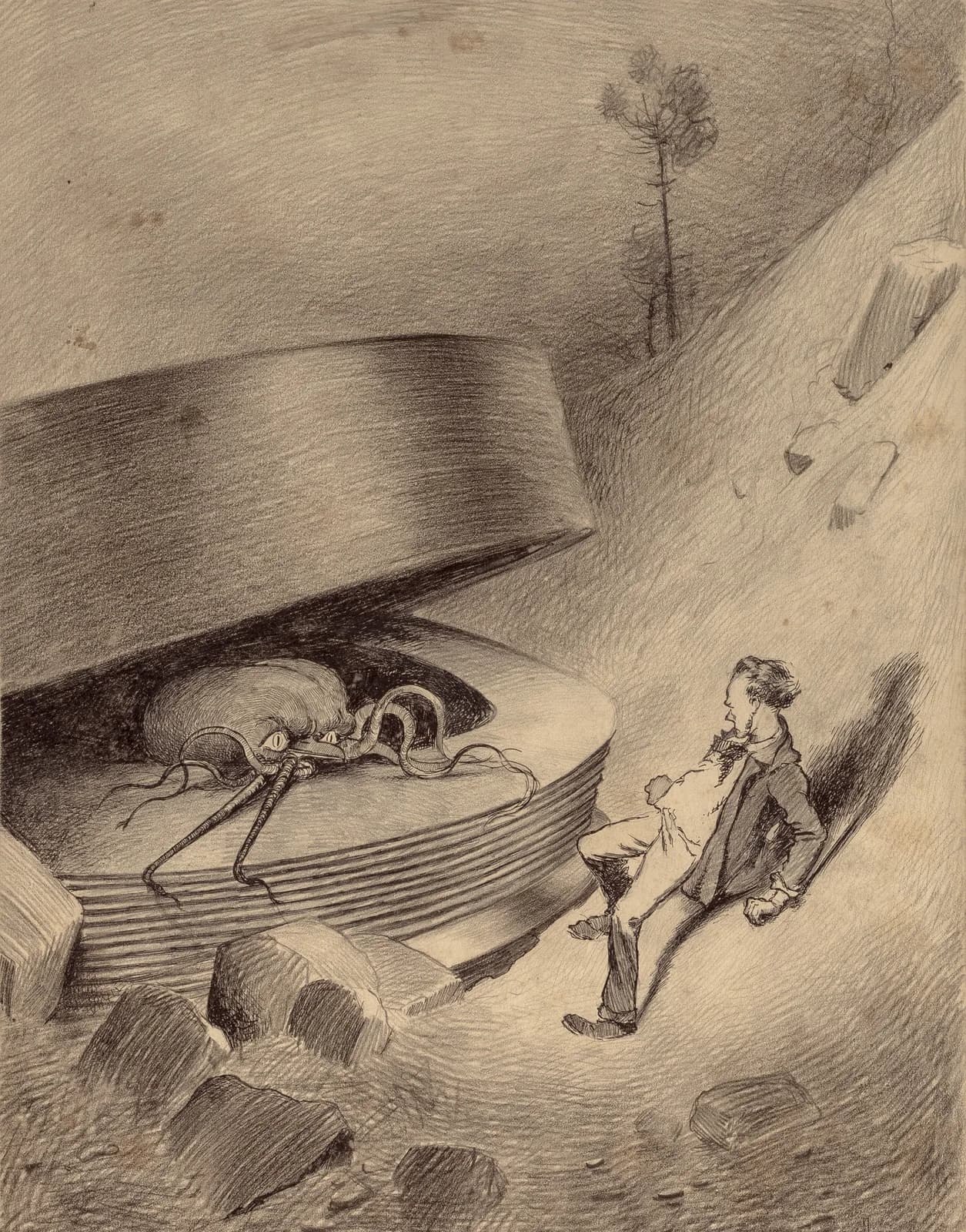
Character lists for this novel tend to be short and slightly embarrassed, because the usual columns do not work. There is no way to write “name” beside the man telling the story, and the playable War of the Worlds inherits the same problem: most of its cast are listed by what they do.
🕵️ The narrator, who never says his name
He is a writer on philosophical subjects living near Woking, married, with a brother in London, and he tells the entire novel in the first person from a point well after the events. Searching the whole text for any self-identification — “my name is”, “my name was”, “call me” — returns nothing across all 920 lines of the Gutenberg edition.
The omission is not shyness on the page. He describes his own cowardice, his intellectual vanity and his exact position on the heath in fine detail, and simply never supplies the one piece of information a Victorian narrator would normally hand over in the first chapter. Even the standard reference summary of the book has to describe him as “an unnamed protagonist in Surrey” because there is nothing else available to call him.
🏠 His wife and his brother, also unnamed
The wife appears in Chapter I, on a starlit walk during which the narrator points out Mars and explains the signs of the Zodiac to her, and she is the reason he takes the risks he takes for the rest of Book One. She is never given a name, a maiden name, or an initial.
The brother is a medical student in London, and from Chapter XIV he takes over the narration for four chapters while the narrator is stuck in Surrey. His half of the book contains the exodus, the road to the coast and the one naval engagement in the novel, and he is also never named.
The Exodus from the Capital is a doorway in the playable War of the Worlds: you are on the road out of London with the narrator's brother, Mrs. Elphinstone, Miss Elphinstone and a station master, and you can push for the coast or turn back for the people still in the house. Role-play The War of the Worlds →
⛪ The curate
He arrives in Chapter XIII of Book One, after the fighting has already started, and the first description of him is one of the best small portraits in the book: a seated figure in soot-smudged shirt sleeves, clean-shaven face turned up, watching a flicker in the sky. He has lost his church, his town and most of his grip on events.
What he mainly does is talk. He asks what the Martians are, whether this is judgement, why it was his parish, and he keeps asking while the narrator is trying to listen for movement outside, which is a combination the book treats as genuinely dangerous rather than merely irritating. Book Two, Chapter IV is titled after him; this page stops at the title.
🎖️ The artilleryman
He first appears crawling out of a burning common in Chapter XI, one of the few survivors of a battery wiped out in a single pass of the Heat-Ray, and he is the closest thing the novel has to a competent professional. His advice the next morning, as the two of them set out for Leatherhead in Chapter XII, is practical and cold: “It’s no kindness to the right sort of wife,” he tells the narrator, “to make her a widow”.
He comes back much later, on Putney Hill, with a fully worked-out plan for what human beings should become now, and that plan is the argument the essay on villains and empire takes apart in full. Here it is enough to say that he is the only character who tries to think past the invasion instead of through it.
📛 Who does get a name, and what it costs them
The named characters fit in a single block, and the pattern is hard to miss once you set them side by side.
- Ogilvy, the astronomer who finds the cylinder “on the common between Horsell, Ottershaw, and Woking”. He is the first person in the book to be wrong out loud, and one of the first to walk towards the pit.
- Stent, the Astronomer Royal — tall, fair-haired, issuing directions to workmen with spades in a clear, high-pitched voice. He is the official response, arriving with a job title and a crowd-control problem.
- Henderson, the London journalist, who is called over his garden palings to be told about the shooting star and who goes to look.
- Lord Hilton, the lord of the manor, whom the narrator is sent to fetch and never finds; he is expected on the six o’clock train from Waterloo and the book leaves him there.
- Major Eden, of the Inkerman barracks, who exists in the novel only as a line in a report: he “was reported to be missing”.
- Mrs. Elphinstone and Miss Elphinstone, met on the road by the brother — the woman in white who keeps calling for George, and her sister-in-law, who turns out to have had a revolver under the seat the whole time.
Three of those names belong to men who walk towards the pit in the first few chapters and are the first casualties of the Heat-Ray; two belong to men who are named in official contexts and never appear in a scene at all. The only named characters who travel any distance through the book are the two Elphinstone women, and they are named by accident, in an aside, because the brother happens to overhear it.
Mrs. Elphinstone—that was the name of the woman in white— would listen to no reasoning, and kept calling upon “George”; but her sister-in-law was astonishingly quiet and deliberate.
Set against a Victorian novel of the same decade, that distribution is the whole design. Names in this book are a function of office rather than of importance, and the further a person gets from a title the less likely Wells is to give them one, which is a strange way to build a cast and a very efficient way to make an invasion feel like something happening to everybody at once. The full public-domain text is one file if you want to run the search yourself.
Sources
- The War of the Worlds (Project Gutenberg eBook #36) — Project Gutenberg
- The War of the Worlds — Wikipedia
- The Massacre of Mankind — Wikipedia
- “Martian Emerges”, Henrique Alvim Corrêa, 1906 Belgian edition plate — Wikimedia Commons
- H. G. Wells — The Science Fiction Encyclopedia
Frequently asked questions
- Who is the narrator in War of the Worlds?
- An unnamed writer on philosophical subjects living near Woking, married, with a brother in London. He tells the whole novel in retrospect, from a point well after the invasion, and he is the only viewpoint in the book apart from four chapters his brother narrates. Wells gives him no name at any point across 27 chapters.
- Who was Ogilvy in War of the Worlds?
- The astronomer who finds the first cylinder, and the first person in the book to be wrong about it out loud. Standing at his telescope in Chapter I he tells the narrator, “The chances against anything manlike on Mars are a million to one.” He walks down to the pit at dawn the next morning, well ahead of the crowd.
- Who is the Artilleryman in War of the Worlds?
- A survivor of a gun battery destroyed on Horsell Common, never named, who appears twice. The first time he gives the narrator practical advice about staying alive. The second time, in Book Two, he lays out a plan for human life underground and then spends most of the chapter drinking, playing cards and failing to finish a tunnel.
- How did H.G. Wells describe the Martians?
- As heads, essentially. The first one out of the cylinder is “a big greyish rounded bulk, the size, perhaps, of a bear”, glistening like wet leather, with two large dark eyes and a lipless, V-shaped mouth that quivers and drips. Wells gives them no brow ridges, no chin, and what he calls “Gorgon groups of tentacles”.
- Who are the Elphinstones in War of the Worlds?
- Two women the narrator’s brother meets on the road out of London: Mrs. Elphinstone, the woman in white who keeps calling for her husband George, and her sister-in-law, who turns out to have had a revolver under the seat. Stephen Baxter’s authorised 2017 sequel, The Massacre of Mankind, names the sister-in-law Julie and makes her its narrator.
Enjoyed this one?