Are the Martians the Villains of War of the Worlds — or Is Empire?
Wells answers the villain question himself, six paragraphs in, using an atrocity his own readers were old enough to remember.


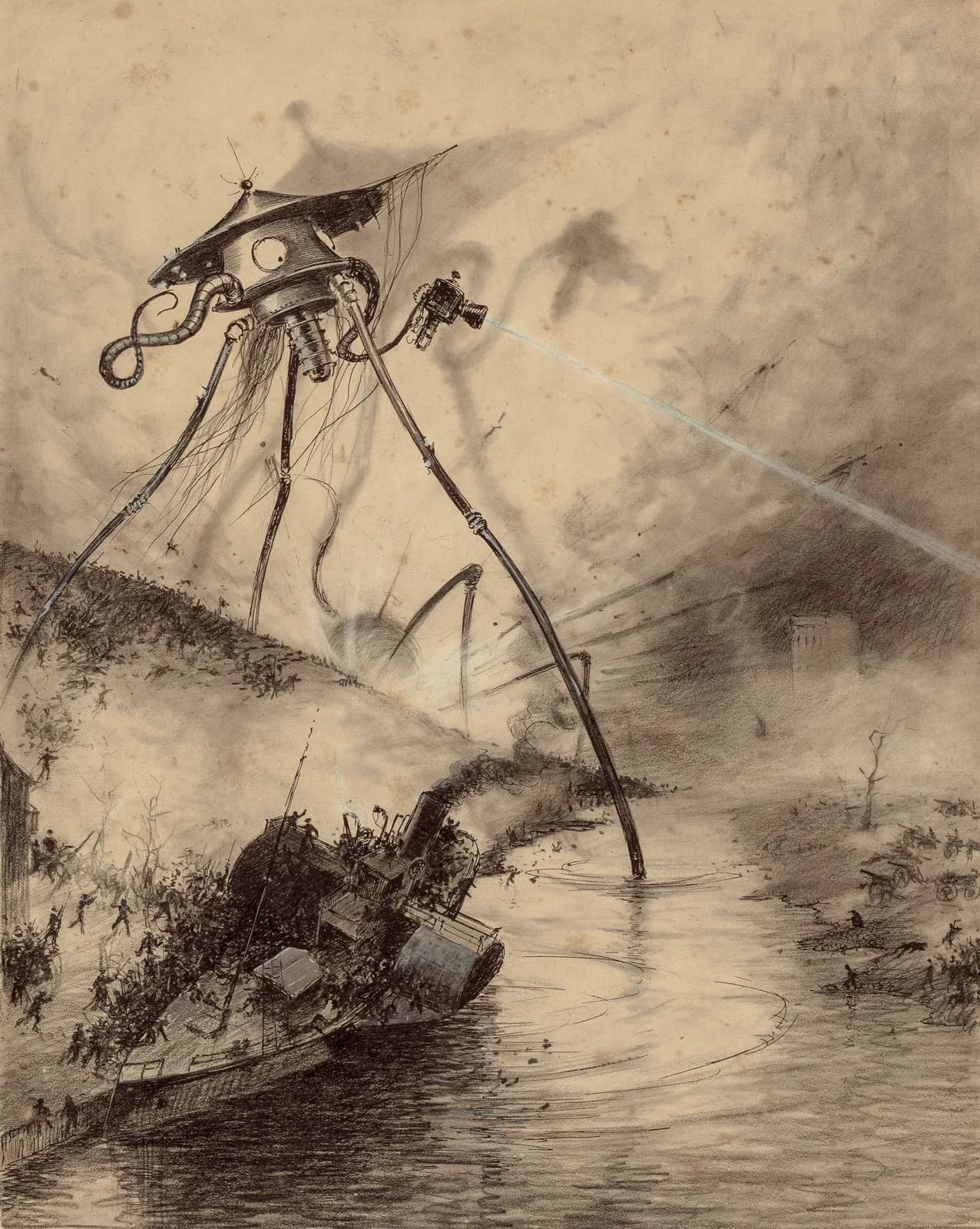
Villain questions usually get asked about characters with motives you can argue with. This one gets asked about creatures who are given no dialogue, no stated politics and no scene in which they explain themselves, which is why the playable War of the Worlds keeps putting the question to the humans instead.
🌏 The comparison Wells makes on page one
Six paragraphs into the first chapter, long before the first cylinder, the narrator interrupts his own scene-setting to forestall a reaction he expects from his reader. The sentence is one of the most-cited in nineteenth-century science fiction and it names a specific, recent, documented act.
“The Tasmanians, in spite of their human likeness, were entirely swept out of existence in a war of extermination waged by European immigrants, in the space of fifty years. Are we such apostles of mercy as to complain if the Martians warred in the same spirit?”
Note the pronoun. Wells does not write “the British” or “the colonists”; he writes “our own species” in the sentence before and “we” in this one. The reader is placed inside the species the question is being asked about, and kept there for the rest of the paragraph. The sentence has been sitting in the free public-domain text for a century and it is still the sixteenth line of the file.
👁️ What the Martians are never given
The novel withholds almost everything a villain normally needs. The Martians never speak, never negotiate, never explain, and the one account of their reasoning in the whole book comes from the narrator summarising the state of their planet for us in Chapter I: the last stage of exhaustion, which for Earth is still remote, “has become a present-day problem for the inhabitants of Mars”.
Everything else we know about them is behaviour observed from a distance, usually through a hedge. Wells built the book that way on purpose, and the choice has a consequence for the villain question that most summaries skip over.
- No interiority. There is no Martian point of view chapter, no captured Martian who talks, no translated message.
- No ideology. The stated motive is a dying world and a habitable one next door, which is the same motive the narrator has just used to describe European settlement.
- No answer to the flag.In Chapter V a deputation walks towards the pit waving a white flag — “a little black knot of men, the foremost of whom was waving a white flag” — and the reply is the Heat-Ray.
A creature that cannot be reasoned with is frightening, but it is not really available for moral judgement, and Wells knows it. The judgement in this novel keeps getting routed back towards people who can be reasoned with, which is where the artilleryman comes in.
The Underground Resistance is a doorway in the playable War of the Worlds: you are in a drain under Putney with the artilleryman while he lays out who gets to live in the world he is planning, and you can take the shovel, argue, or leave. Role-play The War of the Worlds →
🎖️ The speech that says it in English
Book Two, Chapter VII is the longest single scene in the novel and it contains no Martians at all. The artilleryman, last seen crawling out of a burning battery, has spent the intervening weeks planning a new human society in the sewers, and he describes its membership rules at length to a narrator who is by then very hungry and quite impressed.
“Life is real again, and the useless and cumbersome and mischievous have to die. They ought to die. They ought to be willing to die. It’s a sort of disloyalty, after all, to live and taint the race.”
That is the invasion’s logic in a London accent, offered by a man who has been on the receiving end of it for a fortnight, and the novel lets him say it himself, at length, in his own accent, with no summary standing between him and the reader. The narrator spends the rest of the chapter watching him fail to dig a tunnel, drink the wine and play cards, which is Wells’s way of marking the difference between holding a theory of survival and being able to act on one.
⚖️ Whether the argument actually settles
It does not, and the scholarship is where that shows. An article in the University of Victoria’s journal The Albatrossputs the doubt in its own title — “Questioning H.G. Wells’s Colonial Critique in ‘The War of the Worlds’” — and the question mark hanging over the word “critique” is the same one a careful reader arrives at around Book Two.
The honest reading is that the book contains an argument rather than a verdict. The Tasmania sentence is unambiguous and the invasion that follows is designed to make an English reader feel what that sentence describes, but the Martians themselves are written as weather, and weather cannot be indicted. Whatever moral weight the novel carries ends up distributed across the people running away from them, which is probably why it has stayed arguable for a hundred and twenty-five years while most of its contemporaries have not.
Sources
- The War of the Worlds (Project Gutenberg eBook #36) — Project Gutenberg
- Questioning H.G. Wells’s Colonial Critique in “The War of the Worlds” — The Albatross (University of Victoria), vol. 8, 2018
- The War of the Worlds — Wikipedia
- Invasion — The Science Fiction Encyclopedia
- “Martian Fighting Machine in the Thames Valley”, Henrique Alvim Corrêa, 1906 — Wikimedia Commons
Frequently asked questions
- What inspired the H. G. Wells' War of the Worlds?
- The book names two of its own sources. Chapter I cites the light seen on Mars during the opposition of 1894, first at the Lick Observatory and then by Perrotin of Nice, and it cites the destruction of the Tasmanians as the human precedent. The genre it grew out of, British invasion fiction, began with George Chesney’s The Battle of Dorking in 1871.
- What is the message behind The War of the Worlds?
- That the position a species occupies is temporary and not deserved. Wells builds it structurally rather than stating it: the narrator who explains at the start why the Martians are entitled to behave this way spends the rest of the book being hunted under the same rule. He wrote it between 1895 and 1897, at the high-water mark of the British Empire.
- Why were the aliens invading in War of the Worlds?
- Because Mars is dying. Wells gives it an older, smaller, cooler world whose “last stage of exhaustion” has arrived early, and a neighbour that is warm and wet and, as Chapter I measures it, “forty millions of miles” away. Nothing in the book suggests conquest for its own sake, and no Martian ever states a war aim, because none of them ever speaks.
- How are the Martians described in War of the Worlds?
- Almost entirely as heads and tentacles. They are bulks about the size of a bear, greyish and glistening, with huge dark eyes and a quivering V-shaped mouth, and Wells keeps returning to how badly Earth’s gravity and atmosphere suit them. He never gives one a face you could read an intention off, which is central to the villain question.
- What does War of the Worlds say about colonialism?
- It puts the comparison in its narrator’s mouth on the first page and then makes an English reader live inside it for two hundred pages. How far Wells carries the critique is still argued: the University of Victoria journal The Albatross ran an article titled “Questioning H.G. Wells’s Colonial Critique” in volume 8, 2018, and the question mark is where most careful readings land.
Enjoyed this one?