Is War of the Worlds Worth Reading? It Basically Invented the Alien Invasion Story
Shorter than its reputation suggests, faster than its century, and the reason the alien invasion still looks the way it looks.


Almost everybody meets this story through something other than the book — a film, a record, a radio myth, or the playable War of the Worlds — and the usual surprise on finally opening it is how fast and how modern it moves.
🔭 The real astronomy Wells puts in front of the invasion
The first chapter is a credibility exercise. Before anything falls, Wells names Giovanni Schiaparelli, who mapped the Martian surface and “failed to interpret the fluctuating appearances of the markings they mapped so well”, and then he gets specific about observations a reader in 1897 could look up.
- The opposition of 1894. A great light seen on the illuminated part of the disk, first at the Lick Observatory, then by Perrotin of Nice.
- A specific issue of a real journal.English readers “heard of it first in the issue of Naturedated August 2” — a citation, in a novel, in 1897.
- Then one invented observer.“Lavelle of Java” sets the astronomical exchange going with the report that starts the plot, placed immediately after three checkable names.
That sequence is the whole trick of the book compressed into two paragraphs, and it is the thing later invasion stories borrowed hardest. Establish something the reader can verify, then slide the invention in behind it while their guard is down.
The Road to Leatherhead is a doorway in the playable War of the Worlds: you are driving a borrowed cart with your wife beside you and a panicked driver coming the other way, and you can push on for Leatherhead or turn back towards the pit to see what is happening. Role-play The War of the Worlds →
👽 What the book actually founded
The claim you see everywhere is that Wells invented the alien invasion. The precise version is better and slightly different. Invasion fiction already existed as a British genre — George Chesney’s The Battle of Dorkinghad been frightening readers with a German landing since 1871 — and a German novel about Martians, Kurd Lasswitz’s Auf zwei Planeten, appeared in the same year Wells was serialised.
What Wells did was fuse the two and make the result the template. The Science Fiction Encyclopedia puts it in one sentence: his novel “was far more influential in making the role of invader central to the fictional image of the alien for the next half-century”. Its entry on Wells adds the detail that matters for a reader coming to it now, which is that he was writing into empty space rather than into a convention.
Wells “introduced Aliens from Mars in a role which had not yet become a Cliché: as totally unhuman monstrous invaders of Earth”.
📰 How it reached the American pulps
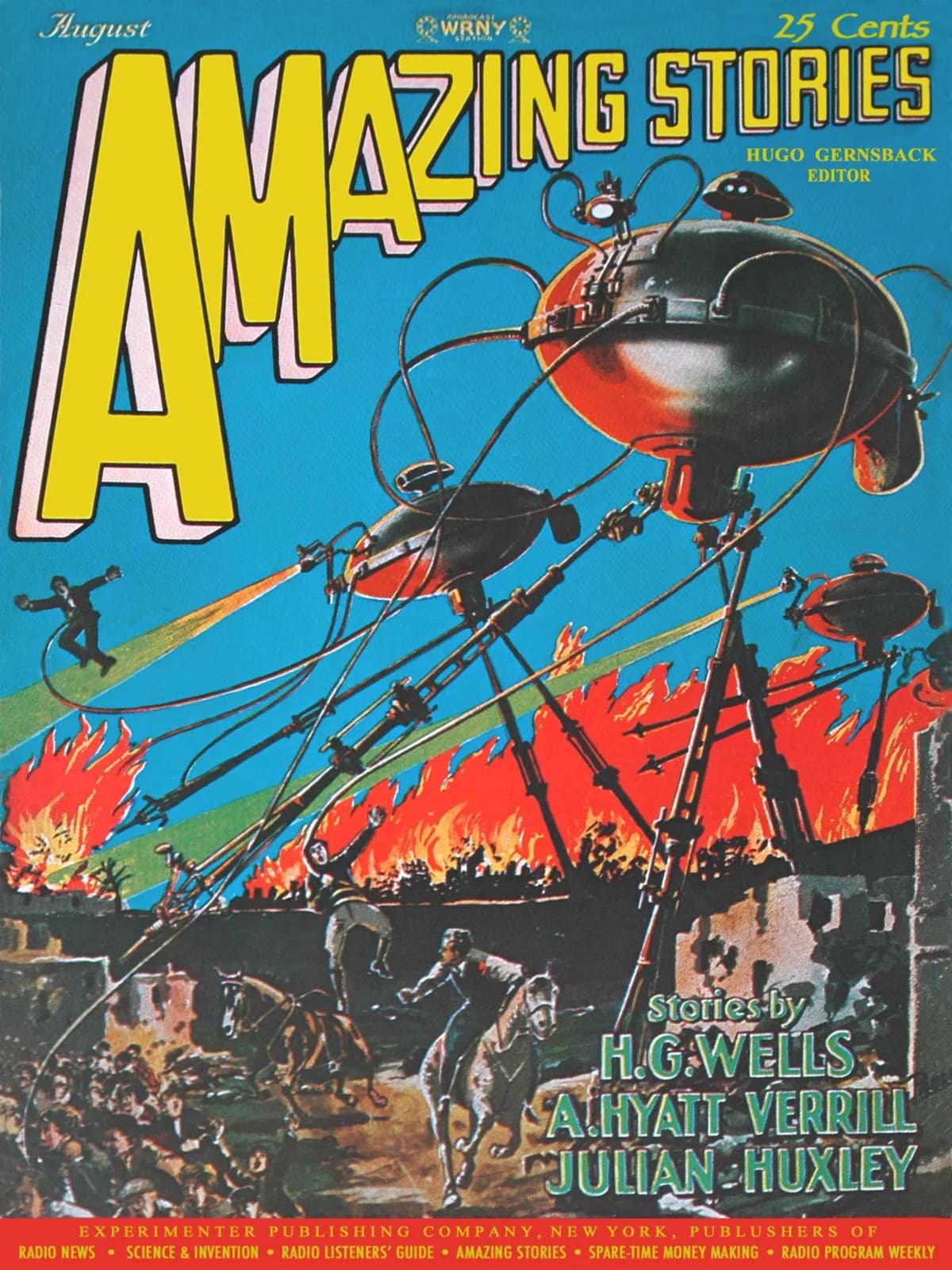
The transmission route is unusually easy to point at. In August 1927, thirty years after the Pearson’s serial, Hugo Gernsback reprinted the novel in Amazing Stories, the magazine that effectively invented the American science-fiction market, and put Frank R. Paul’s tripods on the cover above the words “Stories by H.G. Wells”.
That cover — a twenty-five-cent pulp with burning towers and tentacled machines — is the image most later invasion films are descended from, rather than anything in Wells’s own prose. Wells describes his machines almost entirely by their motion and their sound; Paul gave them a silhouette, and the silhouette is what travelled.
🎲 The other Wells, including the wargame
If you have read this one and want the rest of him, the useful thing to know is how wide he ranges. The same man who wrote the Martian invasion also wrote the first widely used set of rules for playing with toy soldiers, published as Little Wars in 1913 with a subtitle offering the game to boys from twelve to a hundred and fifty.
The book also has an authorised sequel, which is rarer than it sounds for a novel this old. Stephen Baxter’s The Massacre of Mankind, published in 2017 with the Wells estate’s blessing, is set in 1921 and is narrated by one of the very few people Wells bothered to name — Miss Elphinstone, whom Baxter calls Julie, and whom the cast guide here picks out for the revolver under her seat.
📖 So is it worth reading now
The arithmetic is the strongest argument. Sixty thousand words across twenty-seven chapters works out at roughly 2,225 words each, and Wells wrote them for weekly magazine instalments, so nearly every chapter turns on an incident rather than on a conversation. Most readers finish it in two or three evenings.
The register is the second argument. It is written as a report by a frightened man with a good vocabulary, which is much closer to modern disaster prose than to the three-volume novels published around it, and it carries no romance plot and no subplot about an inheritance. What dates it is the technology and the class assumptions, not the sentences.
Sources
- The War of the Worlds (Project Gutenberg eBook #36) — Project Gutenberg
- Invasion — The Science Fiction Encyclopedia
- H. G. Wells — The Science Fiction Encyclopedia
- Little Wars — Wikipedia
- The Massacre of Mankind — Wikipedia
- Cover of Amazing Stories, August 1927 (Frank R. Paul) — Wikimedia Commons
Frequently asked questions
- What genre is H. G. Wells' "The war of the Worlds"?
- Science fiction, and two of its sub-genres at once. It is an alien-invasion story and a scientific romance, the term used for Wells’s kind of book decades before “science fiction” existed as a phrase. Libraries also file it under invasion literature, the late-Victorian British genre about foreign forces landing in Surrey and Essex.
- Is War of the Worlds considered a classic?
- Yes, on every measure a library uses: continuous print since 1898, a permanent place in the standard science-fiction reference works, and adaptation into radio, film, television, a concept album and an arena stage show. The Science Fiction Encyclopedia treats it and The Time Machine as Wells’s two most famous novels.
- Which of H. G. Wells' books is considered the best?
- The reference works name The Time Machine and this one most often, with The Invisible Man and The Island of Doctor Moreau as the usual next two. For a first-time reader the choice is really about appetite: The Time Machine is shorter and argues harder, while The War of the Worlds has the set pieces and the better ending to talk about afterwards.
- What is the reading level of H. G. Wells' "The war of the Worlds"?
- No reading-level figure is worth quoting, and the difficulty is vocabulary rather than sentence length. The book is 17 short chapters in Book One and 10 in Book Two, and what stops modern readers is period nouns used without explanation. Heliograph, ironclad, chaise and infusoria all turn up in the narration with no gloss, because in 1897 none of them needed one.
- What was the impact of The War of the Worlds radio broadcast?
- Mostly on the book. The 1938 programme made the title famous in the United States, kept the novel continuously in print, set the template for every later American adaptation, and made Orson Welles a national name overnight. Whether it caused a national panic is a separate question, and a much weaker claim than the fame it created.
Enjoyed this one?