“No One Would Have Believed”: What War of the Worlds’ Opening Line Really Means
The most-quoted sentence in the book is not a warning about Martians. It is a remark about the reader, delivered before anything has landed.


The sentence turns up on posters, on the front of paperbacks, at the start of two films and a hit record, and almost always as a piece of atmosphere: something ominous is coming. Read in place, at the head of the playable War of the Worlds, it is doing something colder than that, and the thing it is doing is aimed squarely at the person holding the book.
🔭 The sentence, in place
It is the first line of Book One, Chapter I, and it runs much longer than the fragment everybody quotes. The famous six words are only the opening clause of a sentence that keeps going until it has put the reader under glass.
“No one would have believed in the last years of the nineteenth century that this world was being watched keenly and closely by intelligences greater than man’s and yet as mortal as his own; that as men busied themselves about their various concerns they were scrutinised and studied, perhaps almost as narrowly as a man with a microscope might scrutinise the transient creatures that swarm and multiply in a drop of water.”
Nothing in that has happened yet. No cylinder has fallen, no machine has stood up, nobody has died. The only event the sentence describes is being observed, and the only characters in it are an unnamed intelligence and an unaware species going about its business.
🧫 What the microscope is doing there
The figure Wells chooses is not decoration. He spends the rest of the paragraph pressing it, and each press moves the insult closer to the reader rather than further away.
- “With infinite complacency men went to and fro over this globe about their little affairs.” The adjective doing the work is little, and it is applied to human business, not Martian business.
- “Serene in their assurance of their empire over matter.” The word he picks for human confidence in technology is the word for a political possession.
- “It is possible that the infusoria under the microscope do the same.” One flat sentence closes the loop: the creatures in the water dish presumably also think their affairs are the centre of things.
By the fourth sentence the reader has been told that the position they occupy in the universe is the position of pond life, and told it in the calm register of a man describing laboratory apparatus. That is why the line still works as an opening a hundred and twenty-odd years later, long after the tripods stopped being frightening.
The First Arrival is a doorway in the playable War of the Worlds: you are on Horsell Common with Ogilvy, Stent, Henderson and the local constable while the cylinder is still unscrewing, and you can crowd forward for a better look or start telling people to move back. Role-play The War of the Worlds →
🪐 Why the first names in the book are real ones
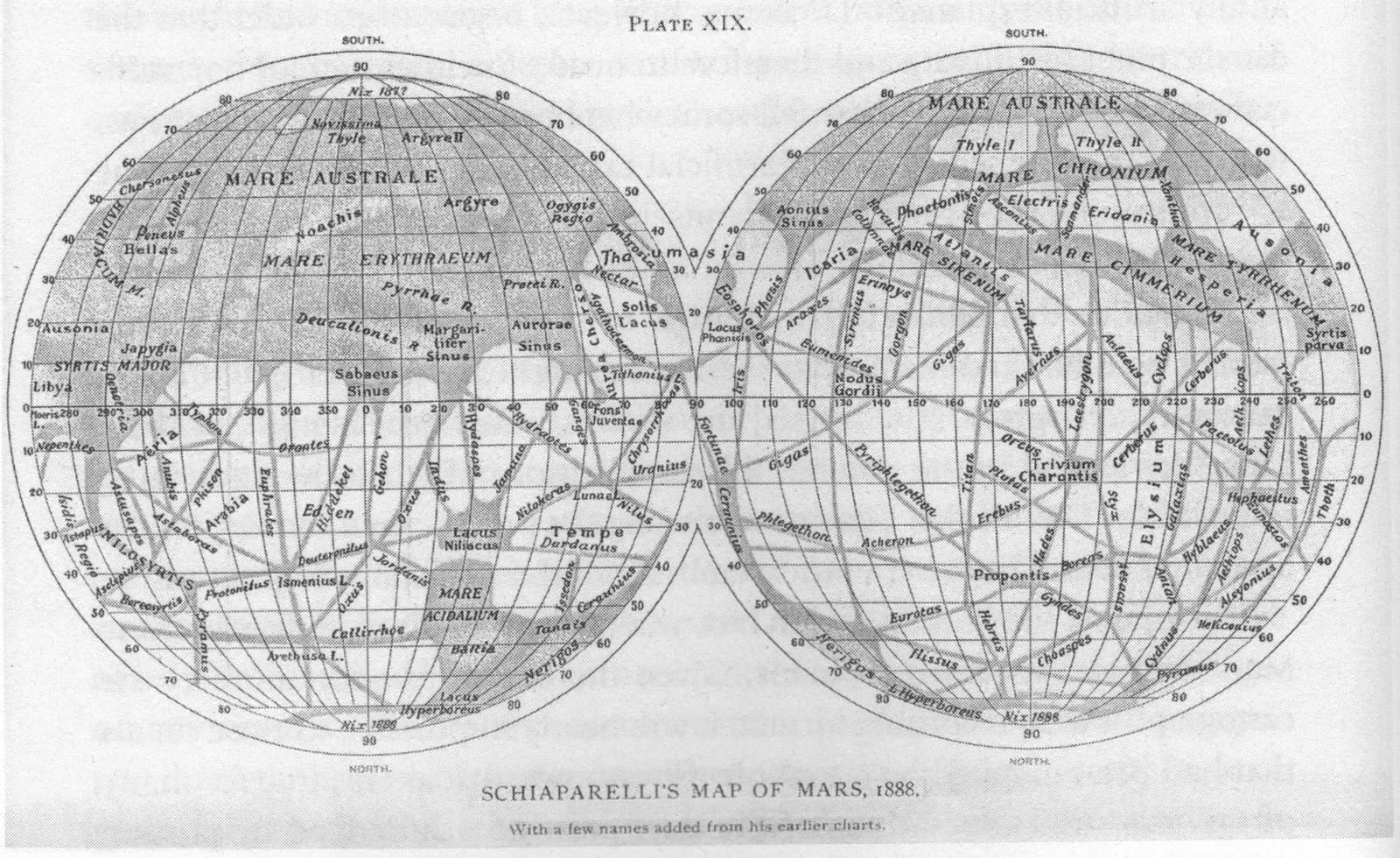
Having established that humanity is being examined, Wells spends the next few pages making the examiners plausible, and he does it by borrowing credibility from working astronomy rather than by inventing it. He names Giovanni Schiaparelli, who mapped the Martian surface and, in Wells’s phrasing, “failed to interpret the fluctuating appearances of the markings they mapped so well”.
The next paragraph is denser still: the light seen during the opposition of 1894, first at the Lick Observatory and then by Perrotin of Nice, and the issue of Nature dated August 2 in which English readers first heard of it. Three of those four are real, checkable things, which is exactly what makes the fourth one — the observatory report from Java that opens the story proper — slide past unexamined. The Science Fiction Encyclopedia records the effect this had on the genre after him, and a separate essay here follows that thread.
The joke Wells sets up in the same chapter is the one nobody remembers quoting. The astronomer Ogilvy, standing beside the narrator, settles the question of life on Mars with a line that the rest of the book exists to demolish.
“The chances against anything manlike on Mars are a million to one,” he said.
📣 The other line people quote, and what it sounds like
The second most recognisable thing in the book is not a sentence at all. Late in Book Two the narrator walks into a South Kensington emptied of everyone and hears a sound he cannot place, described as “a sobbing alternation of two notes” before it is ever given a spelling.
“Ulla, ulla, ulla, ulla,” wailed that superhuman note—great waves of sound sweeping down the broad, sunlit roadway, between the tall buildings on each side.
The cry is printed as a four-fold repetition every time it appears, and it appears on six separate lines of the chapter, which is why it reads on the page as something continuous rather than as a single shout.
A claim that circulates online holds that Wells really wrote “Aloo” and that “Ulla” is a later corruption, and the interesting thing is that both words are in the public-domain text, doing different jobs in different books. “Aloo! Aloo!” is an “exultant deafening howl” from a fighting-machine in full advance, in Book One; “Ulla, ulla” is the sound in the empty city, hundreds of pages later, and the two are never confused on the page.
🔇 The most-quoted sentence this page will not finish
There is a third famous line, and it is the one readers of this book tend to reach for first: the sentence about being slain, after all man’s devices had failed, by the humblest things that God in his wisdom has put upon this earth. It sits in Book Two, Chapter VIII, and it is the last turn of the plot as well as the most anthologised sentence in the novel, which makes it almost impossible to quote in full without handing over the ending.
So this page leaves the humblest things unnamed, and notes only that the line’s fame is oddly private: search for it and Google returns a single organic result, against a full page of study guides and quote cards for the opening line. It is famous among people who have finished the book and nearly invisible to everybody else, which is a fair description of how the whole novel travels.
Sources
- The War of the Worlds (Project Gutenberg eBook #36) — Project Gutenberg
- H. G. Wells — The Science Fiction Encyclopedia
- The War of the Worlds — Wikipedia
- Schiaparelli’s Map of Mars, 1888 (Plate XIX) — Wikimedia Commons
- Giovanni Schiaparelli — Wikipedia
Frequently asked questions
- What are the opening lines of H. G. Wells' "The war of the Worlds"?
- “No one would have believed in the last years of the nineteenth century that this world was being watched keenly and closely by intelligences greater than man’s and yet as mortal as his own.” Three lines above that, the novel carries an epigraph from Kepler, quoted from Burton’s Anatomy of Melancholy: “But who shall dwell in these worlds if they be inhabited?”
- What is a famous quote from The War of the Worlds?
- Three compete. The opening sentence about being watched and studied; the Martian wail, printed as “Ulla, ulla, ulla, ulla”; and the sentence near the end about being slain by the humblest things, which most readers meet as a spoiler rather than as a quotation. The novel carrying them ran in Pearson’s Magazine from April to December 1897 and reached hardcovers in 1898.
- What is the meaning of H.G. Wells' "The War of the Worlds"?
- At the level the book states outright: a technologically confident society has no special claim on survival. The narrator makes the comparison explicit in Chapter I, against the extermination of the Tasmanians by European settlers. The invaders’ own motive sits in the same chapter — their planet has reached “that last stage of exhaustion” and Earth is next door.
- What sound do the Martians make in War of the Worlds?
- Two different sounds, in two different books. The fighting-machines in Book One give an “exultant deafening howl” written as “Aloo! Aloo!”, and between themselves they use “sirenlike howls, running up and down the scale from one note to another”. The wailing “Ulla, ulla” belongs to Book Two and to a London with nobody left in it.
- How does H. G. Wells create suspense in the opening paragraph of The War of the Worlds?
- By reporting the threat in the past tense and then withholding every detail of it. The first paragraph names no creature, no weapon and no date; it says only that something with greater intelligence had been watching. The chapter then goes back to ordinary Surrey — an observatory vigil, a telescope, a starlit walk during which the narrator explains the Signs of the Zodiac to his wife — and nothing comes down until the chapter after it.
Enjoyed this one?