What’s Real and What’s Invented in War of the Worlds
You can walk to the pit. The town put up a statue. Almost everything else readers picture was added later by somebody who was not Wells.


This is the rare Victorian novel you can fact-check on foot. The Surrey place names in the first three chapters are the ones on the map today, which is also why the playable War of the Worlds can put its opening doorway on a common with a car park.
📍 The places you can walk to
The cylinder lands where Wells could see it from his own front door. In Chapter II the astronomer Ogilvy is persuaded a meteorite has come down “on the common between Horsell, Ottershaw, and Woking”, and he finds the pit “not far from the sand-pits” — all four of those are real, and the sand-pits are still there.
Wells wrote the majority of the novel in Maybury Road, Woking, between 1895 and 1898, which is roughly a mile and a half from the common he chose to destroy first. The town’s own record of this notes that the borough later named an entire cycle network after the planets, so the joke has been running for some time.
🦿 What Wells actually calls the machines
Search the text and the word everybody uses turns out to be the word Wells barely uses. His own systematic terms are compounds, and they are applied consistently from the moment the machines appear.
- “Fighting-machine”: 17 occurrences, spread across 17 separate lines. This is the book’s formal name for the walking weapons.
- “Handling-machine”: 17 occurrenceson 12 lines — the crab-like tool-users that do the digging and assembling in the pit, and the machines the narrator watches longest.
- “Tripod”: 8 occurrences on 7 lines, across a 60,000-word novel, and used inconsistently even then.
Twice the word means the legs and nothing else — something “staggered up on tripod legs” in Book One, Chapter XI, and machines whose “tripod supports were almost entirely submerged” in the Thunder Child chapter. Elsewhere it stands in loosely for the whole thing, as in “a monstrous tripod, higher than many houses” in Chapter X. No consistent rule emerges from the eight uses, and the inconsistency is the finding here: Wells never settled the word into a technical term for any one part of the machine.
He also gets irritated about it in the text. In Book Two the narrator stops the story to complain about an illustrator who had drawn the machines for a popular pamphlet after one hasty look.
“He presented them as tilted, stiff tripods, without either flexibility or subtlety, and with an altogether misleading monotony of effect... They were no more like the Martians I saw in action than a Dutch doll is like a human being.”
The Ruined Pit is a doorway in the playable War of the Worlds: you are watching a handling-machine unpack the second cylinder through a slit in a broken wall, close enough to see what it is assembling, and you can keep watching or move before the light changes. Role-play The War of the Worlds →
🩸 Where the blood-spraying comes from
One of the questions Google suggests about this book is why the tripods spray blood, and the answer is that in Wells they never do. The red weed in the novel is simply a plant that arrived with the cylinders: it spreads up the sides of the pit within days, chokes the waterways, and is described as “quite a transitory growth” that few people ever saw.
The image people are remembering belongs to Steven Spielberg’s 2005 film, in which the machines harvest human blood and tissue and spray it across the landscape to fertilise the alien vegetation. It is an elegant solution to a problem Wells left open — where the red weed gets its nutrients — and it is an invention of the screenplay.
📺 What the BBC added in 2019
The BBC’s three-part series is the most faithful version on the geography, keeping the story in England and shooting around the right county, and the least faithful on the cast. It moves the invasion to Edwardian 1905, and it builds the whole thing around a couple, George and Amy, of whom only the man has even a loose counterpart in Wells.
The 2019 production made that change deliberately. Wells gives his narrator a wife who appears twice and is never named, so any adaptation that wants a second lead has to write one from nothing, which is exactly what the cast guide here finds when it goes looking for names.
🗿 A statue for an invasion that never happened
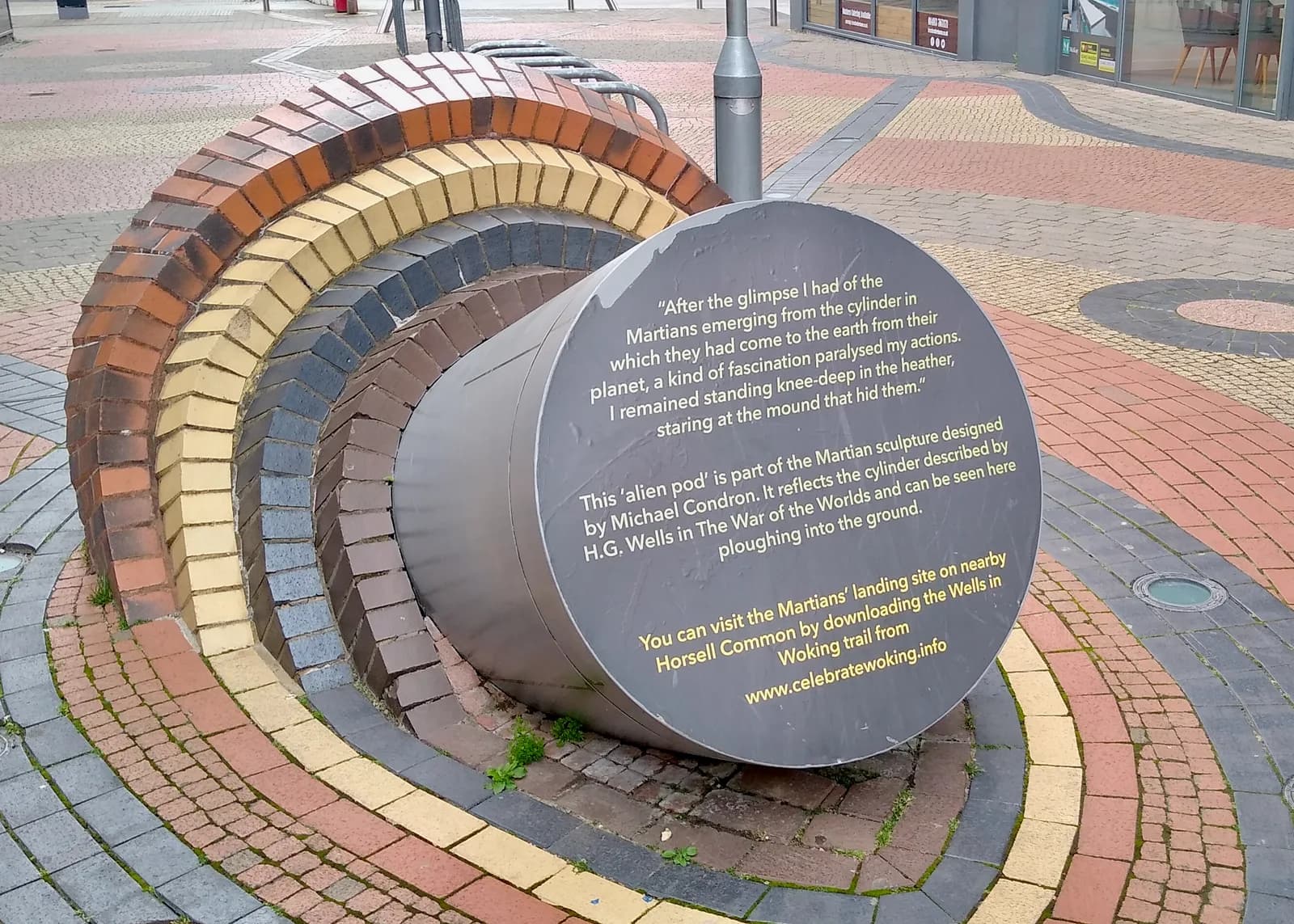
Since April 1998 a seven-metre Martian machine designed by Michael Condron has stood at one end of Crown Square in Woking town centre, with a second piece set into the paving nearby: a cylinder, half buried, ploughing into the ground with the paving stones rippling away from it in coloured rings.
The cylinder carries a plaque quoting the narrator on the moment the first one opened, and the town added a bronze of Wells himself in 2016. A market square in Surrey has therefore been commemorating a fictional atrocity for nearly thirty years, and the machines in the sculpture are called a name the novel it honours almost never uses.
Sources
- The War of the Worlds (Project Gutenberg eBook #36) — Project Gutenberg
- Woking — Wikipedia
- War of the Worlds (2005 film) — Wikipedia
- The War of the Worlds (British TV series) — Wikipedia
- The Martian cylinder, Crown Square, Woking — Wikimedia Commons
Frequently asked questions
- Why is there a War of the Worlds statue in Woking?
- Because the novel’s first cylinder lands on the town’s own common and Wells wrote the book while living there. The borough installed a seven-metre Martian machine by Michael Condron at one end of Crown Square in April 1998, and added a bronze statue of Wells himself, by Wesley Harland, in September 2016.
- Where is the H. G. Wells War of the Worlds set?
- Surrey first, then London and Essex. The landing is on the common between Horsell, Ottershaw and Woking; the narrator’s flight runs through Byfleet, Weybridge and Shepperton; his brother’s half of the book goes out of London through Edgware and Chelmsford to the coast. Nearly every place name in the novel is a real one, and the route still runs through towns that carry those names today.
- Was War of the Worlds based on a true story?
- Wells invented the invasion, and then packed real reporting around it. The Mars observations in Chapter I are genuine — a great light seen during the opposition of 1894, first at the Lick Observatory — and so is the atrocity the narrator names as precedent, the destruction of the Tasmanians. What Wells invented is the cylinder and everything that climbs out of it.
- What is inside the tripod in War of the Worlds?
- A Martian, in the hood at the top. The book confirms it when one machine is brought down at Shepperton: “the Martian within the hood, was slain and splashed to the four winds of heaven, and the Thing was now but a mere intricate device of metal whirling to destruction.” Everything below the hood is machinery, and no living part of the machine is described anywhere in the text.
- Why did the tripods spray blood?
- That image comes from Spielberg’s 2005 film, scripted by Josh Friedman and David Koepp, in which the machines collect human blood and tissue and spray it to feed the red vegetation. Wells’s red weed needs no feeding: it spreads by itself within days of the landings and then dies back almost as fast.
Enjoyed this one?